


Changing pattern in malignant mesothelioma survival
- PMID: 25749175
- PMCID: PMC4350634
- DOI: 10.1016/j.tranon.2014.12.002
Changing pattern in malignant mesothelioma survival
Abstract
Survival for mesothelioma has been shown to be poor, with marginal improvement over time. Recent advances in the understanding of pathophysiology and treatment of mesothelioma may impact therapy to improve survival that may not be evident from available clinical trials that are often small and not randomized. Therapies may affect survival differently based on mesothelioma location (pleural vs peritoneal). Data are conflicting regarding the effect of asbestos exposure on mesothelioma location.
Objectives: We examined survival in a large cohort of mesothelioma subjects analyzed by tumor location and presence and mode of asbestos exposure.
Methods: Data were analyzed from cases (n = 380) diagnosed with mesothelioma from 1992 to 2012. Cases were either drawn from treatment referrals, independent medical evaluation for medical legal purposes, or volunteers who were diagnosed with mesothelioma. Subjects completed an occupational medical questionnaire, personal interview with the examining physician, and physician review of the medical record.
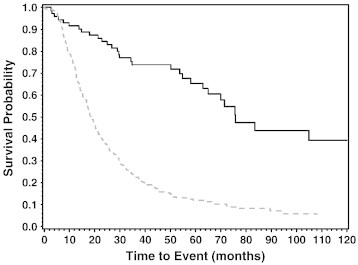
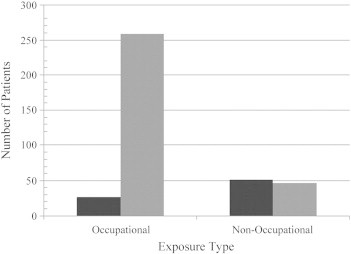
Results: This study reports better survival for mesothelioma than historical reports. Survival for peritoneal mesothelioma was longer than that for pleural mesothelioma (hazard ratio = 0.36, 95% confidence interval = 0.24-0.54, P < .001) after adjusting for gender and age at diagnosis. Non-occupational cases were more likely to be 1) diagnosed with peritoneal mesothelioma, 2) female, 3) exposed, and 4) diagnosed at a younger age and to have a 5) shorter latency compared to occupational cases (P < .001).
Conclusion: Peritoneal mesothelioma was more likely associated with non-occupational exposure, thus emphasizing the importance of exposure history in enhancing early diagnosis and treatment impact.
Copyright © 2014 Neoplasia Press, Inc. Published by Elsevier Inc. All rights reserved.
Figures
References
-
- Robinson BW, Lake RA. Advances in malignant mesothelioma. N Engl J Med. 2005;353(15):1591–1603. - PubMed
-
- Donovan EP, Donovan BL, McKinley MA, Cowan DM, Paustenbach DJ. Evaluation of take home (para-occupational) exposure to asbestos and disease: a review of the literature. Crit Rev Toxicol. 2012;42(9):703–731. - PubMed
-
- Donovan EP, Donovan BL, Sahmel J, Scott PK, Paustenbach DJ. Evaluation of bystander exposures to asbestos in occupational settings: a review of the literature and application of a simple eddy diffusion model. Crit Rev Toxicol. 2011;41(1):52–74. - PubMed
-
- Ampleford EJ, Ohar J. Mesothelioma: you do not have to work for it. Diagn Cytopathol. 2007;35(12):774–777. - PubMed
-
- Roggli VL, Longo WE. Mineral fiber content of lung tissue in patients with environmental exposures: household contacts vs. building occupants. Ann N Y Acad Sci. 1991;643:511–518. - PubMed
LinkOut - more resources
Full Text Sources
Other Literature Sources
