


Prevalence and comorbidity of mental disorders among adolescents living in residential youth care
- PMID: 25749933
- PMCID: PMC4698296
- DOI: 10.1007/s00787-015-0700-x
Prevalence and comorbidity of mental disorders among adolescents living in residential youth care
Abstract
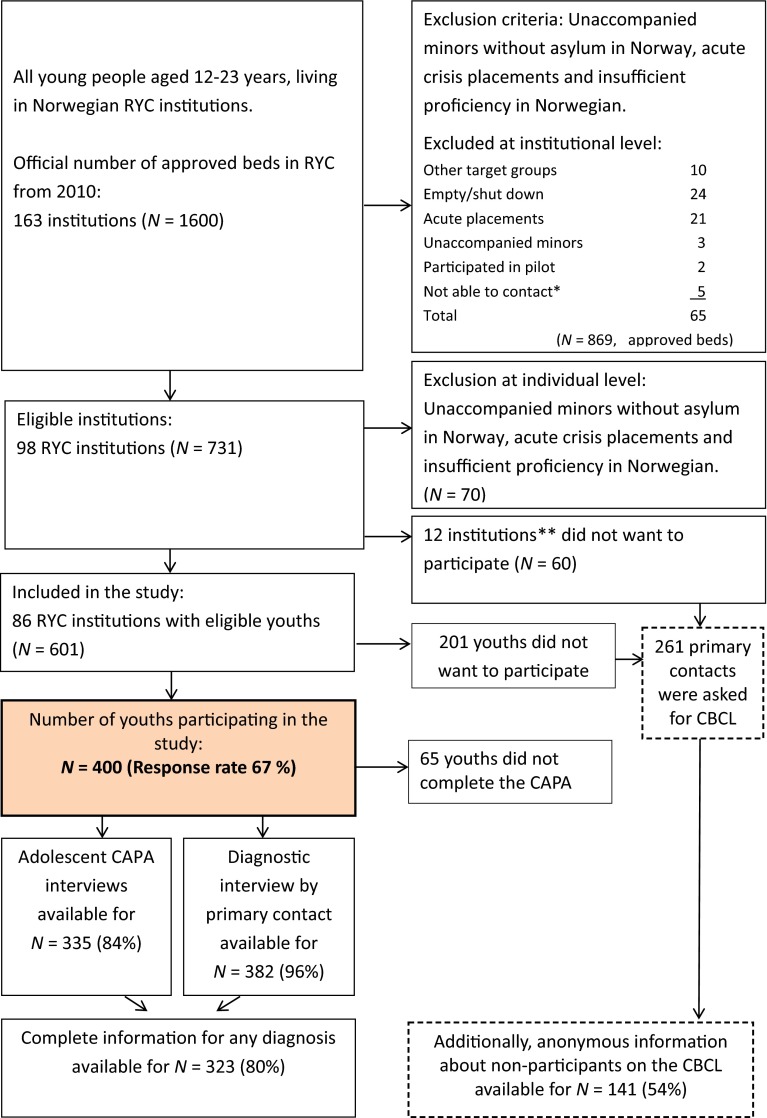
Most adolescents are placed in residential youth care (RYC) because of severe psychosocial strains and child maltreatment, which represent risk factors for developing mental disorders. To plan RYC units and ensure that residents receive evidence-based psychiatric interventions, it is necessary to obtain reliable and valid prevalence estimates of mental disorders in this population. However, there is a lacuna of research on diagnoses derived from standardized clinical interviews. The aim of this study was to assess the prevalence and comorbidity of mental disorders applying diagnostic interviews in an entire population of adolescents living in RYC in Norway. All young people in RYC were invited to participate in the study. Eighty-six RYC institutions with 601 eligible adolescents were included and 400 adolescents, 12-20 years old, participated in the study, yielding a response rate of 67 %. Anonymous Child Behaviour Checklist scores for 141 (70 %) of the declining residents were also available, allowing diagnoses according to the Diagnostic and Statistical Manual of Mental Disorders Fourth Edition (DSM-IV) for 541 youths to be estimated. Diagnoses were assessed by trained interviewers with the Child and Adolescent Psychiatric Assessment interview (CAPA). Seventy-six point two per cent (71.5-80.8 CI 95 %) of adolescents received at least one 3-month DSM-IV diagnosis. Prevalence rates for internalizing psychiatric disorders were higher than for behavioural disorders. Comorbidity was high between these two groups. Mental disorders were prevalent among children and youth in RYC. Our results create major concerns and challenge the existing organization of the RYC system.
Keywords: Adolescents; CAPA; Comorbidity; Mental disorders; Prevalence; Residential youth care.
Figures
References
-
- Green JG, McLaughlin KA, Berglund PA, Gruber MJ, Sampson NA, Zaslavsky AM, Kessler RC. Childhood adversities and adult psychiatric disorders in the national comorbidity survey replication I: associations with first onset of DSM-IV disorders. Arch Gen Psychiatr. 2010;67(2):113–123. doi: 10.1001/archgenpsychiatry.2009.186. - DOI - PMC - PubMed
-
- Backe-Hansen E, Bakketeigen E, Gautun H, AB. G (2011) Institusjonsplassering—siste utvei. Betydningen av barnevernsreformen fra 2004 for institusjonstilbudet. (Placement in institutions—the last opportunity. The importance of the child welfare reform in 2004 for placement policy in institutions.) NOVA—Norsk institutt for forskning om oppvekst, velferd og aldring
-
- Berridge D. Theory and explanation in child welfare: education and looked-after children. Child Family Soc Work. 2007;12(1):1–10. doi: 10.1111/j.1365-2206.2006.00446.x. - DOI
-
- Vinnerljung B, Oman M, Gunnarson T. Educational attainments of former child welfare clients—a Swedish national cohort study. Int J Soc Welf. 2005;14(4):265–276. doi: 10.1111/j.1369-6866.2005.00369.x. - DOI
Publication types
MeSH terms
LinkOut - more resources
Full Text Sources
Other Literature Sources
Medical
