Review
. 2015 Apr 19;370(1666):20140218.
doi: 10.1098/rstb.2014.0218.

Forging patterns and making waves from biology to geology: a commentary on Turing (1952) 'The chemical basis of morphogenesis'

Affiliations
Review

Forging patterns and making waves from biology to geology: a commentary on Turing (1952) 'The chemical basis of morphogenesis'

Philip Ball. Philos Trans R Soc Lond B Biol Sci. .

Abstract

Alan Turing was neither a biologist nor a chemist, and yet the paper he published in 1952, 'The chemical basis of morphogenesis', on the spontaneous formation of patterns in systems undergoing reaction and diffusion of their ingredients has had a substantial impact on both fields, as well as in other areas as disparate as geomorphology and criminology. Motivated by the question of how a spherical embryo becomes a decidedly non-spherical organism such as a human being, Turing devised a mathematical model that explained how random fluctuations can drive the emergence of pattern and structure from initial uniformity. The spontaneous appearance of pattern and form in a system far away from its equilibrium state occurs in many types of natural process, and in some artificial ones too. It is often driven by very general mechanisms, of which Turing's model supplies one of the most versatile. For that reason, these patterns show striking similarities in systems that seem superficially to share nothing in common, such as the stripes of sand ripples and of pigmentation on a zebra skin. New examples of 'Turing patterns' in biology and beyond are still being discovered today. This commentary was written to celebrate the 350th anniversary of the journal Philosophical Transactions of the Royal Society.

Keywords: animal markings; chemical kinetics; developmental biology; morphogenesis; pattern formation; reaction–diffusion.


Figures
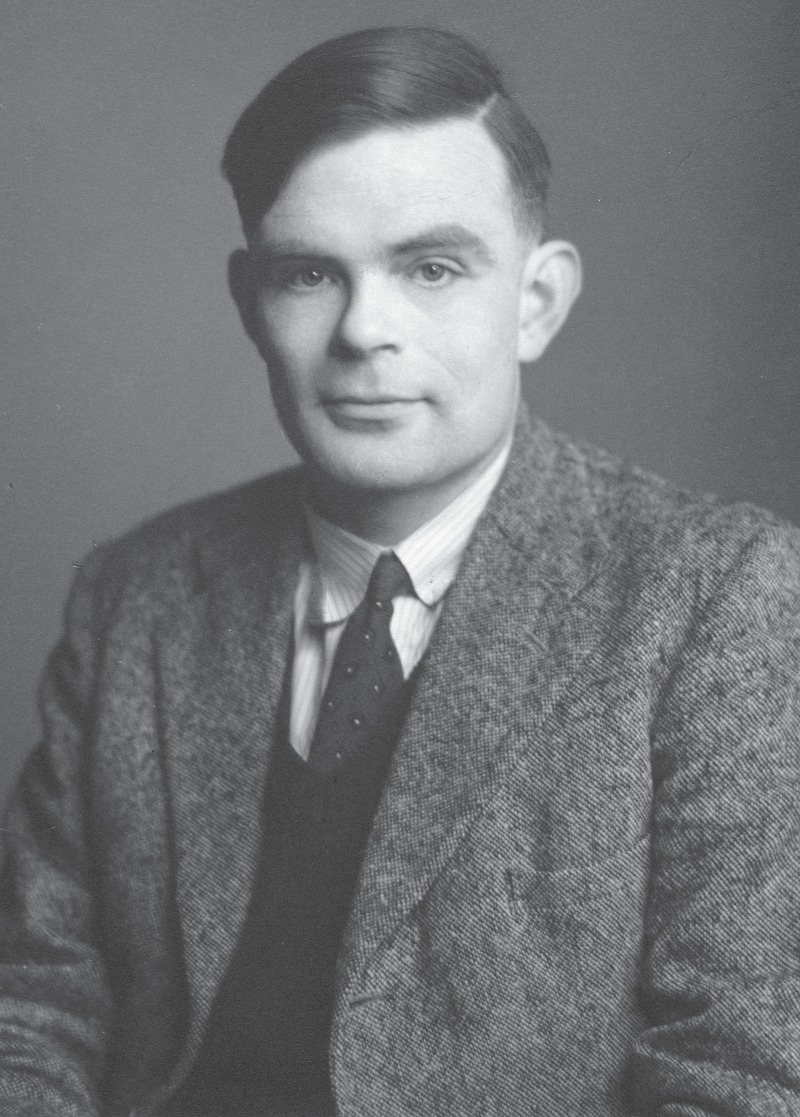
Figure 1.
Figure 1.
Alan Turing (1912–1954). Copyright © The Royal Society.
Figure 2.
Figure 2.
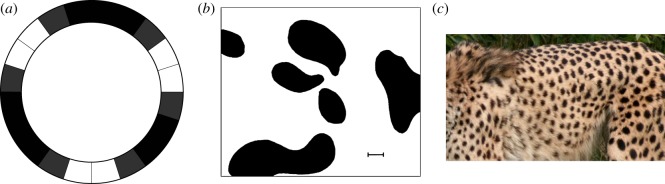
(a) The morphogen pattern in a ring of cells as deduced by Turing. The greyscale indicates concentration differences. (b) Turing's hand-calculated ‘dappled pattern’ created by a morphogen scheme in two dimensions [, fig. 2]. (c) The resemblance to animal markings (here a cheetah) was obvious, albeit at this point no more than qualitative.
Figure 3.
Figure 3.
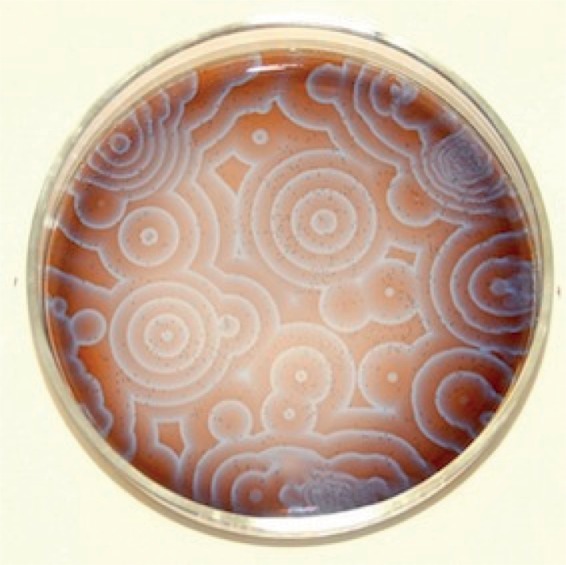
Patterns in the Belousov–Zhabotinsky reaction. Image courtesy of Michael C. Rogers and Stephen Morris, University of Toronto.
Figure 4.
Figure 4.
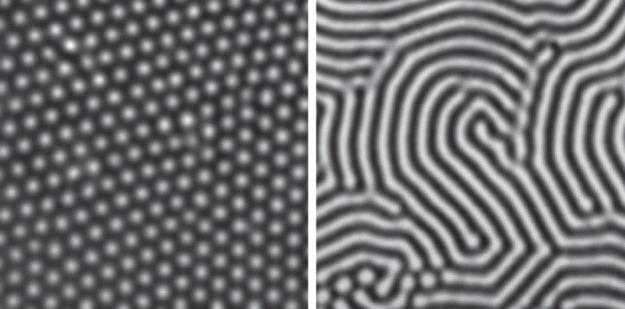
The generic patterns of an activator–inhibitor scheme. Images: courtesy of Jacques Boissonade and Patrick De Kepper, University of Bordeaux.
Figure 5.
Figure 5.
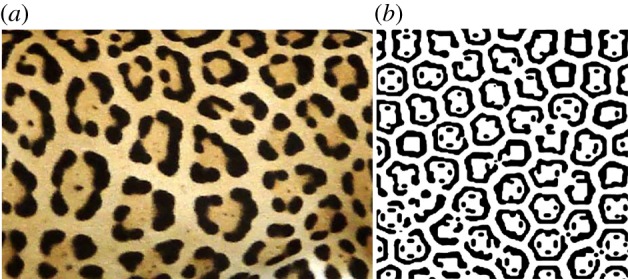
(a) The ‘rosette’ spots of a jaguar, and (b) an analogous pattern produced by two coupled activator–inhibitor processes. (b) Courtesy of Philip Maini, University of Oxford. From [19], © American Physical Society.
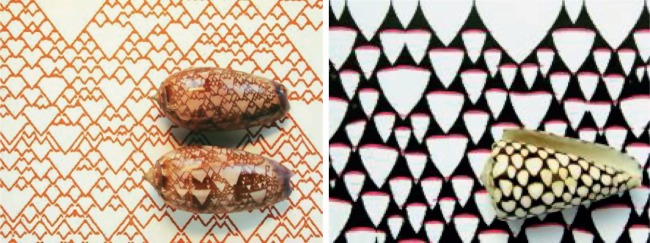
Figure 6.
Figure 6.
Patterns on seashells and their analogues in theoretical activator–inhibitor systems. From [23], courtesy of Hans Meinhardt, MPI for Developmental Biology, Tübingen.
Figure 7.
Figure 7.
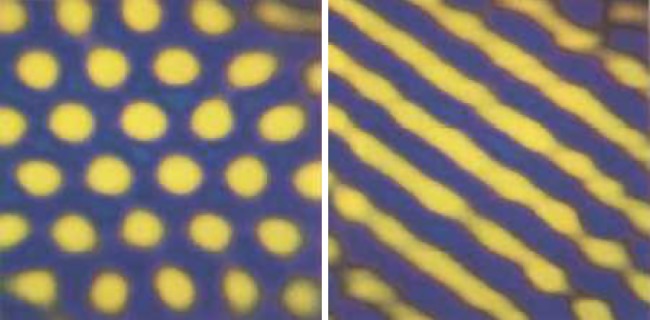
Turing structures in the CIMA reactions: spots and stripes. From [29] courtesy of Harry Swinney, University of Texas at Austin, and Qi Ouyang, Peking University.
Figure 8.
Figure 8.
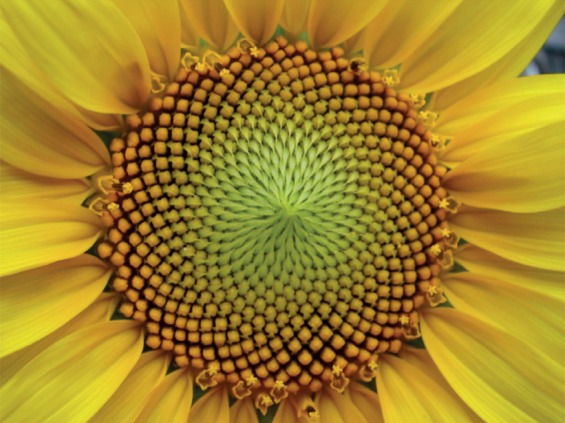
The spiral arrangement of florets or leaf-related features on plants follows the Fibonacci series, as shown here for a sunflower: there are 21 anticlockwise spirals and 34 clockwise spirals. Image: Esdras Calderan/Wikimedia Commons, used under Creative Commons licence.
Figure 9.
Figure 9.
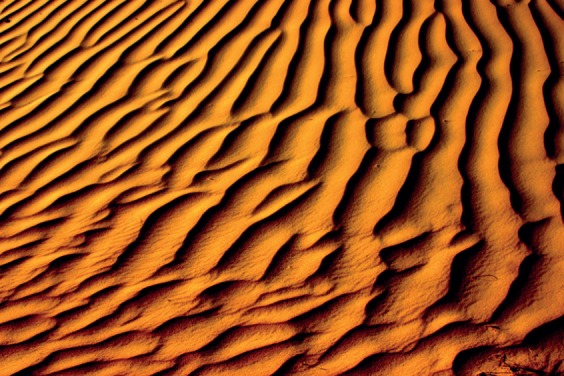
Sand ripples can be regarded as a kind of Turing pattern. Image: EVO, used under Creative Commons licence.
Figure 10.
Figure 10.
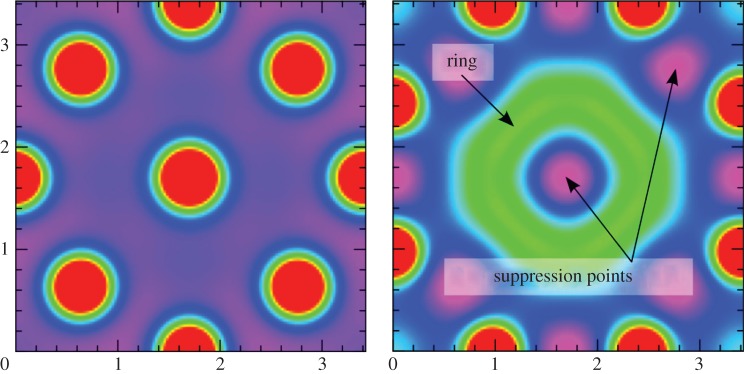
Crime hotspots as Turing structures in a theoretical model of how crime propagates in communities. (a) The hotspots in red. If policing is concentrated on one of these spots in an effort to suppress crime, the criminality merely spreads elsewhere in a diffuse ring (green, (b)). From [45], courtesy of Martin Short, University of California at Los Angeles.

References

    1. Turing A. 1952. The chemical basis of morphogenesis. Phil. Trans. R. Soc. Lond. B 237, 37–72. (10.1098/rstb.1952.0012) - DOI - PMC - PubMed
    1. Hodges A. 1983. Alan Turing: the enigma. New York, NY: Simon & Schuster.
    1. McCorduck P. 1979. In Machines who think, p. 53. New York: W.H. Freeman.
    1. Brown G. 2009. http://webarchive.nationalarchives.gov.uk/20090909192830/http:/www.numbe... .
    1. Copeland BJ. (ed.). 2004. In The essential Turing, p. 509. Oxford, UK: Oxford University Press.

LinkOut - more resources