


Modeling determinants of medication attitudes and poor adherence in early nonaffective psychosis: implications for intervention
- PMID: 25750247
- PMCID: PMC4393703
- DOI: 10.1093/schbul/sbv015
Modeling determinants of medication attitudes and poor adherence in early nonaffective psychosis: implications for intervention
Abstract
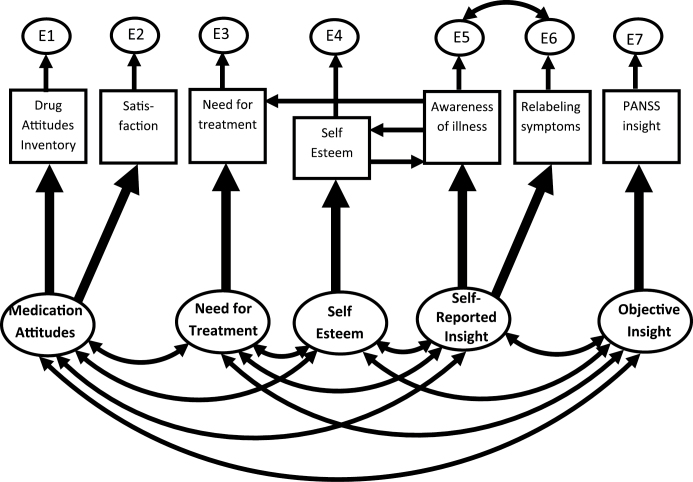
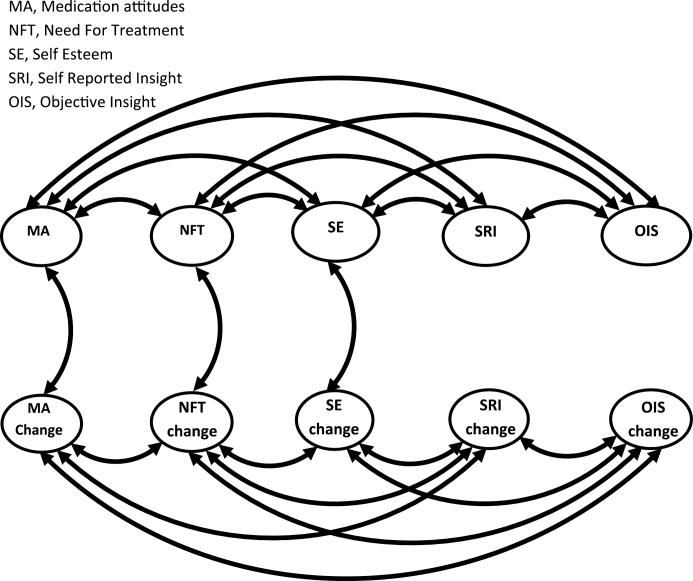
We aimed to design a multimodal intervention to improve adherence following first episode psychosis, consistent with current evidence. Existing literature identified medication attitudes, insight, and characteristics of support as important determinants of adherence to medication: we examined medication attitudes, self-esteem, and insight in an early psychosis cohort better to understand their relationships. Existing longitudinal data from 309 patients with early Diagnostic and Statistical Manual of Mental Disorders, Fourth Edition, nonaffective psychosis (83% first episode) were analyzed to test the hypothesis that medication attitudes, while meaningfully different from "insight," correlated with insight and self-esteem, and change in each influenced the others. Rosenberg Self-Esteem Scale, Birchwood Insight Scale, and Positive and Negative Syndrome Scale insight were assessed at presentation, after 6 weeks and 3 and 18 months. Drug Attitudes Inventory (DAI) and treatment satisfaction were rated from 6 weeks onward. Structural equation models of their relationships were compared. Insight measures' and DAI's predictive validity were compared against relapse, readmission, and remission. Analysis found five latent constructs best fitted the data: medication attitudes, self-esteem, accepting need for treatment, self-rated insight, and objective insight. All were related and each affected the others as it changed, except self-esteem and medication attitudes. Low self-reported insight at presentation predicted readmission. Good 6-week insight (unlike drug attitudes) predicted remission. Literature review and data modeling indicated that a multimodal intervention using motivational interviewing, online psychoeducation, and SMS text medication reminders to enhance adherence without damaging self-concept was feasible and appropriate.
Keywords: adherence; first episode; insight; mHealth; schizophrenia; self-esteem; web-based.
© The Author 2015. Published by Oxford University Press on behalf of the Maryland Psychiatric Research Center. All rights reserved. For permissions, please email: journals.permissions@oup.com.
Figures
References
-
- Barkhof E, Meijer CJ, de Sonneville LM, Linszen DH, de Haan L. Interventions to improve adherence to antipsychotic medication in patients with schizophrenia—a review of the past decade. Eur Psychiatry. 2012;27:9–18. - PubMed
-
- Beck EM, Cavelti M, Kvrgic S, Kleim B, Vauth R. Are we addressing the ‘right stuff’ to enhance adherence in schizophrenia? Understanding the role of insight and attitudes towards medication. Schizophr Res. 2011;132:42–49. - PubMed
-
- Birchwood M, Todd P, Jackson C. Early intervention in psychosis. The critical period hypothesis. Br J Psychiatry Suppl. 1998;172:53–59. - PubMed
-
- Harrison G, Hopper K, Craig T, et al. Recovery from psychotic illness: a 15- and 25-year international follow-up study. Br J Psychiatry. 2001;178:506–517. - PubMed
-
- Drake RJ, Pickles A, Bentall RP, et al. The evolution of insight, paranoia and depression during early schizophrenia. Psychol Med. 2004;34:285–292. - PubMed
Publication types
MeSH terms
LinkOut - more resources
Full Text Sources
Other Literature Sources
Medical
