Minority stress and mechanisms of risk for depression and suicidal ideation among lesbian, gay, and bisexual youth
- PMID: 25751098
- PMCID: PMC4412799
- DOI: 10.1037/a0038994
Minority stress and mechanisms of risk for depression and suicidal ideation among lesbian, gay, and bisexual youth
Abstract
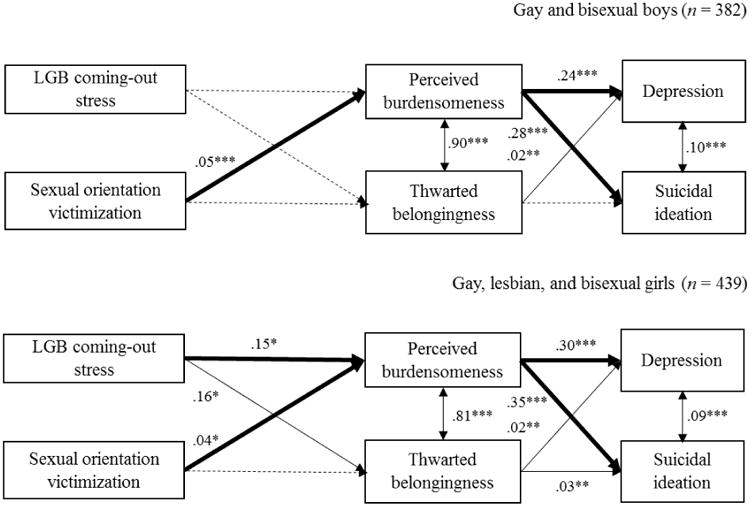
The experience of minority stress is often named as a cause for mental health disparities among lesbian, gay, and bisexual (LGB) youth, including higher levels of depression and suicidal ideation. The processes or mechanisms through which these disparities occur are understudied. The interpersonal-psychological theory of suicide posits 2 key mechanisms for suicidal ideation: perceived burdensomeness and thwarted belongingness (Joiner et al., 2009). The aim of the current study is to assess the mental health and adjustment among LGB youth emphasizing the minority stress model (Meyer, 2003) and the interpersonal-psychological theory of suicide (Joiner et al., 2009). With a survey of 876 LGB self-identified youth, levels of coming-out stress, sexual orientation victimization, perceived burdensomeness, thwarted belongingness, depression, and suicidal ideation were examined. The results of a multigroup mediation model show that for all gender and sexual identity groups, the association of sexual orientation victimization with depression and suicidal ideation was mediated by perceived burdensomeness. For gay, lesbian, and bisexual girls coming-out stress was also found to be related to depression and suicidal ideation, mediated by perceived burdensomeness. The results suggest that feeling like a burden to "people in their lives" is a critical mechanism in explaining higher levels of depression and suicidal ideation among LGB youth. These results have implications for community and social support groups, many of which base their interventions on decreasing social isolation rather than addressing youths' beliefs of burdensomeness. Implications for future research, clinical and community settings are discussed.
(c) 2015 APA, all rights reserved).
Figures
References
-
- Beck JS, Beck AT, Jolly JB. Beck youth inventories. San Antonio, TX, USA: The Psychological Corporation; 2001.
-
- Brown MW, Cudeck R. Alternative ways of assessing model fit. In: Bollen KA, Long JS, editors. Testing structural equation models. Newbury Park, CA: Sage; 1993. pp. 136–162.
Publication types
MeSH terms
Grants and funding
LinkOut - more resources
Full Text Sources
Other Literature Sources
Medical