


Longitudinal and integrative tests of family stress model effects on Mexican origin adolescents
- PMID: 25751100
- PMCID: PMC4412805
- DOI: 10.1037/a0038993
Longitudinal and integrative tests of family stress model effects on Mexican origin adolescents
Abstract
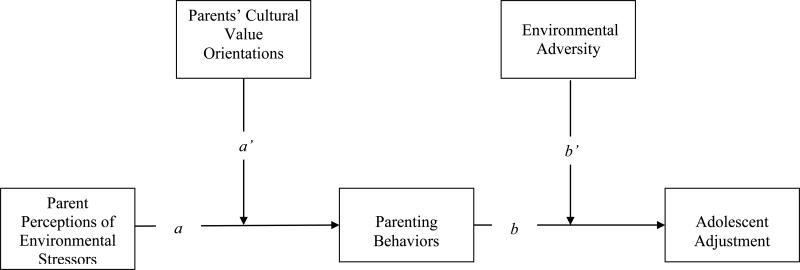
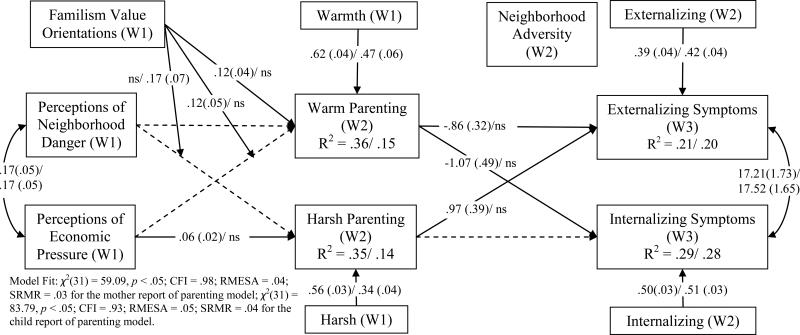
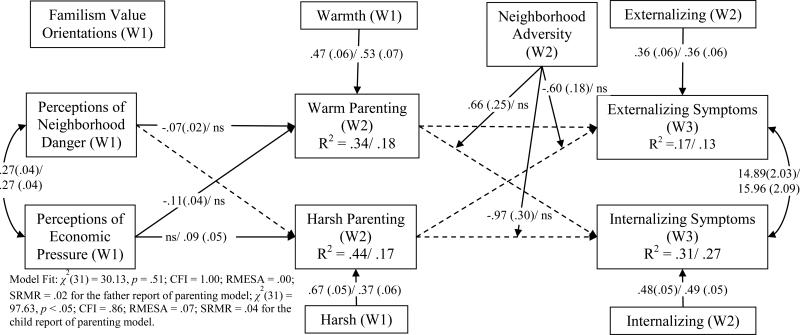
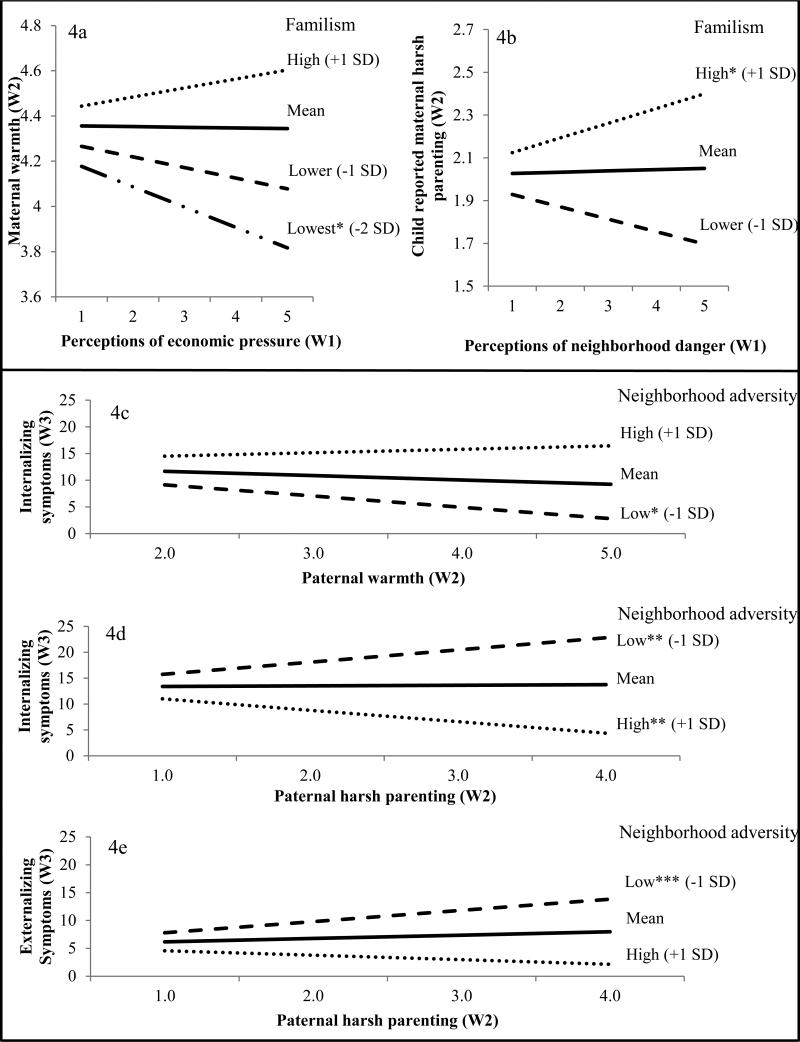
The family stress model represents a common framework through which to examine the effects of environmental stressors on adolescent adjustment. The model suggests that economic and neighborhood stressors influence youth adjustment via disruptions to parenting. Incorporating integrative developmental theory, we examined the degree to which parents' cultural value orientations mitigated the effects of stressors on parenting disruptions and the degree to which environmental adversity qualified the effect of parenting on adolescent adjustment. We tested the hypothesized integrative family stress model longitudinally in a sample of mother-youth dyads (N = 749) and father-youth dyads (N = 467) from Mexican origin families, across 3 times points spanning early to middle adolescence. Providing the first longitudinal evidence of family stress mediated effects, mothers' perceptions of economic pressure were associated with increases in adolescent externalizing symptoms 5 years later via intermediate increases in harsh parenting. The remaining findings supported the notion that integrative developmental theory can inform family stress model hypothesis testing that is culturally and contextually relevant for a wide range of diverse families and youth. For example, fathers' perceptions of economic pressure and neighborhood danger had important implications for adolescent internalizing, via reductions in paternal warmth, but only at certain levels of neighborhood adversity. Mothers' familism value orientations mitigated the effects of economic pressure on maternal warmth, protecting their adolescents from experiencing developmental costs associated with environmental stressors. Results are discussed in terms of identifying how integrative developmental theory intersects with the family stress model to set diverse youth on different developmental pathways.
(c) 2015 APA, all rights reserved).
Figures
References
-
- Barrera JM, Caples H, Tein J-Y. The psychological sense of economic hardship: Measurement models, validity, and cross-ethnic equivalence for urban families. American Journal of community Psychology. 2001;29:493–517. doi: 10.1023/A:1010328115110. - PubMed
-
- Causadias JM. A roadmap for the integration of culture into developmental psychopathology. Development and Psychopathology. 2013;25:1375–1398. doi: 10.1017/S0954579413000679. - PubMed
-
- Conger RD, Song H, Stockdale GD, Ferrer E, Widaman KF, Cauce AM. Resilience and vulnerability of Mexican origin youth and their families: A test of a culturally-informed model of family economic stress. In: Kerig PK, Schultz MS, Hauser ST, editors. Adolescence and beyond: Family processes and development. Oxford University Press; New York: 2012. pp. 268–286. doi:10.1093/acprof:oso/9780199736546.003.0017.
-
- Conger RD, Wallace L, Simons R, McLoyd V, Brody G. Economic pressure in African American families: A replication and extension of the family stress model. Developmental Psychology. 2002;38:179–193. doi:10.1037/0012-1649.38.2.179. - PubMed
Publication types
MeSH terms
Grants and funding
LinkOut - more resources
Full Text Sources
Other Literature Sources
Medical
