. 2015 Jun;122(6):1288-98.
doi: 10.1097/ALN.0000000000000628.

Opioid-induced Respiratory Depression Is Only Partially Mediated by the preBötzinger Complex in Young and Adult Rabbits In Vivo

Affiliations

Opioid-induced Respiratory Depression Is Only Partially Mediated by the preBötzinger Complex in Young and Adult Rabbits In Vivo

Astrid G Stucke et al. Anesthesiology. 2015 Jun.

Abstract

Background: The preBötzinger Complex (preBC) plays an important role in respiratory rhythm generation. This study was designed to determine whether the preBC mediated opioid-induced respiratory rate depression at clinically relevant opioid concentrations in vivo and whether this role was age dependent.

Methods: Studies were performed in 22 young and 32 adult New Zealand White rabbits. Animals were anesthetized, mechanically ventilated, and decerebrated. The preBC was identified by the tachypneic response to injection of D,L-homocysteic acid. (1) The μ-opioid receptor agonist [D-Ala2,N-Me-Phe4,Gly-ol]-enkephalin (DAMGO, 100 μM) was microinjected into the bilateral preBC and reversed with naloxone (1 mM) injection into the preBC. (2) Respiratory depression was achieved with intravenous remifentanil (0.08 to 0.5 μg kg(-1) min(-1)). Naloxone (1 mM) was microinjected into the preBC in an attempt to reverse the respiratory depression.

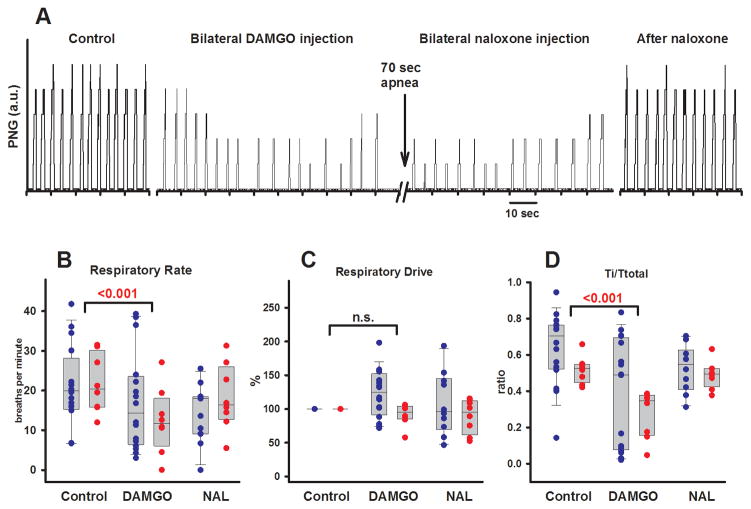
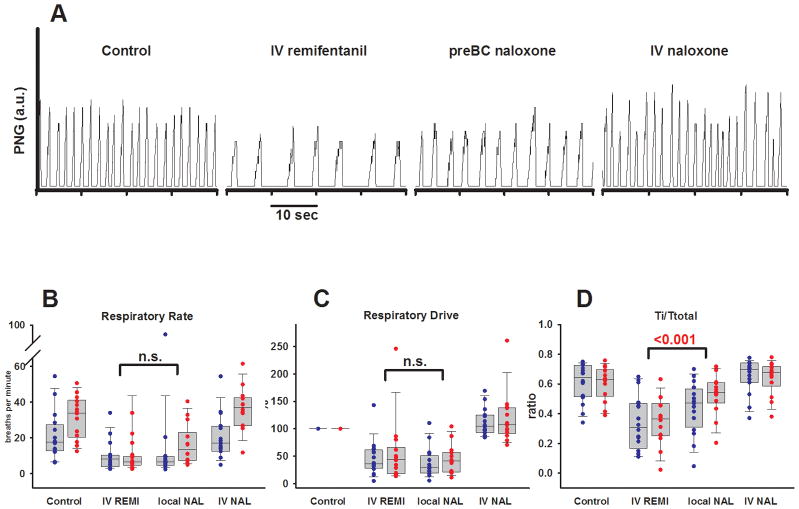
Results: (1) DAMGO injection depressed respiratory rate by 6 ± 8 breaths/min in young and adult rabbits (mean ± SD, P < 0.001). DAMGO shortened the inspiratory and lengthened the expiratory fraction of the respiratory cycle by 0.24 ± 0.2 in adult and young animals (P < 0.001). (2) During intravenous remifentanil infusion, local injection of naloxone into the preBC partially reversed the decrease in inspiratory fraction/increase in expiratory fraction in young and adult animals (0.14 ± 0.14, P < 0.001), but not the depression of respiratory rate (P = 0.19). PreBC injections did not affect respiratory drive. In adult rabbits, the contribution of non-preBC inputs to expiratory phase duration was larger than preBC inputs (3.5 [-5.2 to 1.1], median [25 to 75%], P = 0.04).

Conclusions: Systemic opioid effects on respiratory phase timing can be partially reversed in the preBC without reversing the depression of respiratory rate.


Conflict of interest statement

The authors declare no competing interests.

Figures
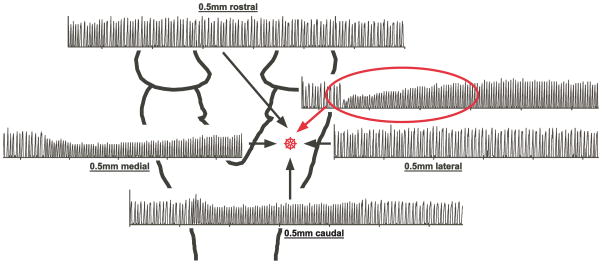
Figure 1
Figure 1
Respiratory response to injection of D,L-homocysteic acid (DLH) into the brainstem. The preBötzinger Complex (star) was functionally identified as the area with recorded respiratory activity where DLH injection caused maximal tachypnea and had the fastest onset and longest effect as determined from the phrenic neurogram (red oval).
Figure 2
Figure 2
Protocol 1. A: Phrenic neurogram of a young rabbit (20d, 325g). Bilateral [D-Ala2,N-Me-Phe4,Gly-ol]-enkephalin (DAMGO) microinjection (70 nl) into the preBötzinger Complex plus 1 mm rostral and 1 mm caudal to this area depressed peak phrenic amplitude and respiratory rate to the point of apnea. Local injection of naloxone (NAL) at the same coordinates reversed the DAMGO effect. B–D: Effects of localized microinjection of the μ-opioid agonist DAMGO in pharmacological concentrations (100 μM) into the bilateral preBötzinger Complex and reversal with localized injection of the opioid antagonist naloxone (1mM). Pooled data are shown separately for 16 adult (blue) and 8 young (red) rabbits. Box plots show median and range (10%, 25%, 75%, 90%); individual data points are superimposed. Levels of significance reflect the results of the 2-way analysis of variance. B: DAMGO injection depressed respiratory rate. C: Respiratory drive, calculated as PPA/Ti, was not affected. D: DAMGO injection depressed inspiratory fraction (Ti/Ttotal). The effects in young and adult animals were not significantly different. n.s. = not significant; PPA = peak phrenic activity; Ti = inspiratory duration; Ttotal = duration of the respiratory cycle.
Figure 3
Figure 3
Protocol 2. A: Phrenic neurogram (PNG, in arbitrary units) of a young rabbit (13d, 160g). Intravenous (IV) remifentanil depressed both peak phrenic amplitude and respiratory rate. Naloxone microinjection into the bilateral preBötzinger Complex (preBC) partially reversed the respiratory depression in this animal. IV naloxone achieved complete reversal of the remifentanil effect. B–D: Effects of intravenous remifentanil infusion (IV REMI), localized microinjection of the opioid antagonist naloxone (local NAL, 1mM) into the bilateral preBötzinger Complex and reversal of residual opioid effects with intravenous bolus of naloxone (IV NAL). Pooled data are shown separately for 16 adult (blue) and 14 young (red) rabbits. Box plots show median and range (10%, 25%, 75%, 90%); individual data points are superimposed. Levels of significance reflect the results of the 2-way analysis of variance. B: Local naloxone did not affect respiratory rate. C: Local naloxone did not affect respiratory drive, calculated as PPA/Ti. D: Local naloxone partially reversed the decrease in Ti/Ttotal. The effects in young and adult animals were not significantly different. n.s. = not significant; PPA = peak phrenic activity; Ti = inspiratory duration; Ttotal = duration of the respiratory cycle.
Figure 4
Figure 4
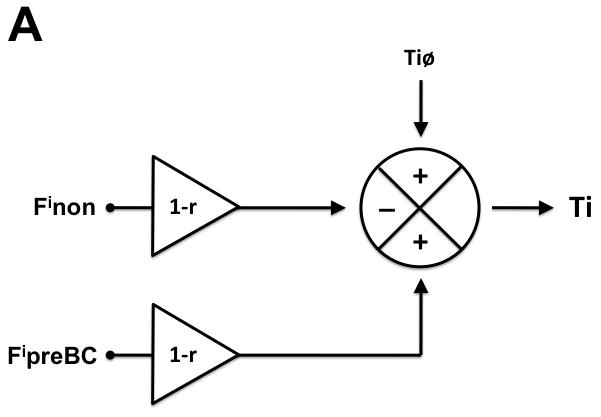
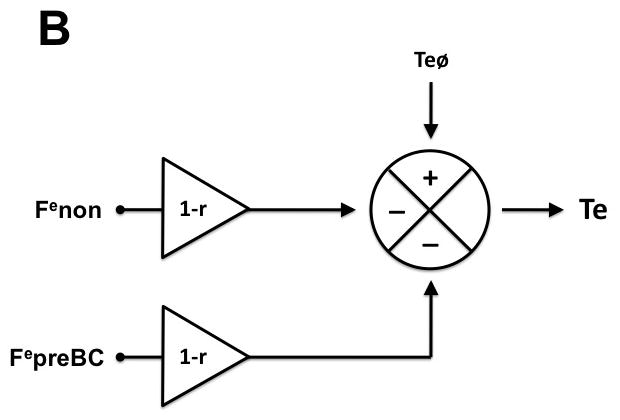
Hypothetical model of preBötzinger Complex (preBC) and non-preBC inputs to inspiratory and expiratory phase duration to explain the observed systemic opioid effects on respiratory phase duration. A: Intrinsic drive that maintains the inspiratory phase (Tiø) is modified by input from the preBC (FipreBC) as well as by input from outside the preBC (Finon) resulting in the observed inspiratory duration (Ti). Under control conditions, preBC input increases (+) and non-preBC input shortens (−) inspiratory duration. Intravenous (IV) remifentanil reduces both inputs by the factor (1-r) resulting in an increase in inspiratory duration. Local reversal of the remifentanil effect with naloxone in the preBC restores the preBC input to Ti (FipreBC), which leads to an additional increase in inspiratory duration. Additional reversal of the inhibition of non-preBC input (Finon) with IV naloxone reduces inspiratory duration to baseline. B: Intrinsic drive that maintains the expiratory phase (Teø) is modified by input from the preBC (FepreBC) as well as by input from outside the preBC (Fenon) resulting in the observed expiratory duration (Te). Under control conditions, both preBC input and non-preBC input shorten (−) expiratory duration. IV remifentanil reduces both inputs by the factor (1-r) resulting in an increase in expiratory duration. Local reversal of the remifentanil effect with naloxone in the preBC restores the preBC input to Te (FepreBC), which leads to a decrease in expiratory duration. Additional reversal of the inhibition of non-preBC input (Fenon) with IV naloxone reduces expiratory duration to baseline.
Figure 4
Figure 4
Hypothetical model of preBötzinger Complex (preBC) and non-preBC inputs to inspiratory and expiratory phase duration to explain the observed systemic opioid effects on respiratory phase duration. A: Intrinsic drive that maintains the inspiratory phase (Tiø) is modified by input from the preBC (FipreBC) as well as by input from outside the preBC (Finon) resulting in the observed inspiratory duration (Ti). Under control conditions, preBC input increases (+) and non-preBC input shortens (−) inspiratory duration. Intravenous (IV) remifentanil reduces both inputs by the factor (1-r) resulting in an increase in inspiratory duration. Local reversal of the remifentanil effect with naloxone in the preBC restores the preBC input to Ti (FipreBC), which leads to an additional increase in inspiratory duration. Additional reversal of the inhibition of non-preBC input (Finon) with IV naloxone reduces inspiratory duration to baseline. B: Intrinsic drive that maintains the expiratory phase (Teø) is modified by input from the preBC (FepreBC) as well as by input from outside the preBC (Fenon) resulting in the observed expiratory duration (Te). Under control conditions, both preBC input and non-preBC input shorten (−) expiratory duration. IV remifentanil reduces both inputs by the factor (1-r) resulting in an increase in expiratory duration. Local reversal of the remifentanil effect with naloxone in the preBC restores the preBC input to Te (FepreBC), which leads to a decrease in expiratory duration. Additional reversal of the inhibition of non-preBC input (Fenon) with IV naloxone reduces expiratory duration to baseline.

References

    1. Dahan A, Aarts L, Smith TW. Incidence, reversal, and prevention of opioid-induced respiratory depression. Anesthesiology. 2010;112:226–38. - PubMed
    1. Hanna MH, Elliott KM, Fung M. Randomized, double-blind study of the analgesic efficacy of morphine-6-glucuronide versus morphine sulfate for postoperative pain in major surgery. Anesthesiology. 2005;102:815–21. - PubMed
    1. McRorie TI, Lynn AM, Nespeca MK, Opheim KE, Slattery JT. The maturation of morphine clearance and metabolism. Am J Dis Child. 1992;146:972–6. - PubMed
    1. Prkic I, Mustapic S, Radocaj T, Stucke AG, Stuth EA, Hopp FA, Dean C, Zuperku EJ. Pontine mu-opioid receptors mediate bradypnea caused by intravenous remifentanil infusions at clinically relevant concentrations in dogs. J Neurophysiol. 2012;108:2430–41. - PMC - PubMed
    1. Mustapic S, Radocaj T, Sanchez A, Dogas Z, Stucke AG, Hopp FA, Stuth EA, Zuperku EJ. Clinically relevant infusion rates of mu-opioid agonist remifentanil cause bradypnea in decerebrate dogs but not via direct effects in the pre-Botzinger complex region. J Neurophysiol. 2010;103:409–18. - PMC - PubMed

Publication types