. 2015 Apr;22(4):291-7.
doi: 10.1038/nsmb.2989. Epub 2015 Mar 9.

Evidence that processing of ribonucleotides in DNA by topoisomerase 1 is leading-strand specific

Affiliations

Evidence that processing of ribonucleotides in DNA by topoisomerase 1 is leading-strand specific

Jessica S Williams et al. Nat Struct Mol Biol. 2015 Apr.

Abstract

Ribonucleotides incorporated during DNA replication are removed by RNase H2-dependent ribonucleotide excision repair (RER). In RER-defective yeast, topoisomerase 1 (Top1) incises DNA at unrepaired ribonucleotides, initiating their removal, but this is accompanied by RNA-DNA-damage phenotypes. Here we show that these phenotypes are incurred by a high level of ribonucleotides incorporated by a leading strand-replicase variant, DNA polymerase (Pol) ɛ, but not by orthologous variants of the lagging-strand replicases, Pols α or δ. Moreover, loss of both RNases H1 and H2 is lethal in combination with increased ribonucleotide incorporation by Pol ɛ but not by Pols α or δ. Several explanations for this asymmetry are considered, including the idea that Top1 incision at ribonucleotides relieves torsional stress in the nascent leading strand but not in the nascent lagging strand, in which preexisting nicks prevent the accumulation of superhelical tension.


Figures
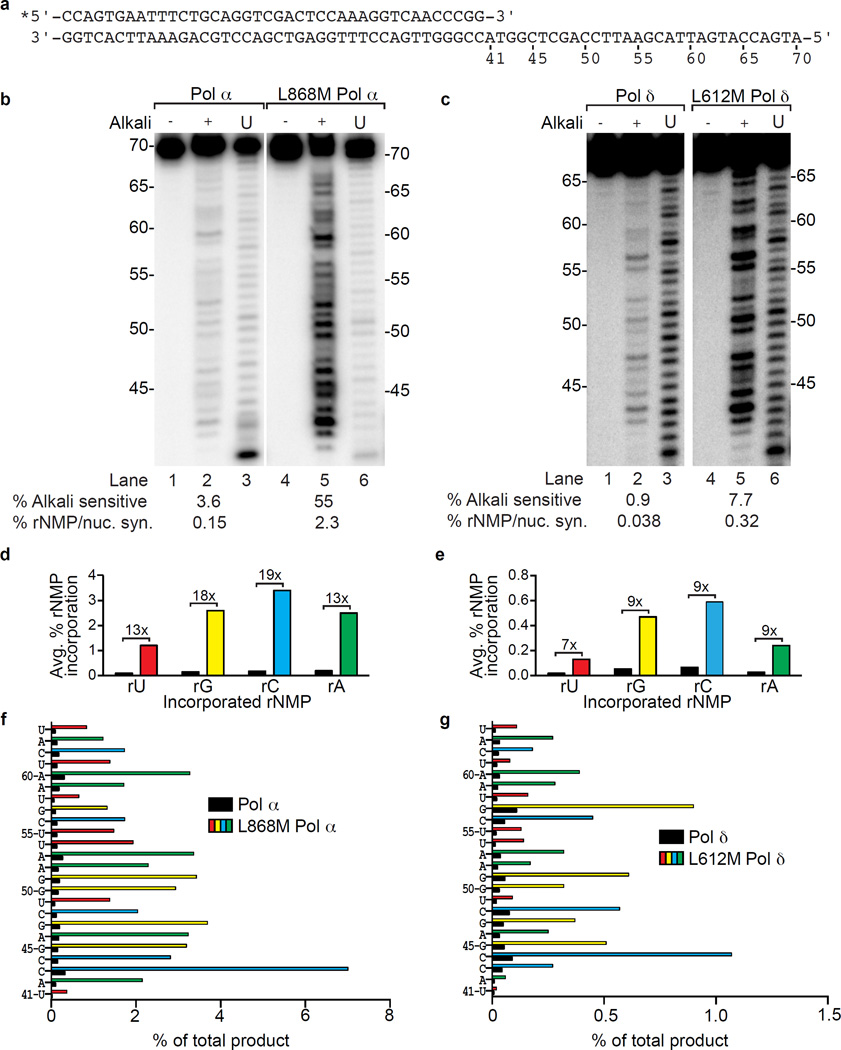
Figure 1
Figure 1
Ribonucleotide incorporation in vitro by variants of Pols α and δ. (a) Sequence of primer-template used for reactions in panels b and c. (b) Stable rNMP incorporation into DNA. The lane marked U depicts the product generated by Pol α or L868M Pol α prior to gel purification, as described in. Lanes marked with (−) and (+) depict gel-purified products treated with 0.3 M KCl (−) or KOH (+). The percentages of alkali-sensitive products and rNMP incorporated per nucleotide synthesized are shown below each lane. The mean and range for duplicate measurements was 3.6 ± 0.3 for Pol α and 55 ± 0.5 for L868M Pol α. (c) As in panel b, but for DNA products made by Pol δ (0.9 ± 0.2) and L612M Pol δ (7.7 ± 1.5). (d) Average frequency of ribonucleotide incorporation for rU, rA, rC and rG calculated from panel b. The relative difference in ribonucleotide incorporation between Pol α and L868M Pol α is shown above each base. (e) As in panel d, but for Pol δ and L612M Pol δ using data from panel c. (f) Percentage of rNMP incorporation by Pol α or L868M Pol α at each of 24 template positions. The position and identity of each incorporated ribonucleotide is displayed on the Y-axis. (g) As in panel f, but for ribonucleotide incorporation by Pol δ or L612M Pol δ.
Figure 2
Figure 2
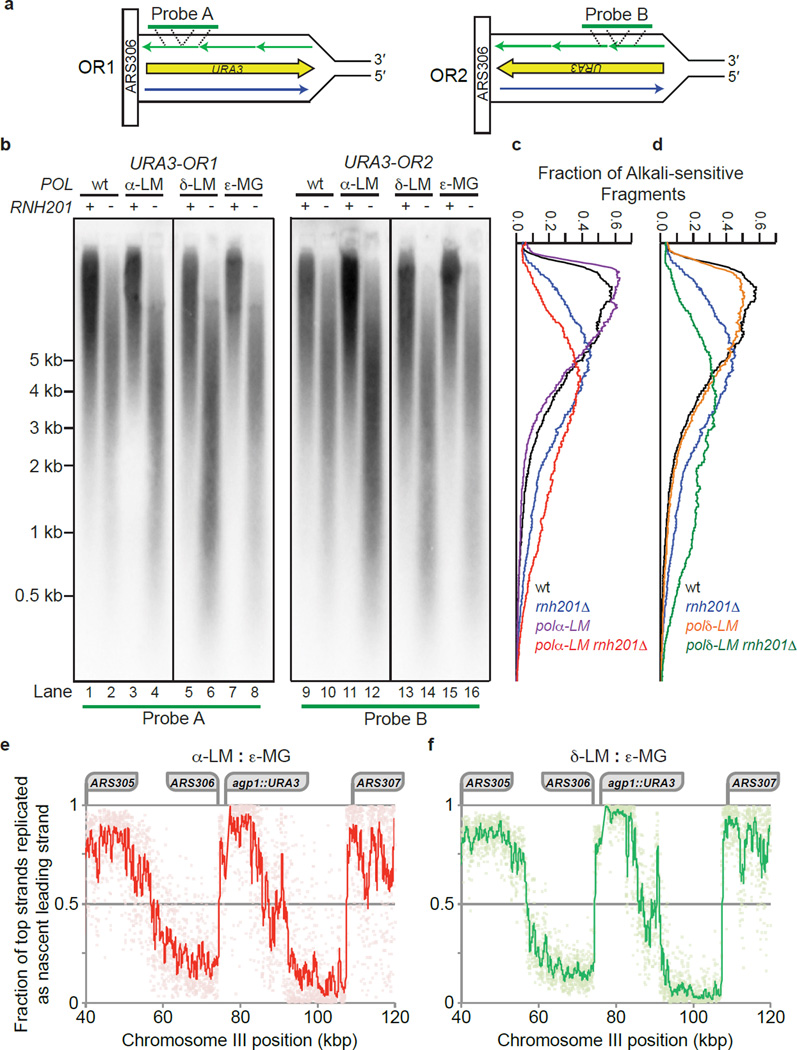
Strand-specific probing for ribonucleotides in nascent lagging strand genomic DNA. (a) Depicted is the URA3 reporter gene on chromosome III placed adjacent to the ARS306 replication origin in each of the two orientations. Template strands are in black, the nascent leading strand (top strand) synthesized by Pol ε is blue and the nascent lagging strand (bottom strand) synthesized by Pols α and δ is purple. The annealing location of strand-specific radiolabeled probes A and B are indicated with dotted lines. (b) Detection of alkali-sensitive sites in nascent lagging strand yeast genomic DNA was performed as described, with smaller fragments indicating the accumulation of unrepaired ribonucleotides in the absence of RNH201. Strains harbor one of four versions of the replicative DNA polymerases: wt (wild type for all enzymes), α-LM (pol1-L868M), δ-LM (pol3-L612M) or ε-MG (pol2-M644G). We note that Okazaki fragment-sized DNA (e.g. 150–300 base pair) fragments were not observed among the products of the alkaline hydrolysis of genomic DNA from the α-LM rnh201Δ or δ-LM rnh201Δ strains. Smaller DNA fragments observed for the ε-MG rnh201Δ mutant when using probes that anneal to the nascent lagging strand (lanes 8 and 16) may be related to the close proximity of URA3 to ARS306 (1.6 kb). These alkali-sensitive sites may arise during ribonucleotide incorporation by Pol ε into the nascent leading strand during bidirectional synthesis proceeding from this origin in the opposite direction (to the left of the origin in panel a). In addition, the small fragments that hybridize to the ‘lagging strand’ probe may be generated by synthesis performed by M644G Pol ε as it replicates from the adjacent ARS307 origin. (c) and (d) The data presented in panel b (for both Probe A and B) were quantified to determine the average fraction of total alkali-sensitive fragments at each position along the membrane as described in. The vertical axis corresponds to the DNA marker positions in panel b. Curves are derived by plotting the average values from two independent experiments. (e) This panel depicts the fraction of replication events in which the bottom strand is replicated as the nascent lagging strand, as estimated from pol1-L868M rnh201Δ HydEn-seq data (N=1). Noise was reduced via comparison with pol2-M644G rnh201Δ (N=4; see Supplementary Methods for calculations). Pale diamonds represent data for 20 bp bins. The trend line represents a 20-bin (400 bp) moving average. Loci of interest are labeled above. (f) As per panel e, but calculated from pol3-L612M rnh201Δ (N=2) rather than pol1-L868M rnh201Δ data.
Figure 3
Figure 3
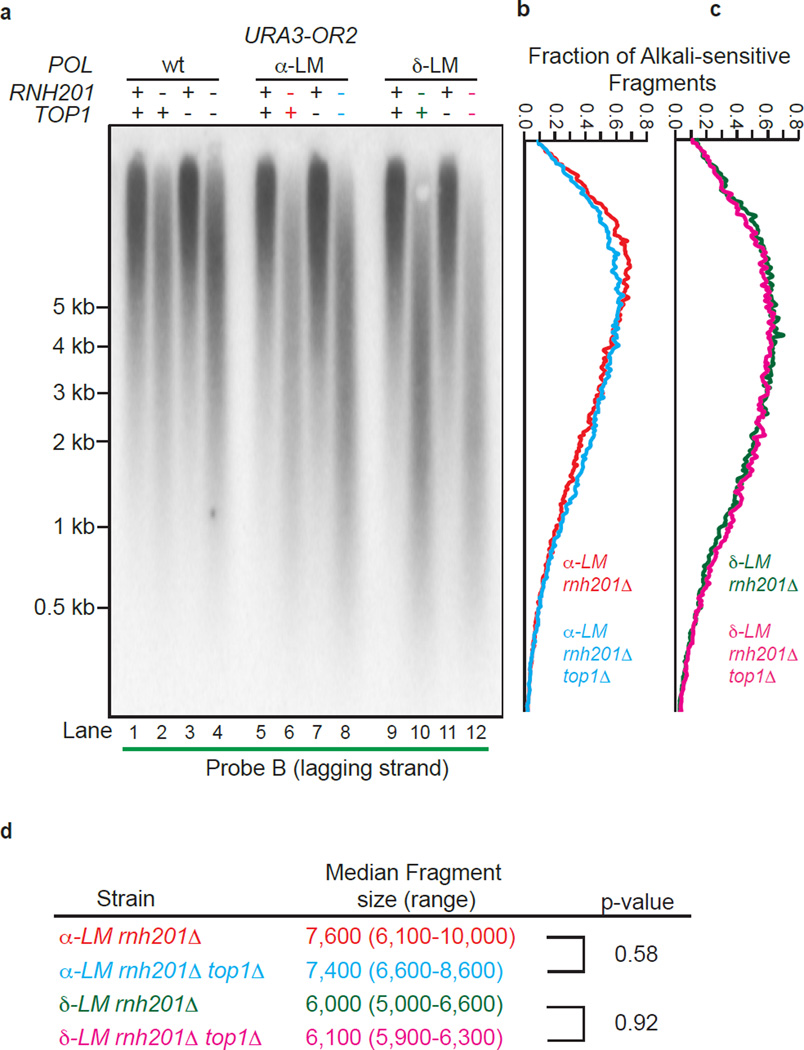
Lack of Top1-initiated ribonucleotide removal in pol1-L868M rnh201Δ and pol3-L612M rnh201Δ strains. (a) Detection of alkali-sensitive sites in nascent lagging strand DNA was performed using strains that were proficient or deficient in Top1 using the same approach as in Figure 2. All strains contain the URA3 reporter gene in orientation 2 (see Fig. 2a). (b) and (c) The data in panel a were quantified to determine the fraction of total alkali-sensitive fragments at each position along the membrane. The curves are derived using data from three independent experiments. (d) Median DNA fragment sizes (and range) in bases were determined as in using quantitation of the alkali-sensitivity data from five (α-LM rnh201Δ and δ-LM rnh201Δ strains) or three (α-LM rnh201Δ top1Δ and δ-LM rnh201Δ top1Δ strains) independent experiments. P values were calculated using a two-tailed Welch’s t-test.
Figure 4
Figure 4
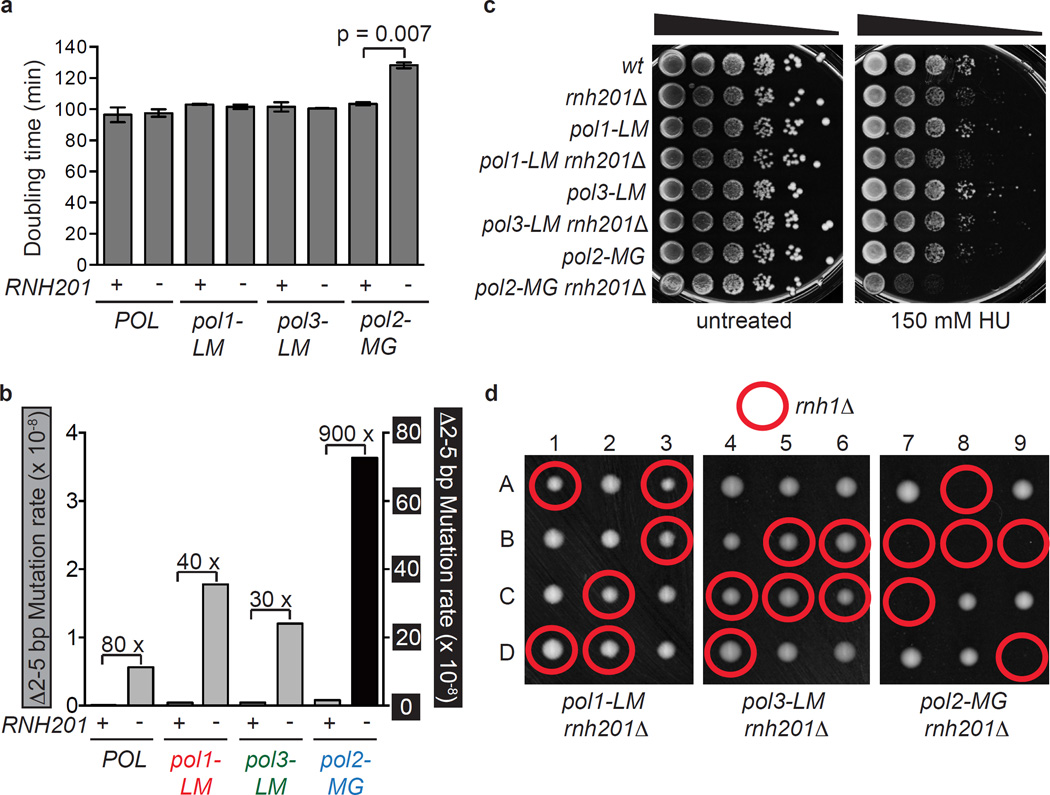
RNase H2 is dispensable for maintaining genome integrity in strains with increased capacity to incorporate ribonucleotides into lagging strand DNA. (a) Deletion of RNH201 does not affect growth rate in pol1-L868M or pol3-L612M mutator strains, but does cause an increase in doubling time (Dt) in the leading strand mutator variant, pol2-M644G. P = 0.007 (two-tailed Student’s t test). (b) 2–5 base pair deletion mutation rates were calculated from the data in Supplementary Table 2 and Supplementary Figure 3 for the URA3-OR2 reporter. The relative fold difference in rate between RNH201 and rnh201Δ is shown above each pair of bars. The 2–5 base pair deletion rates corresponding to those displayed are presented in Supplementary Table 3. (c) Loss of RNH201 does not confer sensitivity to 150 mM HU in the pol1-LM or pol3-LM strains. The experiment was performed in triplicate and the data displayed is a representative example of n=3 independent biological replicates of this test. (d) Tetrad analysis of RNH1/rnh1Δ diploids in the pol1-LM rnh201Δ, pol3-LM rnh201Δ and pol2-MG rnh201Δ backgrounds. Columns1–9 are tetrad dissections and A–D are haploid spore colonies. Plates were photographed after 3 days growth at 30°C on rich medium.
Figure 5
Figure 5
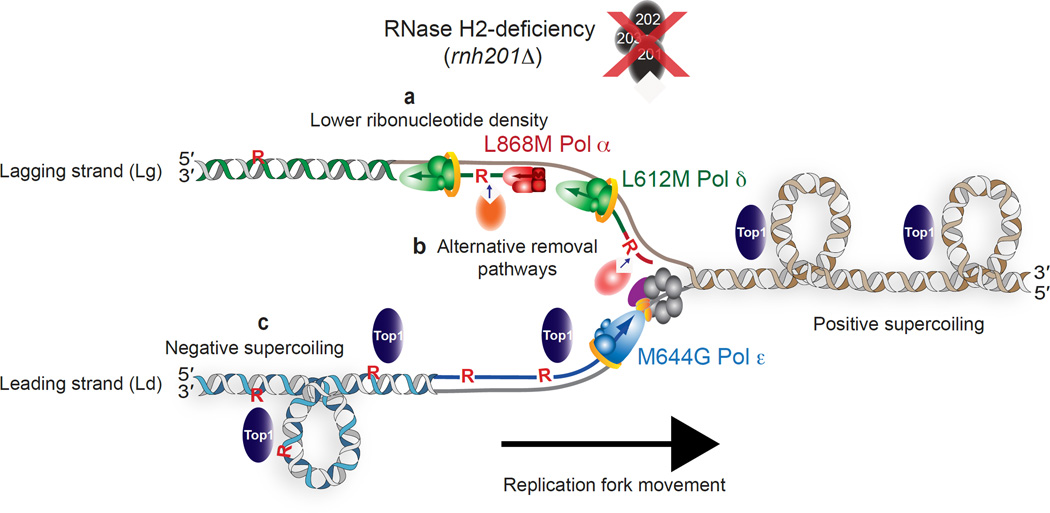
A model depicting three possibilities for strand-specific consequences of unrepaired ribonucleotides in the genomes of RER-defective yeast strains. (a) Failure to observe a Top1-dependent effect in the L868M Pol α or L612M Pol δ strains may be related to the fact that these enzymes incorporate fewer ribonucleotides into DNA than does the M644G Pol ε variant. This possibility is supported by the demonstration that deletion of RNH1 is lethal in the pol2-M644G rnh201Δ mutant but not in the pol1-L868M or pol3-L612M strains lacking RNH201 (Fig. 4d), a result that may be directly related to ribonucleotide density. Generation of alternative variants of Pol α and Pol δ that elevate ribonucleotide incorporation into nascent lagging strand DNA is an approach that could be taken to test this idea. (b) A second possibility is the existence of alternative ribonucleotide-repair pathways available on the lagging strand, perhaps involving enzymes involved in Okazaki fragment maturation, such as the Fen1 or Exo1 nucleases or the Dna2 helicase. (c) A third idea involves the possibility that negative supercoils accumulate in leading strand DNA in the wake of the replication fork. This type of superhelical tension may be related to the continuous nature of the leading strand, in contrast to the discontinuity of the lagging strand in the form of preexisting DNA nicks that may allow for DNA rotation and negate the need for relief of such supercoiling by the action of Top1. As a consequence, Top1 incision at ribonucleotides in the nascent leading strand then initiates the RNA-DNA damage observed in a pol2-M644G rnh201Δ mutant.

References

    1. Nick McElhinny SA, et al. Abundant ribonucleotide incorporation into DNA by yeast replicative polymerases. Proc Natl Acad Sci U S A. 2010;107:4949–4954. - PMC - PubMed
    1. Pursell ZF, Isoz I, Lundstrom EB, Johansson E, Kunkel TA. Yeast DNA polymerase epsilon participates in leading-strand DNA replication. Science. 2007;317:127–130. - PMC - PubMed
    1. Nick McElhinny SA, Gordenin DA, Stith CM, Burgers PM, Kunkel TA. Division of labor at the eukaryotic replication fork. Mol Cell. 2008;30:137–144. - PMC - PubMed
    1. Wang J, et al. Crystal structure of a pol alpha family replication DNA polymerase from bacteriophage RB69. Cell. 1997;89:1087–1099. - PubMed
    1. Pavlov YI, Shcherbakova PV, Kunkel TA. In vivo consequences of putative active site mutations in yeast DNA polymerases alpha, epsilon, delta, and zeta. Genetics. 2001;159:47–64. - PMC - PubMed

Publication types

MeSH terms