. 2015 Jun;197(5):657-64.
doi: 10.1007/s00203-015-1101-8. Epub 2015 Mar 10.

Vaginal Lactobacillus gasseri CMUL57 can inhibit herpes simplex type 2 but not Coxsackievirus B4E2

Affiliations

Vaginal Lactobacillus gasseri CMUL57 can inhibit herpes simplex type 2 but not Coxsackievirus B4E2

Imad Al Kassaa et al. Arch Microbiol. 2015 Jun.

Abstract

This study aimed at demonstrating the antiviral activity of Lactobacillus gasseri CMUL57 (L. gasseri CMUL57), L. acidophilus CMUL67 and L. plantarum CMUL140 against herpes simplex type 2 (HSV-2) and Coxsackievirus B4E2 (CVB4E2), which are enveloped and naked viruses, respectively. These lactobacilli were non-cytotoxic and were able to reduce the cytopathic effect induced by HSV-2 in Vero cell monolayers. However, lactobacilli were not active against CVB4E2. Tested lactobacilli displayed anti-HSV-2 activity when they were co-incubated with the virus prior to inoculating the mixture to Vero cell monolayers. The detection of HSV-2 DNA by PCR in pellets of bacteria/virus mixtures let us to hypothesize that anti-HSV-2 activity of lactobacilli resulted from the viruses' entrapment. This study showed the capabilities of vaginal lactobacilli to inhibit enveloped viruses such as HSV-2.


Figures
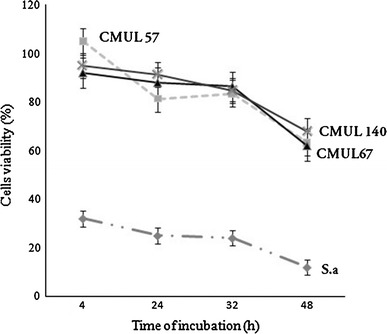
Fig. 1
Fig. 1
Viability of Vero cells in the presence of vaginal lactobacilli CMUL57, CMUL67, CMUL140 and Staphylococcus aureus (S. aureus) ATCC33862 at 107 CFU/ml. The cell viability was measured using UptiBlue, and the results were expressed as the percentage of viability compared to the negative control (100 % viable Vero cell monolayers). The results were the means (±SD) of at least three independent experiments
Fig. 2
Fig. 2
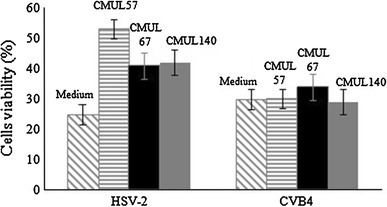
Antiviral activity of live lactobacilli strains on HSV-2- and CVB4E2-infected Vero cells. After removing the unbound bacteria, Vero cells were incubated for a further 24 h before viral infection by HSV-2 or CVB4E2. The results show the cell viability assay obtained after 48 h of infection by the viruses. The results are expressed as the percentage of cell survival, in comparison with the controls represented by the wells containing the untreated Vero cells (medium). The data are the means (±SD) of at least three independent experiments
Fig. 3
Fig. 3
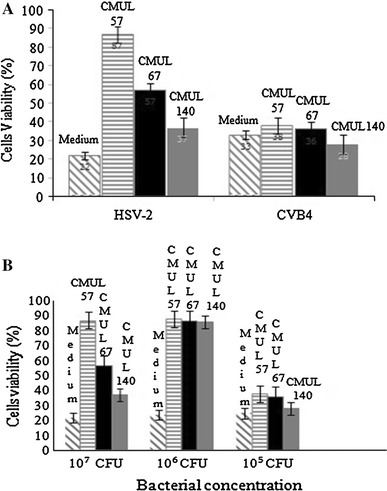
Antiviral activity of live vaginal lactobacilli CMUL57, CMUL67 and CMUL140 on HSV-2- or CVB4E2-infected Vero cells. The antiviral effect was examined when lactobacilli were applied on the Vero cell together with the viruses (co-incubation) (a), taking into account the bacterial concentrations (b). Results were collected after 48 h of HSV-2 challenge and expressed as percentage of cell survival, compared to the control wells (medium) containing cells which were challenged with the virus in the absence of lactobacilli. The data are the means (±SD) of at least three independent experiments
Fig. 4
Fig. 4
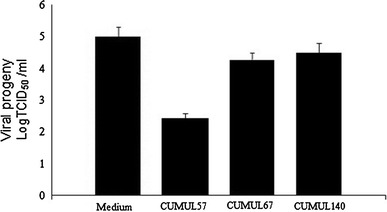
Reduction in viral (HSV-2) progeny by lactobacilli strains. The vaginal lactobacilli were added at the same time as the viruses. HSV-2 and CVB4E2 were used to challenge Vero cells and then incubated for 6 h. The unbound virus particles were removed by three washings. Results were recorded after 48 h of incubation and represented by the virus titration and expressed as logTCID50/ml, compared to the control cells (medium) which were not treated with lactobacilli. The data (±SD) are the means of at least three independent experiments
Fig. 5
Fig. 5
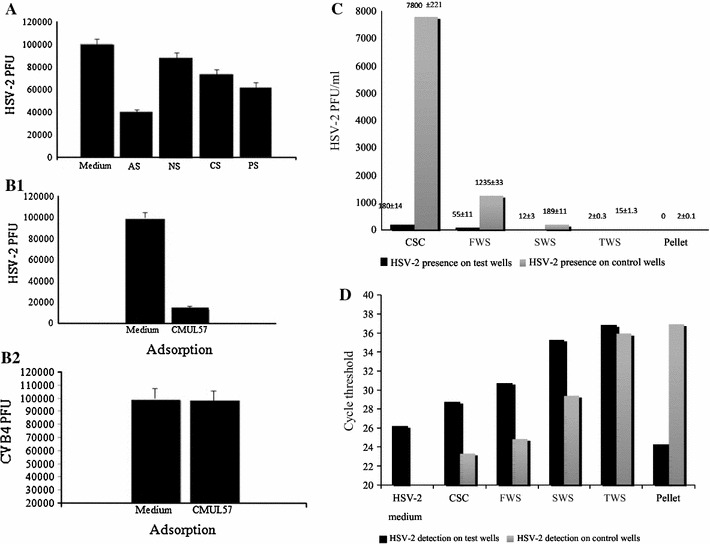
Putative mechanism of anti-HSV-2 activity of L. gasseri CMUL57. a Anti-HSV-2 activity of crude cell-free supernatant (AS) (pH 4.5), neutralized supernatant (NS) (pH 6.8), supernatant treated with catalase (CS) or with protease (PS). The data (±SD) are the means of at least three independent experiments. Adsorption of HSV-2 (b) and CVB4E2 (c) on CMUL57 strain. The data (± SD) are the means of at least three independent experiments. d Detection for infectious particles in the washing supernatants of the CMUL57 strain and HSV-2 mixture was determined using the PRA method. e The real-time PCR method was used to detect the presence of “trapped” viruses in the mixture pellet and residual viral particles in washing supernatants. CSC crude supernatant of co-incubation, FWS first washing supernatant, SWS second washing supernatant, TWS third washing supernatant. The control wells refer to the wells containing HSV-2 only, whereas the test wells refer to the wells containing HSV-2 co-incubated with CMUL57 strain

References

    1. Al Kassaa I, Hamze M, Hober D, Monzer H, Chihib NE, Drider D. Identification of vaginal lactobacilli with potential probiotic properties isolated from women in North Lebanon. Microb Ecol. 2014;67:722–734. doi: 10.1007/s00248-014-0384-7. - DOI - PubMed
    1. Al Kassaa I, Hober D, Hamze M, Chihib NE, Drider D. Antiviral potential of lactic acid bacteria and their bacteriocins. Probiotics Antimicrob Prot. 2014;6:177–185. doi: 10.1007/s12602-014-9162-6. - DOI - PubMed
    1. An HM, Lee do K, Kim JR, Lee SW, Cha MK, Lee KO, Ha NJ. Antiviral activity of Bifidobacteriumadolescentis SPM 0214 against herpes simplex virus type 1. Arch Pharm Res. 2012;35:1665–1671. doi: 10.1007/s12272-012-0918-9. - DOI - PubMed
    1. Bacon TH, Levin MJ, Leary JJ, Sarisky RT, Sutton D. Herpes simplex virus resistance to acyclovir and penciclovir after two decades of antiviral therapy. Clin Microbiol Rev. 2003;16:114–128. doi: 10.1128/CMR.16.1.114-128.2003. - DOI - PMC - PubMed
    1. Botić T, Klingberg TD, Weingartl H, Cencic A. A novel eukaryotic cell culture model to study antiviral activity of potential probiotic bacteria. Int J Food Microbiol. 2007;115:227–234. doi: 10.1016/j.ijfoodmicro.2006.10.044. - DOI - PubMed

Publication types

LinkOut - more resources