


Enhancing k-space quantitative susceptibility mapping by enforcing consistency on the cone data (CCD) with structural priors
- PMID: 25752805
- PMCID: PMC4561604
- DOI: 10.1002/mrm.25652
Enhancing k-space quantitative susceptibility mapping by enforcing consistency on the cone data (CCD) with structural priors
Abstract
Purpose: The inversion from the magnetic field to the magnetic susceptibility distribution is ill-posed because the dipole kernel, which relates the magnetic susceptibility to the magnetic field, has zeroes at a pair of cone surfaces in the k-space, leading to streaking artifacts on the reconstructed quantitative susceptibility maps (QSM). A method to impose consistency on the cone data (CCD) with structural priors is proposed to improve the solutions of k-space methods.
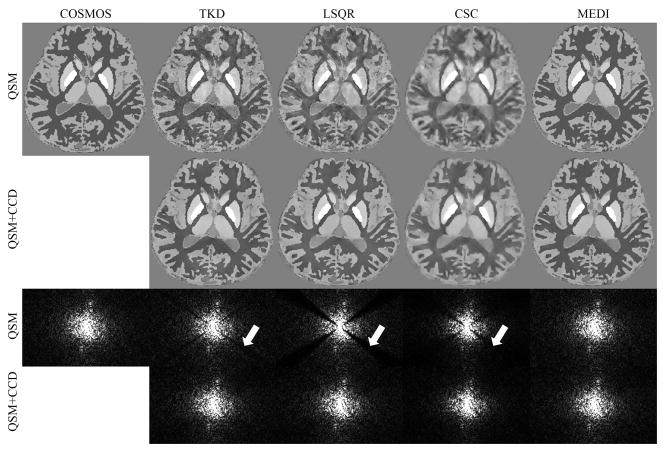
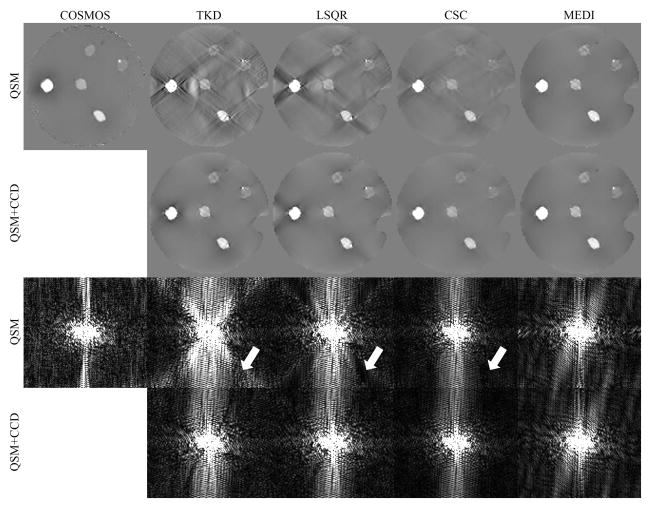
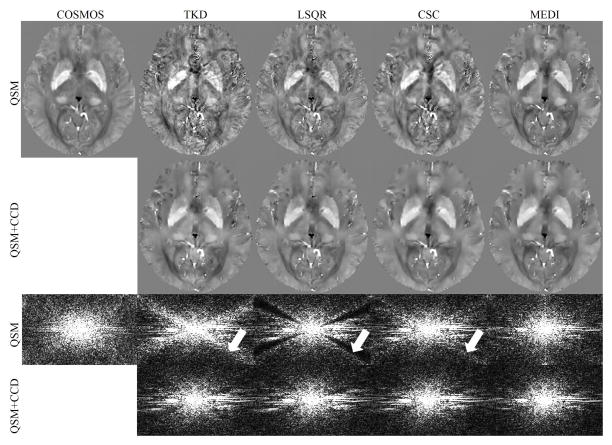
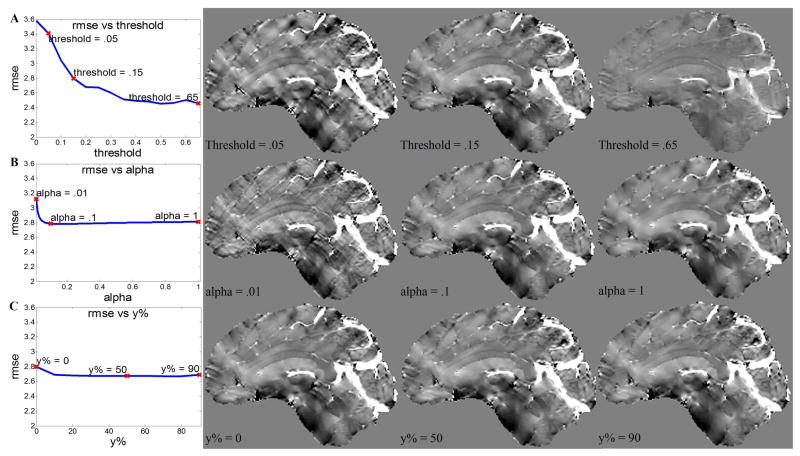
Methods: The information in the cone region is recovered by enforcing structural consistency with structural prior, while information in the noncone trust region is enforced to be consistent with the magnetic field measurements in k-space. This CCD method was evaluated by comparing the initial results of existing QSM algorithms to the QSM results after CCD enhancement with respect to the COSMOS results in simulation, phantom, and in vivo human brain.
Results: The proposed method demonstrated suppression of streaking artifacts and the resulting QSM showed better agreement with reference standard QSM compared with other k-space based methods.
Conclusion: By enforcing consistency with structural priors in the cone region, the missing data in the cone can be recovered and the streaking artifacts in QSM can be suppressed.
Keywords: conjugate gradient algorithm; data fitting; quantitative susceptibility mapping.
© 2015 Wiley Periodicals, Inc.
Figures
References
-
- de Rochefort L, Brown R, Prince MR, Wang Y. Quantitative MR susceptibility mapping using piece-wise constant regularized inversion of the magnetic field. Magn Reson Med. 2008;60(4):1003–1009. - PubMed
-
- de Rochefort L, Liu T, Kressler B, Liu J, Spincemaille P, Lebon V, Wu J, Wang Y. Quantitative susceptibility map reconstruction from MR phase data using bayesian regularization: validation and application to brain imaging. Magn Reson Med. 2010;63(1):194–206. - PubMed
Publication types
MeSH terms
Grants and funding
LinkOut - more resources
Full Text Sources
Other Literature Sources
Medical
Molecular Biology Databases
