


Gestational weight gain and obesity, adiposity and body size in African-American and Dominican children in the Bronx and Northern Manhattan
- PMID: 25753294
- PMCID: PMC4561015
- DOI: 10.1111/mcn.12174
Gestational weight gain and obesity, adiposity and body size in African-American and Dominican children in the Bronx and Northern Manhattan
Abstract
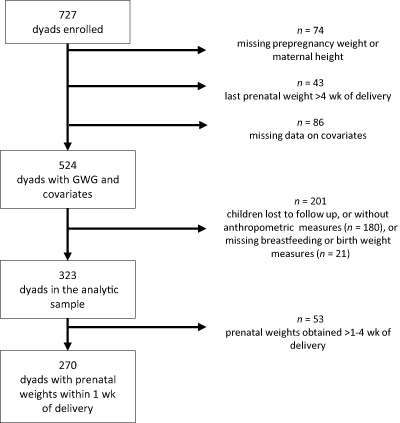
Gestational weight gain (GWG) is potentially modifiable and is associated with infant size and body composition; however, long-term effects on childhood obesity have not been reported among multi-ethnic urban populations. We examined the association between GWG and child anthropometric measures and body composition at 7 years [waist circumference (WC), body mass index z-score (BMIZ), obesity (BMIZ ≥95%ile) and bioelectrical impedance analysis estimates of percentage body fat (%fat)] in African-American and Dominican dyads (n = 323) in the Columbia Center for Children's Environmental Health prospective birth cohort study from 1998 to 2013. Linear and logistic regression evaluated associations between excessive GWG [>Institute of Medicine (IOM) 2009 guidelines] and outcomes, adjusting for pre-pregnancy BMI and covariates. Pre-pregnancy BMI (mean ± standard deviation, all such values) and total GWG were 25.8 ± 6.2 kg m(-2) (45% overweight/obese) and 16.4 ± 7.9 kg (64% > IOM guidelines), respectively. Excessive GWG was associated with higher BMIZ {0.44 [95% confidence interval (CI): 0.2, 0.7], P < 0.001}, WC [β: 2.9 cm (95% CI: 1.1, 4.6), P = 0.002], %fat at 7 years [β: 2.2% (95% CI: 1.0, 3.5), P = 0.001)] and obesity [odds ratio: 2.93 (95% CI: 1.5, 5.8), P = 0.002]. Pre-pregnancy BMI was positively associated with child size, adiposity and obesity (all P < 0.05). Excessive GWG was highly prevalent and was associated with child obesity, greater percentage body fat and abdominal adiposity. Strategies to support healthy GWG are warranted to promote healthy growth and prevent childhood obesity.
Keywords: body composition; childhood adiposity; childhood obesity; life course; pregnancy; weight gain.
© 2015 John Wiley & Sons Ltd.
Conflict of interest statement
The authors declare no conflicts of interest.
Figures

References
-
- Black R.E., Victora C.G., Walker S.P., Bhutta Z.A., Christian P., de Onis M. et al (2013) Maternal and child undernutrition and overweight in low‐income and middle‐income countries. Lancet 382, 427–451. - PubMed
-
- Butte N.F., Ellis K.J., Wong W.W., Hopkinson J.M. & Smith E.O. (2003) Composition of gestational weight gain impacts maternal fat retention and infant birth weight. American Journal of Obstetrics and Gynecology 189, 1423–1432. - PubMed
-
- Centers for Disease Control and Prevention (2012) 2011 pregnancy nutrition surveillance: summary of trends in maternal health indicators by race/ethnicity. [Online] Available at: http://www.cdc.gov/pednss/pnss_tables/html/pnss_national_table20.htm (Accessed February 2014).
MeSH terms
Grants and funding
LinkOut - more resources
Full Text Sources
Other Literature Sources
Medical
