


In vivo classification of colorectal neoplasia using high-resolution microendoscopy: Improvement with experience
- PMID: 25753782
- PMCID: PMC4504008
- DOI: 10.1111/jgh.12937
In vivo classification of colorectal neoplasia using high-resolution microendoscopy: Improvement with experience
Abstract
Background and aims: High-resolution microendoscopy (HRME) is a novel, low-cost "optical biopsy" technology that allows for subcellular imaging. The study aim was to evaluate the learning curve of HRME for the differentiation of neoplastic from non-neoplastic colorectal polyps.
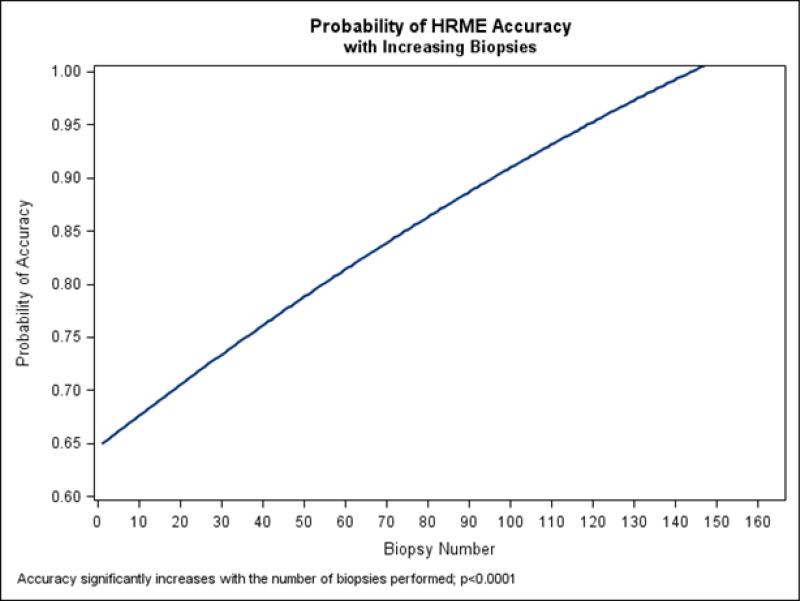
Methods: In a prospective cohort fashion, a total of 162 polyps from 97 patients at a single tertiary care center were imaged by HRME and classified in real time as neoplastic (adenomatous, cancer) or non-neoplastic (normal, hyperplastic, inflammatory). Histopathology was the gold standard for comparison. Diagnostic accuracy was examined at three intervals over time throughout the study; the initial interval included the first 40 polyps, the middle interval included the next 40 polyps examined, and the final interval included the last 82 polyps examined.
Results: Sensitivity increased significantly from the initial interval (50%) to the middle interval (94%, P = 0.02) and the last interval (97%, P = 0.01). Similarly, specificity was 69% for the initial interval but increased to 92% (P = 0.07) in the middle interval and 96% (P = 0.02) in the last interval. Overall accuracy was 63% for the initial interval and then improved to 93% (P = 0.003) in the middle interval and 96% (P = 0.0007) in the last interval.
Conclusions: In conclusion, this in vivo study demonstrates that an endoscopist without prior colon HRME experience can achieve greater than 90% accuracy for identifying neoplastic colorectal polyps after 40 polyps imaged. HRME is a promising modality to complement white light endoscopy in differentiating neoplastic from non-neoplastic colorectal polyps.
Keywords: adenoma classification; colorectal polyps; microendoscopy.
© 2015 Journal of Gastroenterology and Hepatology Foundation and Wiley Publishing Asia Pty Ltd.
Figures
References
-
- Winawer SJ, Zauber AG, Ho MN, et al. Prevention of colorectal cancer by colonoscopic polypectomy. The National Polyp Study Workgroup. The New England journal of medicine. 1993;329:1977–81. - PubMed
-
- Hassan C, Pickhardt PJ, Rex DK. A resect and discard strategy would improve cost-effectiveness of colorectal cancer screening. Clin Gastroenterol Hepatol. 2010;8:865–9. 9 e1–3. - PubMed
-
- Chang SS, Shukla R, Polydorides AD, et al. High resolution microendoscopy for classification of colorectal polyps. Endoscopy. 2013;45:553–9. - PubMed
Publication types
MeSH terms
Grants and funding
LinkOut - more resources
Full Text Sources
Other Literature Sources
Medical
