. 2015 Aug;112(8):1533-43.
doi: 10.1002/bit.25584. Epub 2015 Jun 11.

Bioprocessing analysis of Pyrococcus furiosus strains engineered for CO₂-based 3-hydroxypropionate production

Affiliations

Bioprocessing analysis of Pyrococcus furiosus strains engineered for CO₂-based 3-hydroxypropionate production

Aaron B Hawkins et al. Biotechnol Bioeng. 2015 Aug.

Abstract

Metabolically engineered strains of the hyperthermophile Pyrococcus furiosus (T(opt) 95-100°C), designed to produce 3-hydroxypropionate (3HP) from maltose and CO2 using enzymes from the Metallosphaera sedula (T(opt) 73°C) carbon fixation cycle, were examined with respect to the impact of heterologous gene expression on metabolic activity, fitness at optimal and sub-optimal temperatures, gas-liquid mass transfer in gas-intensive bioreactors, and potential bottlenecks arising from product formation. Transcriptomic comparisons of wild-type P. furiosus, a genetically-tractable, naturally-competent mutant (COM1), and COM1-based strains engineered for 3HP production revealed numerous differences after being shifted from 95°C to 72°C, where product formation catalyzed by the heterologously-produced M. sedula enzymes occurred. At 72°C, significantly higher levels of metabolic activity and a stress response were evident in 3HP-forming strains compared to the non-producing parent strain (COM1). Gas-liquid mass transfer limitations were apparent, given that 3HP titers and volumetric productivity in stirred bioreactors could be increased over 10-fold by increased agitation and higher CO2 sparging rates, from 18 mg/L to 276 mg/L and from 0.7 mg/L/h to 11 mg/L/h, respectively. 3HP formation triggered transcription of genes for protein stabilization and turnover, RNA degradation, and reactive oxygen species detoxification. The results here support the prospects of using thermally diverse sources of pathways and enzymes in metabolically engineered strains designed for product formation at sub-optimal growth temperatures.

Keywords: 3-hydroxypropionate; CO2 fixation; Metallosphaera sedula; Pyrococcus furiosus.


Figures

Figure 1
Figure 1
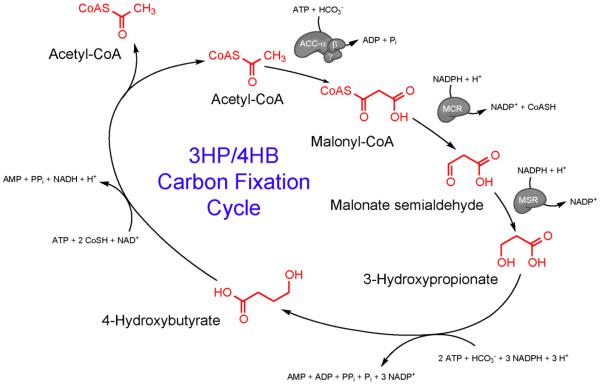
3-Hydroxypropionate (3HP)/4-Hydroxybutyrate (4HB) Carbon Fixation Cycle from Metallosphaera sedula, highlighting the portion of the cycle for 3HP production. The first step requires carboxylation of acetyl-CoA via acetyl-CoA carboxylase with bicarbonate as substrate, followed by two reductions to form 3HP. Enzyme abbreviations: ACC – Acetyl-CoA carboxylase; MCR – Malonyl-CoA reductase; MSR – Malonate semialdehyde reductase (Table 1).
Figure 2
Figure 2
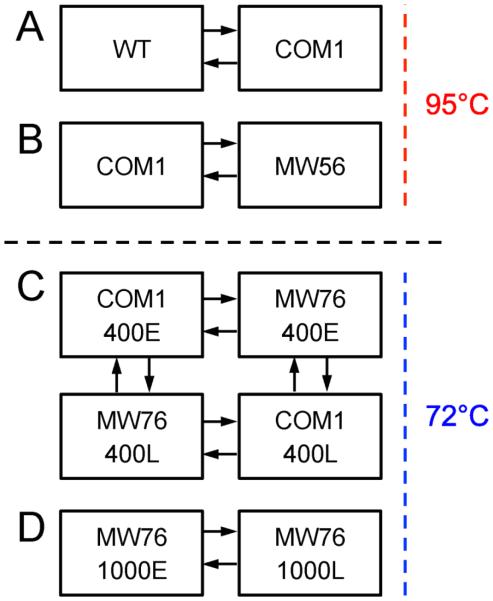
Experimental design overview for the transcriptional response experiments used in this study. See Materials and Methods section and Table 2 for detailed information about strains and growth conditions. A) Dye-flip between P. furiosus Wild-type (WT) and the naturally competent genetic host strain (COM1) grown at 95°C (serum bottles). B) Dye-flip between the genetic parent strain (COM1) and P. furiosus strain MW56 grown at 95°C (serum bottles). C) Four-slide loop comparing the genetic parent strain (COM1) with P. furiosus strain MW76 grown in gas-intensive bioreactor at 72°C with low agitation (400 rpm) at 2.5 h (E - Early) and 40 h (L – Late) after the temperature switch from 95°C. D) Dye-flip between P. furiosus strain MW76 grown in gas-intensive bioreactor at 72°C with high agitation (1000 rpm) at 1 h (E - Early) and 31 h (L – Late) after the temperature switch from 95°C.
Figure 3
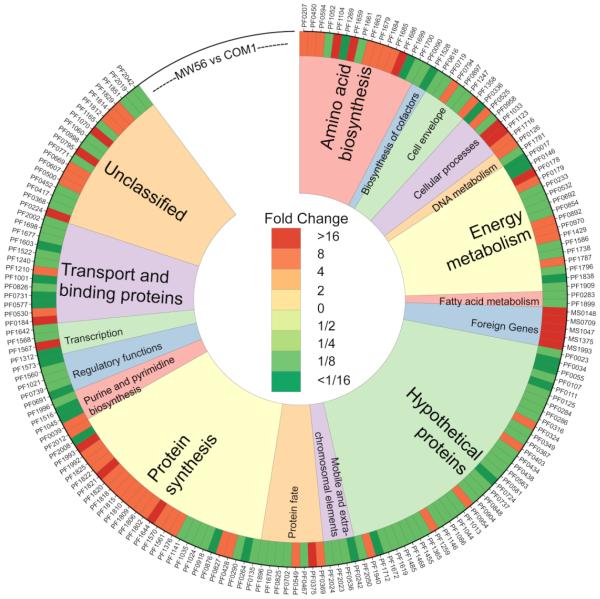
Figure 3. Heatmap showing Differential Transcription between P. furiosus COM1 and P. furiosus MW56 strains
Select genes with log2-fold changes of ≥ ±2.1, sorted by TIGR functional categories. P. furiosus ORF numbers are listed on outer edge. Red indicates higher transcriptional levels for a given gene in MW56 compared to COM1, while green indicates lower transcription levels. See Figure 2 for microarray experimental loop summary.
Figure 4
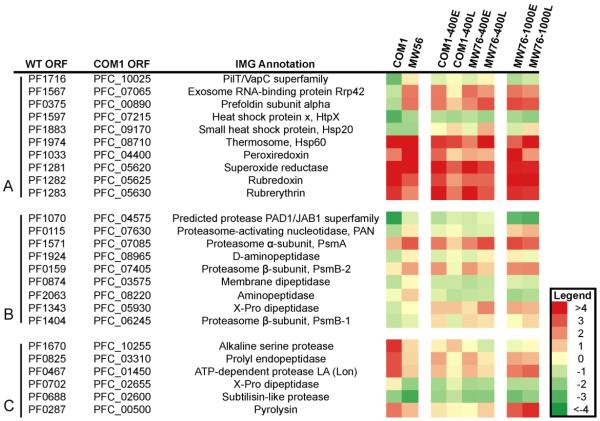
Figure 4. Heat plot showing normalized transcription levels for select genes in P. furiosus strains
High transcription levels are shown in red, low transcription in green. The corresponding numbers depicted here are least-squares mean values of transcription relative to the overall average transcription level of zero (yellow). The genes are divided into three groups: protease genes up-regulated on COM1 (top), proteases up-regulated on MW56 (middle), and select stress responsive genes (bottom). Stress response genes include RNA degradation enzymes, protein chaperones, and oxygen/peroxide scavenging molecules.
Figure 5
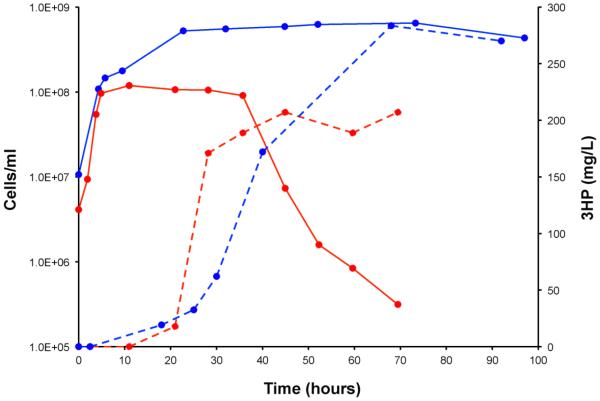
Figure 5. Cell Density and 3HP production levels for selected bioreactor runs
Solid lines show cell densities (left axis) and dashed lines show 3HP production levels (right axis); MW76-400 is shown in blue and MW76-1000 in red. Note the rapid decrease in cell viability for MW76-1000 (red) compared to MW76-400 (blue), corresponding to higher 3HP production rates.
Figure 6
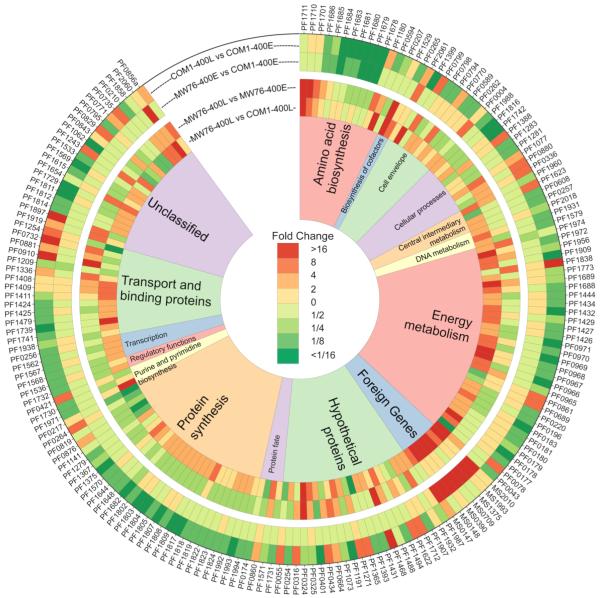
Figure 6. Heatmap showing Differential Transcription for P. furiosus COM1 and MW76 strains
Select genes with log2-fold changes of ≥ ±2.2, sorted by TIGR functional categories. P. furiosus ORF numbers are listed on outer edge. Each track represents a separate transcriptional comparison, labeled in the top of the figure. See Figure 2 for microarray experiment loop summary.

References

    1. Adams MW, Holden JF, Menon AL, Schut GJ, Grunden AM, Hou C, Hutchins AM, Jenney FE, Kim C, Ma K, Pan G, Roy R, Sapra R, Story SV, Verhagen MF. Key role for sulfur in peptide metabolism and in regulation of three hydrogenases in the hyperthermophilic archaeon Pyrococcus furiosus. J. Bacteriol. 2001;183:716–724. - PMC - PubMed
    1. Basen M, Sun J, Adams MWW. Engineering a hyperthermophilic archaeon for temperature-dependent product formation. mBio. 2012;3:1–8. - PMC - PubMed
    1. Berg IA, Kockelkorn D, Buckel W, Fuchs G. A 3-hydroxypropionate/4-hydroxybutyrate autotrophic carbon dioxide assimilation pathway in Archaea. Science. 2007;318:1782–1786. - PubMed
    1. Bridger SL, Lancaster WA, Poole FL, Schut GJ, Adams MWW. Genome sequencing of a genetically tractable Pyrococcus furiosus strain reveals a highly dynamic genome. J. Bacteriol. 2012;194:4097–4106. - PMC - PubMed
    1. Choi SH, Baumler DJ, Kaspar CW. Contribution of dps to acid stress tolerance and oxidative stress tolerance in Escherichia coli O157: H7. Appl. Environ. Microbiol. 2000;66:3911–3916. - PMC - PubMed

Publication types

MeSH terms