


Formerly eclamptic women have lower nonpregnant blood pressure compared with formerly pre-eclamptic women: a retrospective cohort study
- PMID: 25753846
- PMCID: PMC4551599
- DOI: 10.1111/1471-0528.13285
Formerly eclamptic women have lower nonpregnant blood pressure compared with formerly pre-eclamptic women: a retrospective cohort study
Abstract
Objective: To compare nonpregnant blood pressure and circulating metabolic factors between formerly pre-eclamptic women who did and did not deteriorate to eclampsia.
Design: Retrospective observational cohort study.
Setting: Tertiary referral centre.
Population: Formerly pre-eclamptic women with (n = 88) and without (n = 698) superimposed eclampsia.
Methods: Women who experienced pre-eclampsia with or without superimposed eclampsia during their pregnancy or puerperium were tested for possible underlying cardiovascular risk factors at least 6 months postpartum. We measured blood pressure and determined cardiovascular and metabolic risk markers in a fasting blood sample. Groups were compared using Mann-Whitney U test, Spearman's Rho test or Fisher's Exact test (odds ratios).
Main outcome measures: Differences in postpartum blood pressures and features of the metabolic syndrome between formerly pre-eclamptic and formerly eclamptic women.
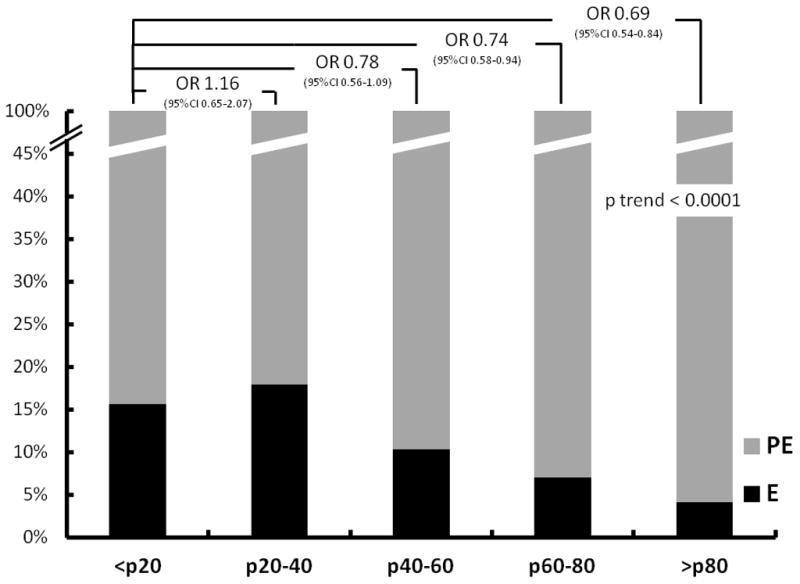
Results: Formerly pre-eclamptic women who developed eclampsia differed from their counterparts without eclampsia by a lower blood pressure (P < 0.01) with blood pressure correlating inversely with the likelihood of having experienced eclampsia (P < 0.001). In addition, formerly eclamptic women had higher circulating C-reactive protein levels than formerly pre-eclamptic women (P < 0.05). All other circulating metabolic factors were comparable. Finally, 40% of all eclamptic cases occurred in the puerperium.
Conclusions: Formerly pre-eclamptic women with superimposed eclampsia have lower nonpregnant blood pressure compared with their counterparts without neurological sequelae with blood pressure negatively correlated to the occurrence of eclampsia. As about 40% of all eclamptic cases occur postpartum, routine blood pressure monitoring postpartum should be intensified.
Keywords: Blood pressure; eclampsia; pre-eclampsia.
© 2015 Royal College of Obstetricians and Gynaecologists.
Conflict of interest statement
All authors declare that there are no conflicts of interest.
Figures
References
-
- Sibai B, Dekker G, Kupferminc M. Pre-eclampsia. Lancet. 2005;365:785–799. - PubMed
-
- Roberts JM, Pearson GD, Cutler JA, Lindheimer MD. Summary of the nhlbi working group on research on hypertension during pregnancy. Hypertens Pregnancy. 2003;22:109–127. - PubMed
-
- Zeeman GG. Neurologic complications of pre-eclampsia. Seminars in perinatology. 2009;33:166–172. - PubMed
Publication types
MeSH terms
Grants and funding
LinkOut - more resources
Full Text Sources
Other Literature Sources
Medical
Research Materials
