


Evaluating historical candidate genes for schizophrenia
- PMID: 25754081
- PMCID: PMC4414705
- DOI: 10.1038/mp.2015.16
Evaluating historical candidate genes for schizophrenia
Abstract
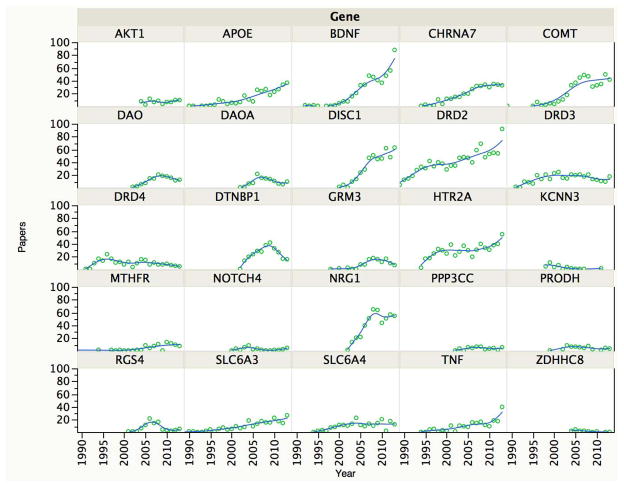
Prior to the genome-wide association era, candidate gene studies were a major approach in schizophrenia genetics. In this invited review, we consider the current status of 25 historical candidate genes for schizophrenia (for example, COMT, DISC1, DTNBP1 and NRG1). The initial study for 24 of these genes explicitly evaluated common variant hypotheses about schizophrenia. Our evaluation included a meta-analysis of the candidate gene literature, incorporation of the results of the largest genomic study yet published for schizophrenia, ratings from informed researchers who have published on these genes, and ratings from 24 schizophrenia geneticists. On the basis of current empirical evidence and mostly consensual assessments of informed opinion, it appears that the historical candidate gene literature did not yield clear insights into the genetic basis of schizophrenia. A likely reason why historical candidate gene studies did not achieve their primary aims is inadequate statistical power. However, the considerable efforts embodied in these early studies unquestionably set the stage for current successes in genomic approaches to schizophrenia.
Conflict of interest statement
The authors report no conflicts.
Figures
References
-
- Sullivan PF, Kendler KS, Neale MC. Schizophrenia as a complex trait: evidence from a meta-analysis of twin studies. Arch Gen Psychiatry. 2003;60(12):1187–1192. - PubMed
-
- Allen NC, Bagade S, McQueen MB, Ioannidis JPA, Kavvoura FK, Khoury MJ, et al. Systematic meta-analyses and field synopsis of genetic association studies in schizophrenia: the SzGene database. Nat Genet. 2008;40(18583979):827–834. - PubMed
-
- Lander ES, Linton LM, Birren B, Nusbaum C, Zody MC, Baldwin J, et al. Initial sequencing and analysis of the human genome. Nature. 2001;409(6822):860–921. - PubMed
Publication types
MeSH terms
Grants and funding
LinkOut - more resources
Full Text Sources
Other Literature Sources
Medical
Miscellaneous
