


Treatment and demographic factors affecting time to next pulmonary exacerbation in cystic fibrosis
- PMID: 25754096
- PMCID: PMC4561033
- DOI: 10.1016/j.jcf.2015.02.007
Treatment and demographic factors affecting time to next pulmonary exacerbation in cystic fibrosis
Abstract
Background: Pulmonary exacerbations (PEx) are important CF clinical events.
Methods: We studied time to next PEx following intravenous (IV) antibiotic PEx treatment among Cleveland Ohio CF center patients occurring between January 2010 and September 2014. Patient demographics, clinical presentations, and treatments were modeled by Cox proportional hazards regression to identify covariates associated with time to next PEx.
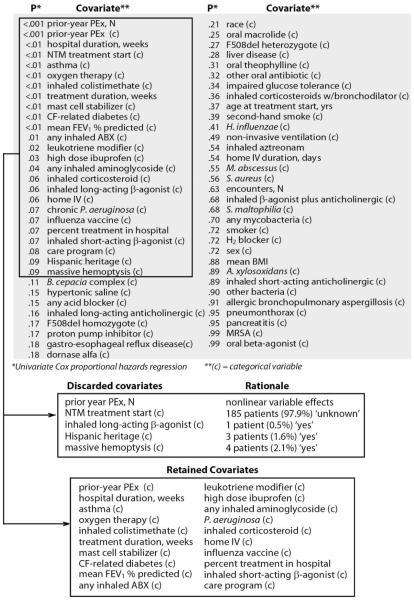
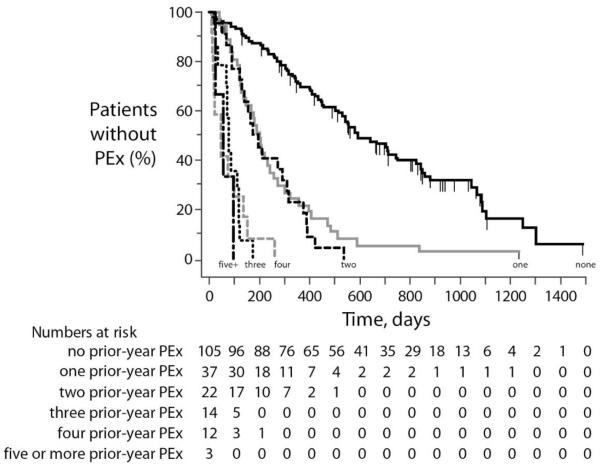
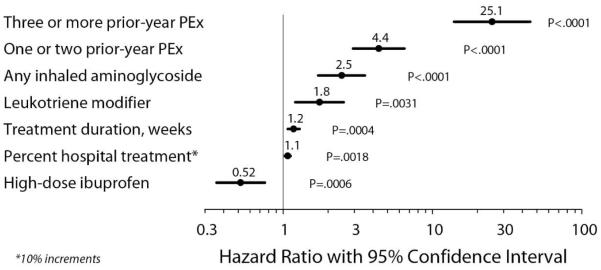
Results: 193 patients were treated for PEx; 155 had a subsequent IV-treated PEx. Six covariates were associated with future PEx hazard: number of PEx in the prior year (hazard ratio 25.1 for ≥3 and 4.4 for 1-2 prior-year PEx versus none; P<.0001), IV treatment duration in weeks (1.2; P=.0004), percent hospital treatment (1.1; P=.0018), and chronic inhaled aminoglycosides (2.5; P<.0001), leukotriene modifiers (1.8; P=.0031), and high dose ibuprofen (0.52; P=.0006).
Conclusions: Time to next PEx was profoundly associated with prior-year PEx, suggestive of high-risk PEx phenotypes that warrant recognition and further study.
Keywords: Cystic fibrosis; Pulmonary exacerbation phenotype.
Copyright © 2015 European Cystic Fibrosis Society. Published by Elsevier B.V. All rights reserved.
Figures
Comment in
-
The epidemiology of poor outcomes after pulmonary exacerbations.J Cyst Fibros. 2015 Nov;14(6):679-80. doi: 10.1016/j.jcf.2015.10.002. Epub 2015 Oct 21. J Cyst Fibros. 2015. PMID: 26476777 No abstract available.
References
-
- Ferkol T, Rosenfeld M, Milla CE. Cystic fibrosis pulmonary exacerbations. J Pediatr. 2006 Feb;148(2):259–64. Review. - PubMed
-
- Konstan M, Morgan W, Butler S, Pasta D, Craib M, Silva S, et al. Risk factors for rate of decline in forced expiratory volume in one second in children and adolescents with cystic fibrosis. J Pediatr. 2007;151:134–139. 139. - PubMed
-
- Amadori A, Antonelli A, Balteri I, Schreiber A, Bugiani M, De Rose V. Recurrent exacerbations affect FEV(1) decline in adult patients with cystic fibrosis. Respir Med. 2009 Mar;103(3):407–13. - PubMed
Publication types
MeSH terms
Substances
Grants and funding
LinkOut - more resources
Full Text Sources
Other Literature Sources
Medical
