. 2015 Jul;172(13):3341-52.
doi: 10.1111/bph.13122. Epub 2015 Apr 29.

Role of aldehyde dehydrogenase in hypoxic vasodilator effects of nitrite in rats and humans

Affiliations

Role of aldehyde dehydrogenase in hypoxic vasodilator effects of nitrite in rats and humans

Sayqa Arif et al. Br J Pharmacol. 2015 Jul.

Abstract

Background and purpose: Hypoxic conditions favour the reduction of nitrite to nitric oxide (NO) to elicit vasodilatation, but the mechanism(s) responsible for bioconversion remains ill defined. In the present study, we assess the role of aldehyde dehydrogenase 2 (ALDH2) in nitrite bioactivation under normoxia and hypoxia in the rat and human vasculature.

Experimental approach: The role of ALDH2 in vascular responses to nitrite was studied using rat thoracic aorta and gluteal subcutaneous fat resistance vessels from patients with heart failure (HF; 16 patients) in vitro and by measurement of changes in forearm blood flow (FBF) during intra-arterial nitrite infusion (21 patients) in vivo. Specifically, we investigated the effects of (i) ALDH2 inhibition by cyanamide or propionaldehyde and the (ii) tolerance-independent inactivation of ALDH2 by glyceryl trinitrate (GTN) on the vasodilator activity of nitrite. In each setting, nitrite effects were measured via evaluation of the concentration-response relationship under normoxic and hypoxic conditions in the absence or presence of ALDH2 inhibitors.

Key results: Both in rat aorta and human resistance vessels, dilatation to nitrite was diminished following ALDH2 inhibition, in particular under hypoxia. In humans there was a non-significant trend towards attenuation of nitrite-mediated increases in FBF.

Conclusions and implications: In human and rat vascular tissue in vitro, hypoxic nitrite-mediated vasodilatation involves ALDH2. In patients with HF in vivo, the role of this enzyme in nitrite bioactivation is at the most, modest, suggesting the involvement of other more important mechanisms.


Figures

Figure 1
Figure 1
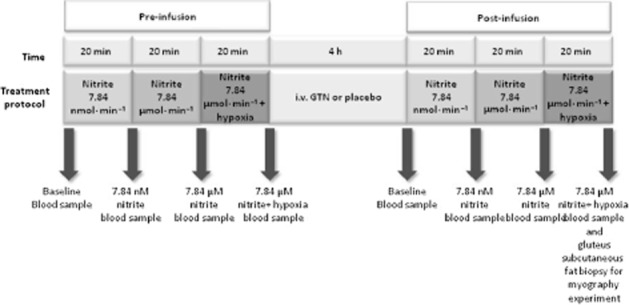
Schematic protocol of the plethysmography study.
Figure 2
Figure 2
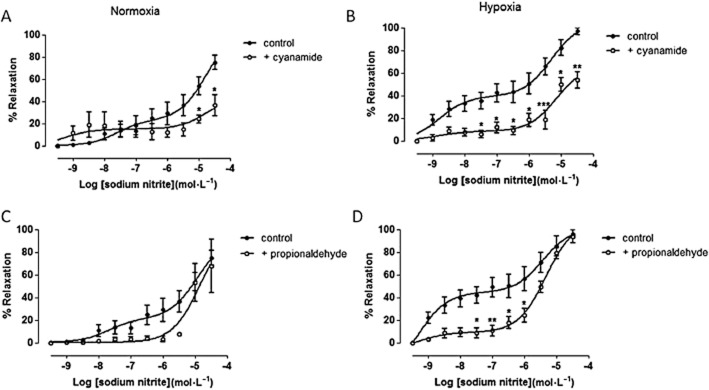
ALDH2 inhibition attenuates nitrite-induced vasorelaxation in rat aortae. Concentration–response curves to sodium nitrite in the presence or absence of ALDH2 inhibitor, cyanamide, during (A) normoxia (n ≥ 5), (B) hypoxia (n ≥ 5), and ALDH2 substrate, propionaldehyde, during (C) normoxia (n ≥ 5) and (D) hypoxia (n ≥ 5). Relaxation is expressed as mean ± SEM percentage reversal of PE-induced tone. *P < 0.05, **P < 0.01 and ***P < 0.001 control versus cyanamide or propionaldehyde by two-way anova.
Figure 3
Figure 3
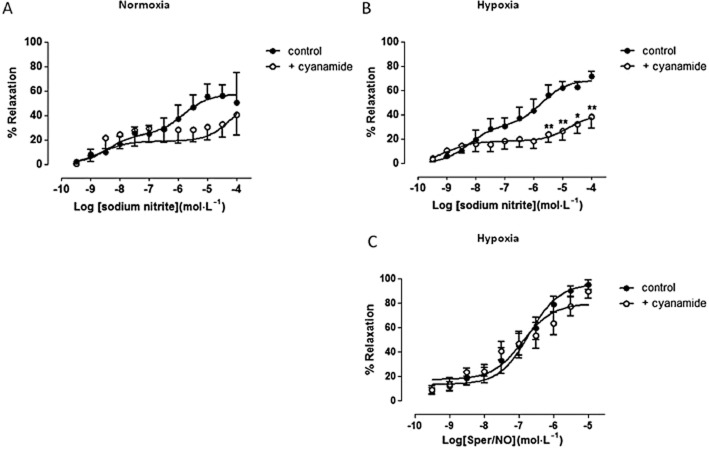
ALDH2 inhibition decreases nitrite-induced vasorelaxation in resistance vessels from HF patients. Concentration–response curve to sodium nitrite in the presence or absence of cyanamide during (A) normoxia (n = 7) and (B) hypoxia (n = 9). (C) Concentration–response curve to Sper/NO in the presence or absence of cyanamide during hypoxic conditions (n ≥ 6). Relaxation is expressed as mean ± SEM percentage reversal of PE-induced tone. *P < 0.05 and **P < 0.01 control versus cyanamide by two-way anova.
Figure 4
Figure 4
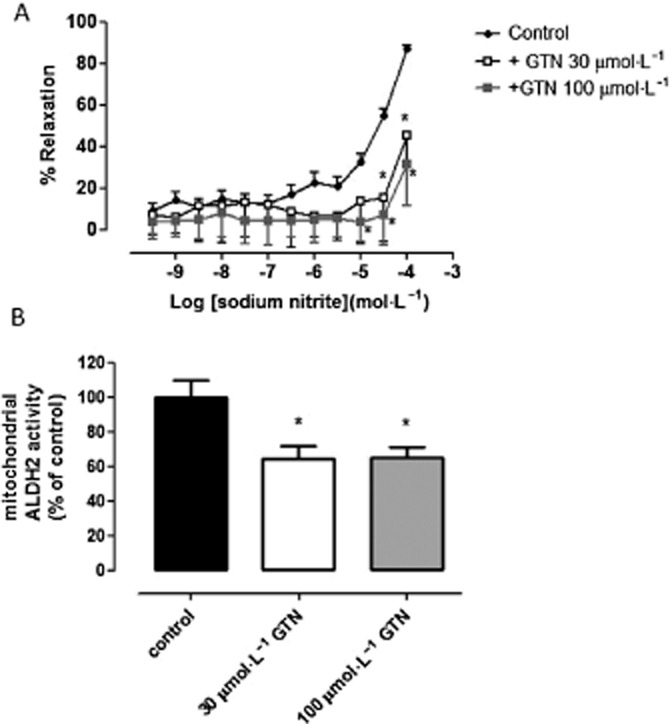
Tolerance-independent inactivation of ALDH2 attenuates vasorelaxation in rat aortae. (A) Concentration–response curve to NaNO2 in the presence or absence of GTN during hypoxic conditions. Relaxation is expressed as mean ± SEM percentage reversal of PE-induced tone (n = 10); *P < 0.05, ***P < 0.001 versus control, two-way anova. (B) The effect of sodium nitrite (control), in the presence or absence of GTN during hypoxic conditions, on mitochondrial ALDH2 activity (mean ± SEM from n = 4–6 animals; *P < 0.05 vs. control by one-way anova).
Figure 5
Figure 5
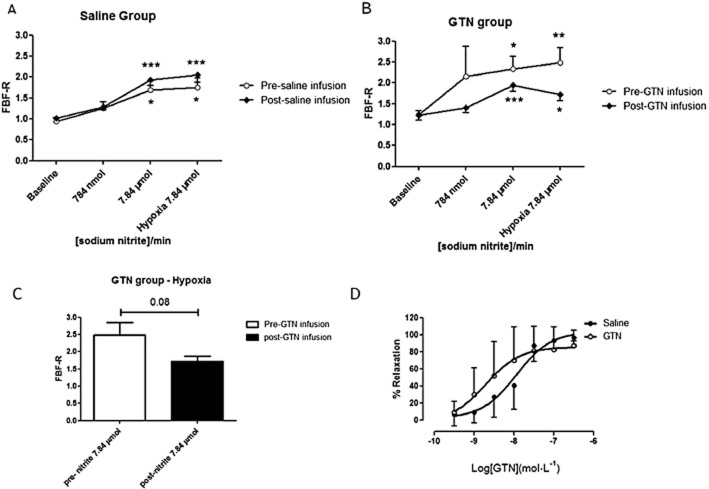
GTN infusion attenuates nitrite-induced vasorelaxation in the resistance vasculature of HF patients. Forearm vasodilator measurements following nitrite infusion in HF patients subjected to 4 h infusion of (A) saline (n = 8 patients) or (B) GTN (n = 11 patients) treatment. *P < 0.05, **P < 0.01, ***P < 0.001 compared with baseline. (C) Comparison of pre- and post-GTN infusion following 7.84 μmol·min−1 sodium nitrite during hypoxic conditions (n = 8 and n = 11 patients, respectively; P = 0.08). (D) Concentration–response curve to GTN in isolated resistance vessels from HF patients (saline n = 7; GTN n = 11 patients).

References

    1. Alexander SPH, Benson HE, Faccenda E, Pawson AJ, Sharman JL, Spedding M, et al. The Concise Guide to PHARMACOLOGY 2013/14: G protein-coupled receptors. Br J Pharmacol. 2013a;170:1459–1581. - PMC - PubMed
    1. Alexander SPH, Benson HE, Faccenda E, Pawson AJ, Sharman JL, Spedding M, et al. The Concise Guide to PHARMACOLOGY 2013/14: enzymes. Br J Pharmacol. 2013b;170:1797–1867. - PMC - PubMed
    1. Angelo M, Singel DJ, Stamler JS. An S-nitrosothiol (SNO) synthase function of hemoglobin that utilizes nitrite as a substrate. Proc Natl Acad Sci U S A. 2006;103:8366–8371. - PMC - PubMed
    1. Badejo AM, Jr, Hodnette C, Dhaliwal JS, Casey DB, Pankey E, Murthy SN, et al. Mitochondrial aldehyde dehydrogenase mediates vasodilator responses of glyceryl trinitrate and sodium nitrite in the pulmonary vascular bed of the rat. Am J Physiol Heart Circ Physiol. 2010;299:H819–H826. - PMC - PubMed
    1. Bailey JC, Feelisch M, Horowitz JD, Frenneaux MP, Madhani M. Pharmacology and therapeutic role of inorganic nitrite and nitrate in vasodilatation. Pharmacol Ther. 2014;144:303–320. - PubMed

Publication types

MeSH terms