Estimating the residency expansion required to avoid projected primary care physician shortages by 2035
- PMID: 25755031
- PMCID: PMC4369588
- DOI: 10.1370/afm.1760
Estimating the residency expansion required to avoid projected primary care physician shortages by 2035
Abstract
Purpose: The purpose of this study was to calculate the projected primary care physician shortage, determine the amount and composition of residency growth needed, and estimate the impact of retirement age and panel size changes.
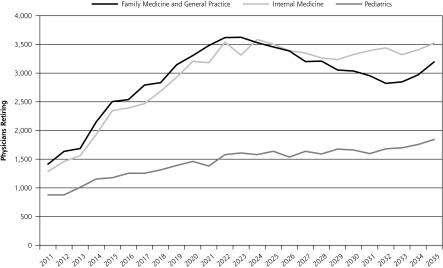
Methods: We used the 2010 National Ambulatory Medical Care Survey to calculate utilization of ambulatory primary care services and the US Census Bureau to project demographic changes. To determine the baseline number of primary care physicians and the number retiring at 66 years, we used the 2014 American Medical Association Masterfile. Using specialty board and American Osteopathic Association figures, we estimated the annual production of primary care residents. To calculate shortages, we subtracted the accumulated primary care physician production from the accumulated number of primary care physicians needed for each year from 2015 to 2035.
Results: More than 44,000 primary care physicians will be needed by 2035. Current primary care production rates will be unable to meet demand, resulting in a shortage in excess of 33,000 primary care physicians. Given current production, an additional 1,700 primary care residency slots will be necessary by 2035. A 10% reduction in the ratio of population per primary care physician would require more than 3,000 additional slots by 2035, whereas changing the expected retirement age from 66 years to 64 years would require more than 2,400 additional slots.
Conclusions: To eliminate projected shortages in 2035, primary care residency production must increase by 21% compared with current production. Delivery models that shift toward smaller ratios of population to primary care physicians may substantially increase the shortage.
Keywords: graduate medical education; health policy; health services research; internship and residency.
© 2015 Annals of Family Medicine, Inc.
Figures
References
-
- Brownlee S. Overtreated. New York, NY: Bloomsbury; 2007.
-
- Berwick DM, Hackbarth AD. Eliminating waste in US health care. JAMA. 2012;307(14):1513–1516. - PubMed
-
- Johnson PJ, Ghildayal N, Ward AC, Westgard BC, Boland LL, Hokanson JS. Disparities in potentially avoidable emergency department (ED) care: ED visits for ambulatory care sensitive conditions. Med Care. 2012;50(12):1020–1028. - PubMed
-
- Phillips RL, Pugno PA, Saultz JW, et al. Health is primary: family medicine for America’s health. Ann Fam Med. 2014;12(Suppl_1):S1–S12 http://annfammed.org/content/12/Suppl_1. - PMC - PubMed
MeSH terms
LinkOut - more resources
Full Text Sources
Other Literature Sources
Medical