


Histological and immunohistochemical markers for progression prediction in transurethrally resected high-grade non-muscle invasive bladder cancer
- PMID: 25755769
- PMCID: PMC4348879
Histological and immunohistochemical markers for progression prediction in transurethrally resected high-grade non-muscle invasive bladder cancer
Abstract
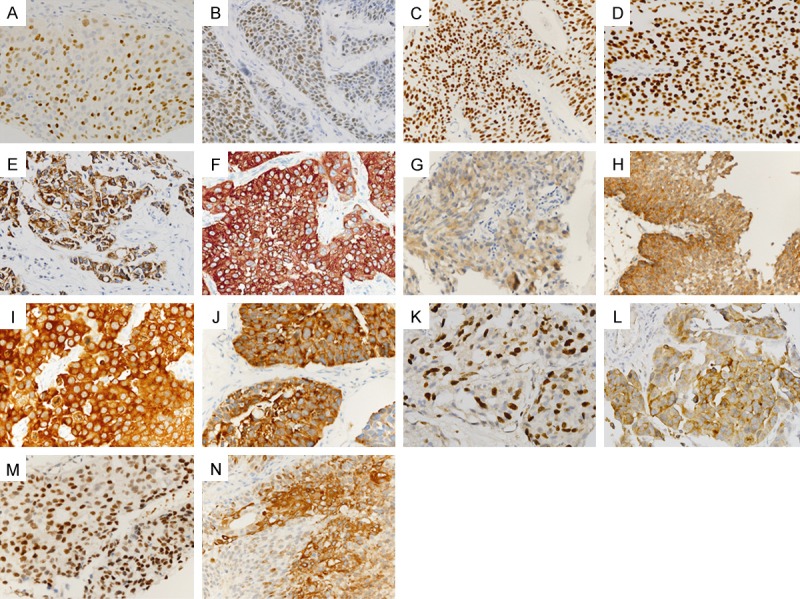
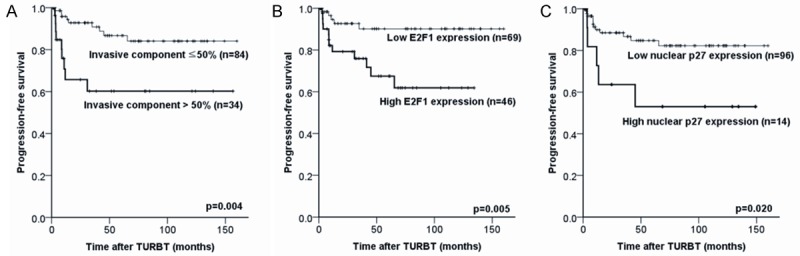
High-grade non-muscle-invasive bladder cancer (Non-MIBC) has a high risk of stage progression to muscle-invasive bladder cancer (MIBC) and could be managed either conservatively by transurethral resection of bladder tumor (TURBT) or more aggressively by radical cystectomy. The selection of patients who may benefit from early radical intervention is a challenge. To define useful prognostic markers for progression, we analyzed clinicopathological features and immunohistochemical expression patterns of E2F1, p27, survivin, p53, EZH2, IMP3, TSC1/hamartin, fatty acid synthase, androgen receptor, 14-3-3σ, MAGEA4, and NY-ESO-1 on 118 cases of high-grade Non-MIBC. During the mean follow-up period of 64.3 months, progression occurred in 18 patients (15.3%). Histologically, large amount of invasive component (> 50%) was noted in 35 cases (29.7%) and was strongly associated with progression. Among the 12 biomarkers, high expressions of E2F1 and nuclear p27 were noted in 46 cases (40.0%) and 14 cases (12.7%), respectively, and were associated with frequent progression. Using multivariate analysis, the proportion of invasive component and high E2F1 expression were independent prognostic factors for the prediction of progression. Our results indicated that large amount of invasive carcinoma component and high expressions of p27 and E2F1 were predictive markers for progression in Non-MIBC. Therefore, we suggest that these parameters, especially proportion of invasive carcinoma component and E2F1 expression, should be evaluated during pathologic examination and considered during selection of the appropriate management strategy for high grade Non-MIBC patients.
Keywords: Bladder cancer; high-grade; non-muscle-invasive bladder cancer; progression; urothelial carcinoma.
Figures
References
-
- Ferlay J, Soerjomataram I, Dikshit R, Eser S, Mathers C, Rebelo M, Parkin DM, Forman DD, Bray F. Cancer incidence and mortality worldwide: Sources, methods and major patterns in GLOBOCAN 2012. Int J Cancer. 2015;136:E359–86. - PubMed
-
- Lamm D, Persad R, Brausi M, Buckley R, Witjes JA, Palou J, Böhle A, Kamat AM, Colombel M, Soloway M. Defining progression in nonmuscle invasive bladder cancer: it is time for a new, standard definition. J Urol. 2014;191:20–27. - PubMed
-
- Sylvester RJ, van der Meijden AP, Oosterlinck W, Witjes JA, Bouffioux C, Denis L, Newling DW, Kurth K. Predicting recurrence and progression in individual patients with stage Ta T1 bladder cancer using EORTC risk tables: a combined analysis of 2596 patients from seven EORTC trials. Eur Urol. 2006;49:466–75. discussion 475-7. - PubMed
-
- van Rhijn BW, Burger M, Lotan Y, Solsona E, Stief CG, Sylvester RJ, Witjes JA, Zlotta AR. Recurrence and progression of disease in non-muscle-invasive bladder cancer: from epidemiology to treatment strategy. Eur Urol. 2009;56:430–42. - PubMed
MeSH terms
Substances
LinkOut - more resources
Full Text Sources
Other Literature Sources
Medical
Research Materials
Miscellaneous