Wild plant species growing closely connected in a subalpine meadow host distinct root-associated bacterial communities
- PMID: 25755932
- PMCID: PMC4349149
- DOI: 10.7717/peerj.804
Wild plant species growing closely connected in a subalpine meadow host distinct root-associated bacterial communities
Abstract
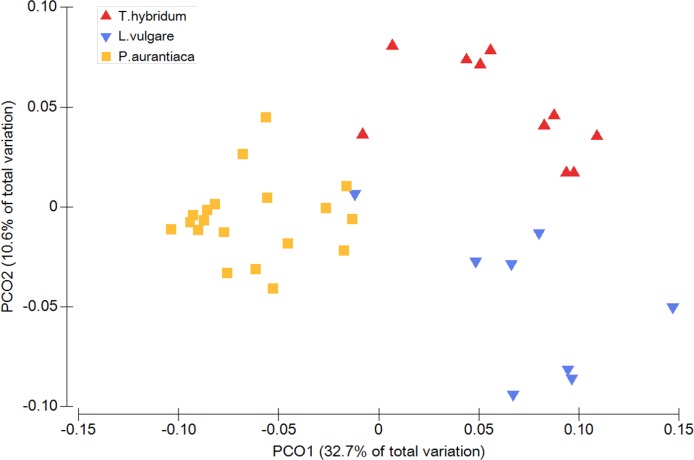
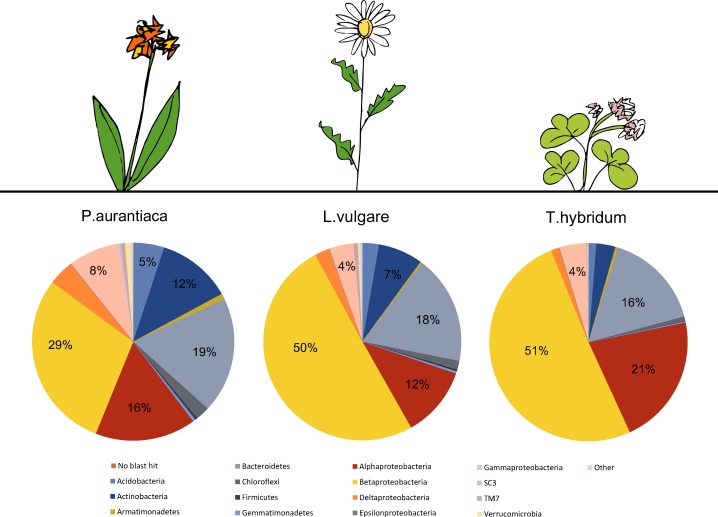
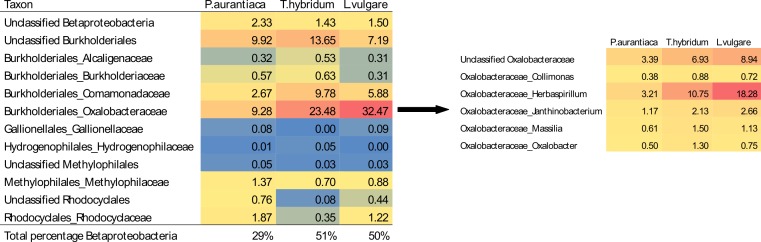
Plant roots are known to harbor large and diverse communities of bacteria. It has been suggested that plant identity can structure these root-associated communities, but few studies have specifically assessed how the composition of root microbiota varies within and between plant species growing under natural conditions. We assessed the community composition of endophytic and epiphytic bacteria through high throughput sequencing using 16S rDNA derived from root tissues collected from a population of a wild, clonal plant (Orange hawkweed-Pilosella aurantiaca) as well as two neighboring plant species (Oxeye daisy-Leucanthemum vulgare and Alsike clover-Trifolium hybridum). Our first goal was to determine if plant species growing in close proximity, under similar environmental conditions, still hosted unique root microbiota. Our results showed that plants of different species host distinct bacterial communities in their roots. In terms of community composition, Betaproteobacteria (especially the family Oxalobacteraceae) were found to dominate in the root microbiota of L. vulgare and T. hybridum samples, whereas the root microbiota of P. aurantiaca had a more heterogeneous distribution of bacterial abundances where Gammaproteobacteria and Acidobacteria occupied a larger portion of the community. We also explored the extent of individual variance within each plant species investigated, and found that in the plant species thought to have the least genetic variance among individuals (P. aurantiaca) still hosted just as diverse microbial communities. Whether all plant species host their own distinct root microbiota and plants more closely related to each other share more similar bacterial communities still remains to be fully explored, but among the plants examined in this experiment there was no trend that the two species belonging to the same family shared more similarities in terms of bacterial community composition.
Keywords: Bacteria; Host effect; Pilosella aurantiaca; Plant identity; Rhizosphere; Root microbiota.
Conflict of interest statement
The authors declare there are no competing interests.
Figures
References
-
- Aleklett K, Hart M. The root microbiota—a fingerprint in the soil? Plant and Soil. 2013;370:671–686. doi: 10.1007/s11104-013-1647-7. - DOI
-
- Alford ÉR, Vivanco JM, Paschke MW. The effects of flavonoid allelochemicals from knapweeds on legume-rhizobia candidates for restoration. Restoration Ecology. 2009;17:506–514. doi: 10.1111/j.1526-100X.2008.00405.x. - DOI
-
- Anderson MJ. 2004. PERMDISP: a FORTRAN computer program for permutational analysis of multivariate dispersions (for any two-factor ANOVA design) using permutation tests.
-
- Anderson MJ. 2005. PERMANOVA: a FORTRAN computer program for permutational multivariate analysis of variance.
LinkOut - more resources
Full Text Sources
Other Literature Sources