. 2015 Feb 14;16(1):78.
doi: 10.1186/s12864-015-1289-7.

The evolutionary and functional diversity of classical and lesser-known cytoplasmic and organellar translational GTPases across the tree of life

The evolutionary and functional diversity of classical and lesser-known cytoplasmic and organellar translational GTPases across the tree of life

Gemma Catherine Atkinson. BMC Genomics. .

Abstract

Background: The ribosome translates mRNA to protein with the aid of a number of accessory protein factors. Translational GTPases (trGTPases) are an integral part of the 'core set' of essential translational factors, and are some of the most conserved proteins across life. This study takes advantage of the wealth of available genomic data, along with novel functional information that has come to light for a number of trGTPases to address the full evolutionary and functional diversity of this superfamily across all domains of life.

Results: Through sensitive sequence searching combined with phylogenetic analysis, 57 distinct subfamilies of trGTPases are identified: 14 bacterial, 7 archaeal and 35 eukaryotic (of which 21 are known or predicted to be organellar). The results uncover the functional evolution of trGTPases from before the last common ancestor of life on earth to the current day.

Conclusions: While some trGTPases are universal, others are limited to certain taxa, suggesting lineage-specific translational control mechanisms that exist on a base of core factors. These lineage-specific features may give organisms the ability to tune their translation machinery to respond to their environment. Only a fraction of the diversity of the trGTPase superfamily has been subjected to experimental analyses; this comprehensive classification brings to light novel and overlooked translation factors that are worthy of further investigation.


Figures
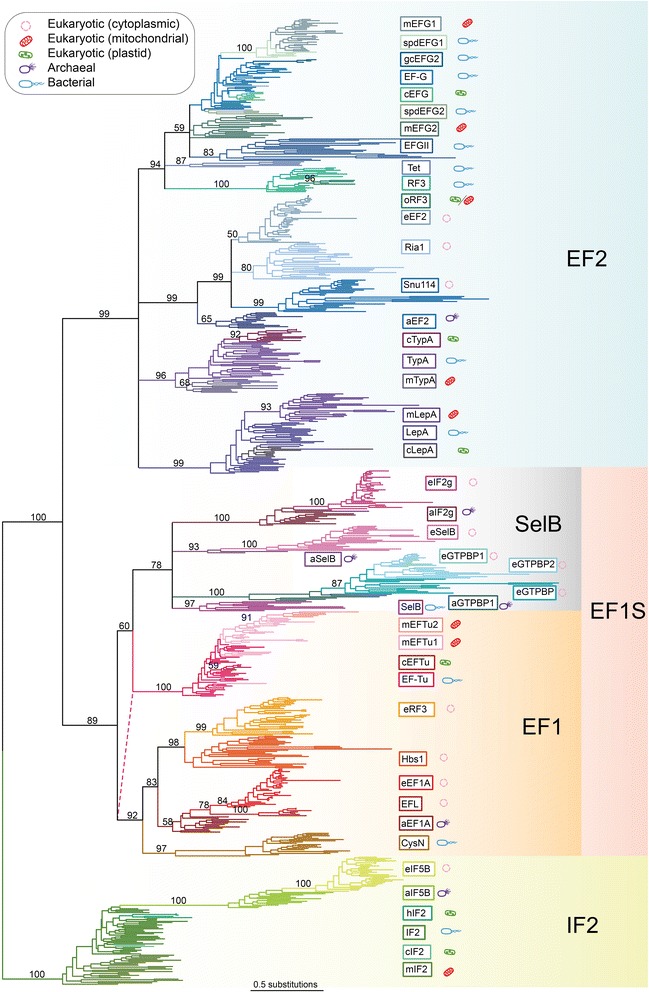
Figure 1
Figure 1
The trGTPase superfamily tree. The tree shown is an unrooted maximum likelihood phylogeny of trGTPase subfamilies from across the tree of life. Numbers on branches show bootstrap support from 100 replicates. Nodes separating subfamilies with less than 50% bootstrap support have been collapsed. The pink dotted line shows an alternative position for the clade containing bacterial and organellar EF-Tu, as supported by operon structure. Branch lengths are proportional to the number of amino acid substitutions (see lower scale bar). The icon next to the subfamily name indicates the domain of life and known or predicted subcellular compartment in which that trGTPase is found, as per the inset box.
Figure 2
Figure 2
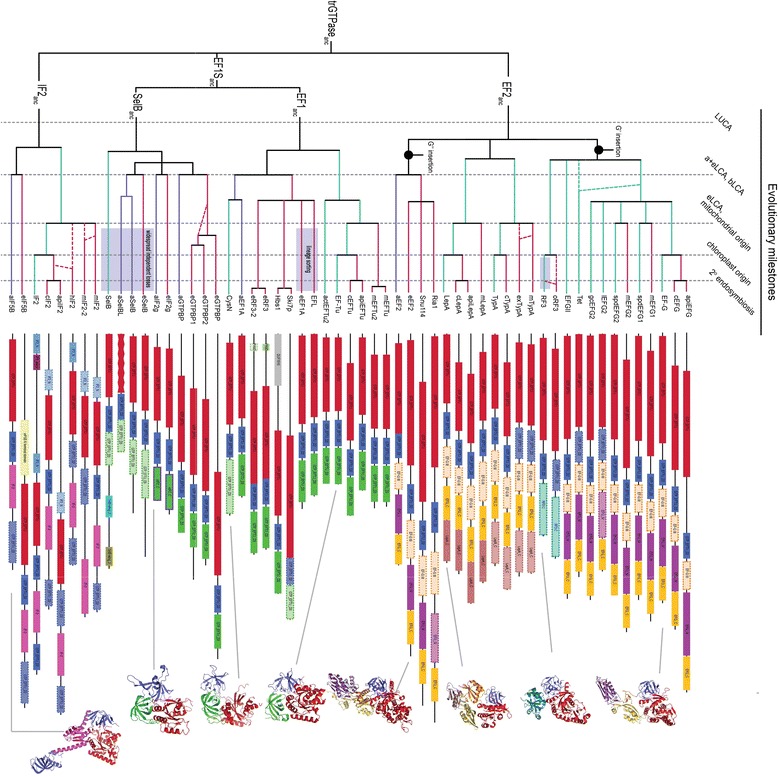
Relative timeline of trGTPase diversification. The diagram summarizes evidence from phylogenetic relationships, domain architecture, transit peptide prediction and taxonomic distributions to show the relative divergence times of trGTPase families and subfamilies. Vertical dotted lines indicate major milestones in the evolution and diversification of life on earth, while horizontal branches are lineages of trGTPases in bacteria (green), archaea (blue) and eukaryotes (red). The subscript protein name suffix “anc” stands for ancestral. The tree assumes that archaea and eukaryotes share a common relative to the exclusion of bacteria. Branch lengths and time between ancestors are not to scale. Branches with dashed lines show uncertainties in relationships, and shading shows cases of particularly high lineage specific loss. LCA stands for last common ancestor, with bLCA being the ancestor of bacteria, eLCA being the ancestor of eukaryotes, aLCA being the ancestor of archaea, and a+eLCA being the ancestor of all archaea and eukaryotes. Typical subfamily domain structures are shown to the right of the tree. Boxes with solid borders show domains that are predicted with PFam. Where the domains are present but do not hit PFam HMMs, the boxes are shown with dotted borders. The G domain (Pfam name GTP_EFTU) of aSelbL is shown with an undulating border to indicate particular divergence in this subfamily. Protein structures are shown on the far right, and are linked with a grey line to their respective subfamily. Protein Data Bank IDs for the structures are as follows: EF-G: 1DAR [14], RF3: 2H5E [15], LepA: 2YWE, eEF2: 1N0V [16], EF-Tu: 1EXM [17], CysN: 1ZUN [18], aIF2g: 3PEN, aIF5B: 1G7R [19].

References

    1. Verstraeten N, Fauvart M, Versées W, Michiels J. The universally conserved prokaryotic GTPases. Microbiol Mol Biol Rev. 2011;75(3):507–42. - PMC - PubMed
    1. Noble CG, Song H. Structural studies of elongation and release factors. Cell Mol Life Sci. 2008;65(9):1335–46. - PMC - PubMed
    1. Voorhees RM, Ramakrishnan V. Structural basis of the translational elongation cycle. Annu Rev Biochem. 2013;82:203–36. - PubMed
    1. Aitken CE, Lorsch JR. A mechanistic overview of translation initiation in eukaryotes. Nat Struct Mol Biol. 2012;19(6):568–76. - PubMed
    1. Myasnikov AG, Simonetti A, Marzi S, Klaholz BP. Structure-function insights into prokaryotic and eukaryotic translation initiation. Curr Opin Struct Biol. 2009;19(3):300–9. - PubMed

Publication types

Substances

LinkOut - more resources