


Fibroblasts from patients with major depressive disorder show distinct transcriptional response to metabolic stressors
- PMID: 25756806
- PMCID: PMC4354345
- DOI: 10.1038/tp.2015.14
Fibroblasts from patients with major depressive disorder show distinct transcriptional response to metabolic stressors
Abstract
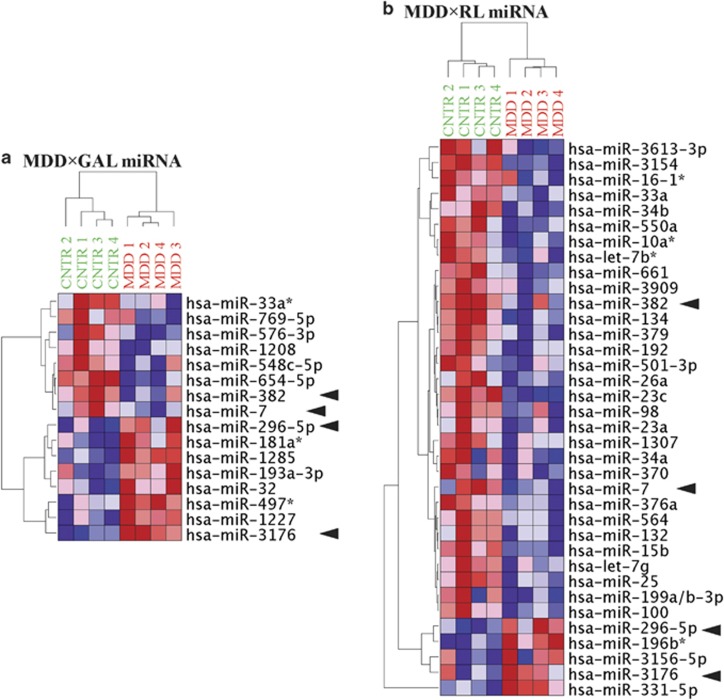
Major depressive disorder (MDD) is increasingly viewed as interplay of environmental stressors and genetic predisposition, and recent data suggest that the disease affects not only the brain, but the entire body. As a result, we aimed at determining whether patients with major depression have aberrant molecular responses to stress in peripheral tissues. We examined the effects of two metabolic stressors, galactose (GAL) or reduced lipids (RL), on the transcriptome and miRNome of human fibroblasts from 16 pairs of patients with MDD and matched healthy controls (CNTR). Our results demonstrate that both MDD and CNTR fibroblasts had a robust molecular response to GAL and RL challenges. Most importantly, a significant part (messenger RNAs (mRNAs): 26-33%; microRNAs (miRNAs): 81-90%) of the molecular response was only observed in MDD, but not in CNTR fibroblasts. The applied metabolic challenges uncovered mRNA and miRNA signatures, identifying responses to each stressor characteristic for the MDD fibroblasts. The distinct responses of MDD fibroblasts to GAL and RL revealed an aberrant engagement of molecular pathways, such as apoptosis, regulation of cell cycle, cell migration, metabolic control and energy production. In conclusion, the metabolic challenges evoked by GAL or RL in dermal fibroblasts exposed adaptive dysfunctions on mRNA and miRNA levels that are characteristic for MDD. This finding underscores the need to challenge biological systems to bring out disease-specific deficits, which otherwise might remain hidden under resting conditions.
Figures


References
-
- Verhoeven JE, Revesz D, Wolkowitz OM, Penninx BW. Cellular aging in depression: permanent imprint or reversible process? An overview of the current evidence, mechanistic pathways, and targets for interventions. Bioessays. 2014;36:968–978. - PubMed
-
- Klengel T, Binder EB. Gene-environment interactions in major depressive disorder. Can J Psychiatry. 2013;58:76–83. - PubMed
-
- Mahar I, Bambico FR, Mechawar N, Nobrega JN. Stress serotonin, and hippocampal neurogenesis in relation to depression and antidepressant effects. Neurosci Biobehav Rev. 2014;38:173–192. - PubMed
-
- Galluzzi L, Kepp O, Trojel-Hansen C, Kroemer G. Mitochondrial control of cellular life, stress, and death. Circ Res. 2012;111:1198–1207. - PubMed
Publication types
MeSH terms
Substances
Grants and funding
LinkOut - more resources
Full Text Sources
Other Literature Sources
Research Materials
