


Effect of extended-release naltrexone on striatal dopamine transporter availability, depression and anhedonia in heroin-dependent patients
- PMID: 25757673
- PMCID: PMC4480848
- DOI: 10.1007/s00213-015-3891-4
Effect of extended-release naltrexone on striatal dopamine transporter availability, depression and anhedonia in heroin-dependent patients
Abstract
Rationale: Extended-release naltrexone (XRNT), an opioid receptor antagonist, is successfully used in the treatment of opioid dependence. However, naltrexone treatment of opioid-dependent patients may reduce striatal dopamine transporter (DAT) availability and cause depression and anhedonia.
Objectives: The aim of this study is to investigate changes in striatal DAT availability and symptoms of depression (Beck Depression Inventory (BDI)) and anhedonia (Snaith Hamilton Pleasure Scale (SHAPS)) before and during XRNT treatment.
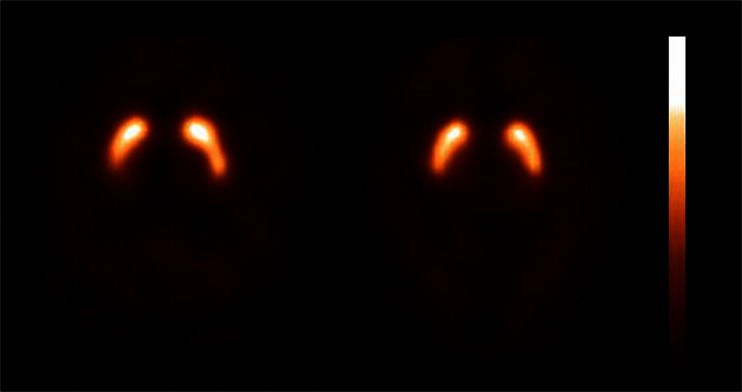
Methods: At baseline, ten detoxified heroin-dependent patients and 11 matched healthy controls underwent [(123)I]FP-CIT single photon emission computed tomography (SPECT) imaging to assess striatal DAT binding. Patients underwent a second SPECT scan 2 weeks after an intramuscular injection with XRNT.
Results: At baseline, the mean binding potential (BPND) in the putamen was at a trend level lower and the mean BDI score was significantly higher in heroin patients (n = 10) than in controls (n = 11) (3.45 ± 0.88 vs. 3.80 ± 0.61, p = 0.067, d = -0.48 and 12.75 ± 7.40 vs. 5.20 ± 4.83, p = 0.019, d = 1.24, respectively). Post hoc analyses in subgroups with negative urine analyses for opioids and cocaine showed significantly lower baseline putamen BPND in heroin patients (n = 8) than controls (n = 10) (3.19 ± 0.43 vs. 3.80 ± 0.64, p = 0.049, d = -1.03). XRNT treatment in heroin patients was not significantly associated with changes in striatal DAT availability (p = 0.348, d = 0.48), but the mean BDI score after XRNT treatment was significantly lower than before treatment (7.75 ± 7.21 vs. 12.75 ± 7.40, p = 0.004, d = -0.68).
Conclusions: The results of this study suggest that XRNT treatment does not reduce striatal DAT availability and has no significant effect on anhedonia, but is associated with a significant reduction of depressive symptoms.
Figures
References
-
- Arnou RC, Meagher MW, Norris MP, Bramson R (2001) Psychometric evaluation of the beck depression inventory-II with primary care medical patients. Health Psychol 20:112–119 - PubMed
-
- Bergstrom K, Jolkkonen J, Kuikka JT, Akerman KK, Viinamaki H, Airaksinen O, Lansimies E, Tiihonen J (1998) Fentanyl decreases β-CIT binding to the dopamine transporter. Synapse 29:413–415 - PubMed
-
- Bhargava HN, Gudehithlu KP (1996) Chronic blockade of opioid receptors alters the binding of [3H]GBR 12935 to dopamine transporter in rat brain regions and spinal cord. Pharmacology 52:243–251 - PubMed
-
- Booij J, Kemp P (2008) Dopamine transporter imaging with [123I]FP-CIT SPECT: potential effects of drugs. Eur J Nucl Med Mol Imaging 35:424–438 - PubMed
Publication types
MeSH terms
Substances
LinkOut - more resources
Full Text Sources
Other Literature Sources
Medical
