


Ipsilateral hippocampal atrophy is associated with long-term memory dysfunction after ischemic stroke in young adults
- PMID: 25757914
- PMCID: PMC6869088
- DOI: 10.1002/hbm.22782
Ipsilateral hippocampal atrophy is associated with long-term memory dysfunction after ischemic stroke in young adults
Abstract
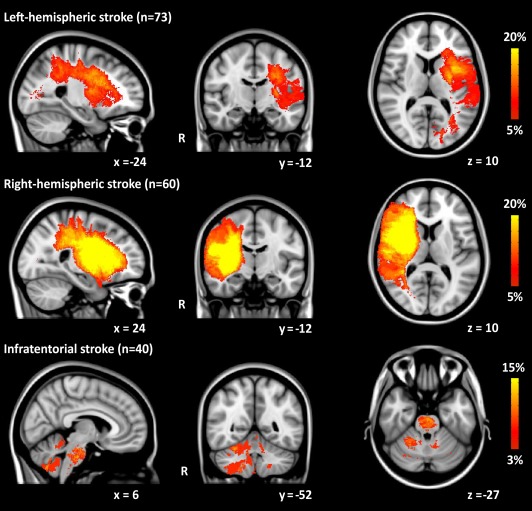
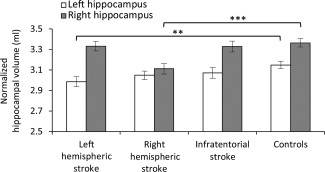
Memory impairment after stroke in young adults is poorly understood. In elderly stroke survivors memory impairments and the concomitant loss of hippocampal volume are usually explained by coexisting neurodegenerative disease (e.g., amyloid pathology) in interaction with stroke. However, neurodegenerative disease, such as amyloid pathology, is generally absent at young age. Accumulating evidence suggests that infarction itself may cause secondary neurodegeneration in remote areas. Therefore, we investigated the relation between long-term memory performance and hippocampal volume in young patients with first-ever ischemic stroke. We studied all consecutive first-ever ischemic stroke patients, aged 18-50 years, admitted to our academic hospital center between 1980 and 2010. Episodic memory of 173 patients was assessed using the Rey Auditory Verbal Learning Test and the Rey Complex Figure and compared with 87 stroke-free controls. Hippocampal volume was determined using FSL-FIRST, with manual correction. On average 10 years after stroke, patients had smaller ipsilateral hippocampal volumes compared with controls after left-hemispheric stroke (5.4%) and right-hemispheric stroke (7.7%), with most apparent memory dysfunctioning after left-hemispheric stroke. A larger hemispheric stroke was associated with a smaller ipsilateral hippocampal volume (b=-0.003, P<0.0001). Longer follow-up duration was associated with smaller ipsilateral hippocampal volume after left-hemispheric stroke (b=-0.028 ml, P=0.002) and right-hemispheric stroke (b=-0.015 ml, P=0.03). Our results suggest that infarction is associated with remote injury to the hippocampus, which may lower or expedite the threshold for cognitive impairment or even dementia later in life.
Keywords: episodic memory; hippocampal volume; ischemic stroke; young adults.
© 2015 Wiley Periodicals, Inc.
Figures
References
-
- Adams HP, Jr ., Bendixen BH, Kappelle LJ, Biller J, Love BB, Gordon DL, Marsh EE, 3rd (1993): Classification of subtype of acute ischemic stroke. Definitions for use in a multicenter clinical trial. TOAST. Trial of Org 10172 in Acute Stroke Treatment. Stroke 24:35–41. - PubMed
-
- Alessio A, Damasceno BP, Camargo CH, Kobayashi E, Guerreiro CA, Cendes F (2004): Differences in memory performance and other clinical characteristics in patients with mesial temporal lobe epilepsy with and without hippocampal atrophy. Epilepsy Behav 5:22–27. - PubMed
-
- Andersson JLR, Jenkinson M, Smith S (2007): Non‐Linear Registration, Aka Spatial Normalisation. Technical Report TR07JA2. Oxford Centre for Functional MRI of the Brain.
-
- Babiloni C, Vecchio F, Mirabella G, Buttiglione M, Sebastiano F, Picardi A, Di Gennaro G, Quarato PP, Grammaldo LG, Buffo P, Esposito V, Manfredi M, Cantore G, Eusebi F (2009): Hippocampal, amygdala, and neocortical synchronization of theta rhythms is related to an immediate recall during rey auditory verbal learning test. Hum Brain Mapp 30:2077–2089. - PMC - PubMed
Publication types
MeSH terms
LinkOut - more resources
Full Text Sources
Other Literature Sources
Medical
