


Two-year survival of patients screened for transcatheter aortic valve replacement with potentially malignant incidental findings in initial body computed tomography
- PMID: 25759083
- PMCID: PMC4463004
- DOI: 10.1093/ehjci/jev055
Two-year survival of patients screened for transcatheter aortic valve replacement with potentially malignant incidental findings in initial body computed tomography
Abstract
Aims: Recently, transcatheter aortic valve replacement (TAVR) has evolved as the standard treatment in patients with inoperable aortic valve stenosis. According to TAVR guidelines, body computed tomography (CT) is recommended for pre-procedural planning. Due to the advanced age of these patients, multiple radiological potentially malignant incidental findings (pmIFs) appear in this cohort. It is unknown how pmIFs influence the decision by the heart team to intervene and the mortality.
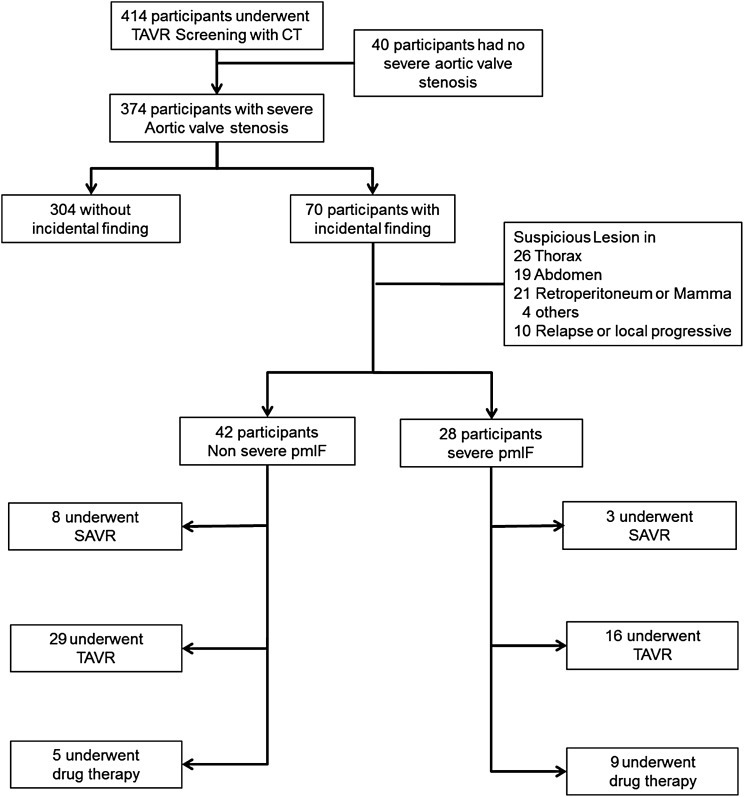
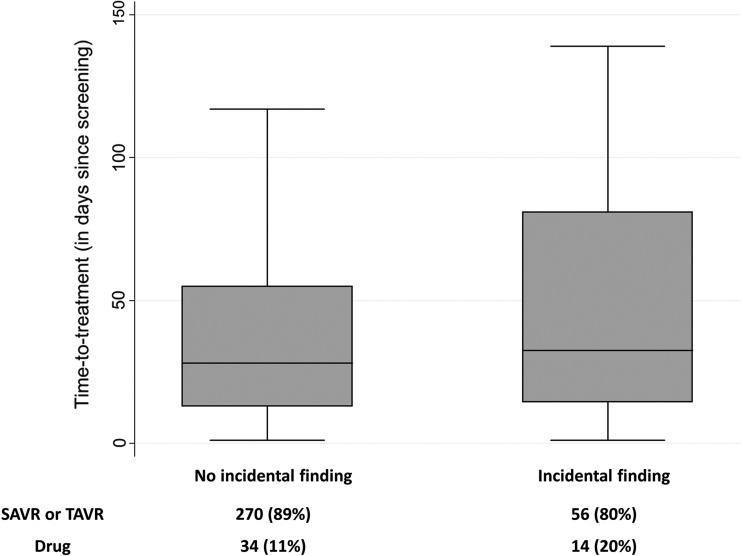
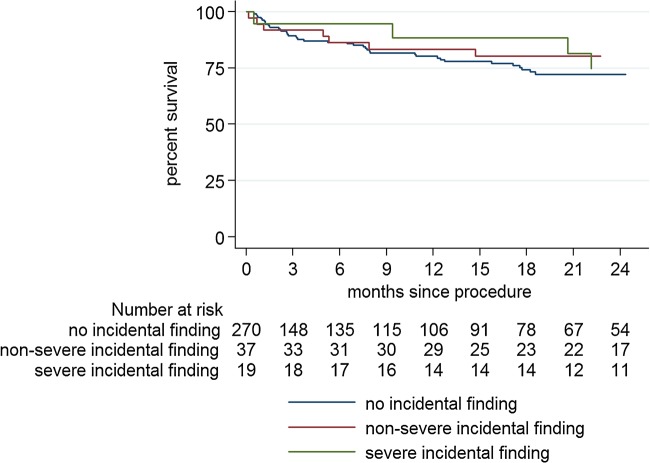
Methods and results: We evaluated in a retrospective single-centre observational study 414 participants screened for TAVR with dual-source CT between October 2010 and December 2012. pmIFs are common and appeared in 18.7% of all patients screened for TAVR. The decision to intervene by TAVR or surgical aortic valve replacement (SAVR) was made by an interdisciplinary heart team and the role of pmIF in decision-making and time to treatment with TAVR or SAVR was analysed, retrospectively. The appearance of a pmIF vs. no pmIF did not significantly influence therapeutic decisions [odds ratio (OR) 1.14; P = 0.835] or time to treatment (91 ± 152 vs. 61 ± 109 days, respectively). Several findings, which are highly suspicious for malignancy, were less likely associated with invasive treatment (OR 0.207; P = 0.046). Patient survival was evaluated for at least 2 years until January 2014. Two-year survival of patients after TAVR or SAVR, treated according to the heart team decision, was ∼75% and independent from the presence of a non-severe (P = 0.923) or severe (P = 0.823) pmIF.
Conclusion: The study indicates that frequently occurring radiologic pmIF did not influence 2-year survival after a decision to intervene was made by an interdisciplinary heart team.
Keywords: TAVI; TAVR; aortic valve replacement; aortic valve stenosis; cancer; computed tomography; incidental finding; malignancy; mortality.
© The Author 2015. Published by Oxford University Press on behalf of the European Society of Cardiology.
Figures
Comment in
-
Incidental findings in patients screened for transcatheter aortic valve replacement: crystal ball or Pandora's box?Eur Heart J Cardiovasc Imaging. 2015 Jul;16(7):721-2. doi: 10.1093/ehjci/jev112. Epub 2015 May 14. Eur Heart J Cardiovasc Imaging. 2015. PMID: 25976348 No abstract available.
References
-
- Leon MB, Smith CR, Mack M, Miller DC, Moses JW, Svensson LG, et al. Transcatheter aortic-valve implantation for aortic stenosis in patients who cannot undergo surgery. N Engl J Med 2010;363:1597–607. - PubMed
-
- Smith CR, Leon MB, Mack MJ, Miller DC, Moses JW, Svensson LG, et al. Transcatheter versus surgical aortic-valve replacement in high-risk patients. N Engl J Med 2011;364:2187–98. - PubMed
-
- Reinohl J, von Zur Muhlen C, Moser M, Sorg S, Bode C, Zehender M. TAVI 2012: state of the art. J Thromb Thrombolysis 2013;35:419–35. - PubMed
-
- Adams DH, Popma JJ, Reardon MJ, Yakubov SJ, Coselli JS, Deeb GM, et al. Transcatheter aortic-valve replacement with a self-expanding prosthesis. N Engl J Med 2014;370:1790–8. - PubMed
-
- Iung B, Cachier A, Baron G, Messika-Zeitoun D, Delahaye F, Tornos P, et al. Decision-making in elderly patients with severe aortic stenosis: why are so many denied surgery? Eur Heart J 2005;26:2714–20. - PubMed
Publication types
MeSH terms
LinkOut - more resources
Full Text Sources
Other Literature Sources
