


Primary antibiotic resistance of Helicobacter pylori strains isolated from patients with dyspeptic symptoms in Beijing: a prospective serial study
- PMID: 25759550
- PMCID: PMC4351232
- DOI: 10.3748/wjg.v21.i9.2786
Primary antibiotic resistance of Helicobacter pylori strains isolated from patients with dyspeptic symptoms in Beijing: a prospective serial study
Abstract
Aim: To determine the resistance patterns of Helicobacter pylori (H. pylori) strains isolated from patients in Beijing and monitor the change of antibiotic resistance over time.
Methods: In this prospective, serial and cross-sectional study, H. pylori cultures were successfully obtained from 371 and 950 patients (never receiving eradication) during 2009-2010 and 2013-2014, respectively. Resistance to amoxicillin, clarithromycin, metronidazole, levofloxacin, tetracycline, and rifampicin was determined by Epsilometer test.
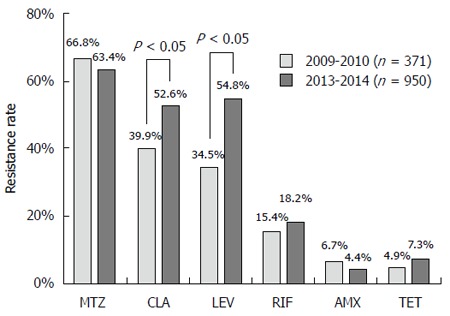
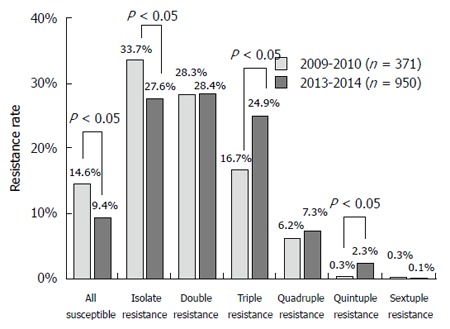
Results: The resistance rates of isolates obtained during 2009-2010 were 66.8%, 39.9%, 34.5%, 15.4%, 6.7%, and 4.9% to metronidazole, clarithromycin, levofloxacin, rifampicin, amoxicillin and tetracycline, respectively; and the corresponding rates for isolates during 2013-2014 were 63.4%, 52.6%, 54.8%, 18.2%, 4.4% and 7.3%, respectively. The resistance rates to clarithromycin and levofloxacin were significantly increased after four years. In 2009-2010, 14.6% of H. pylori isolates were susceptible to all tested antibiotics, with mono (33.7%), double (28.3%), triple (16.7%), quadruple (6.2%), quintuple (0.3%) and sextuple resistance (0.3%) also being detected. In 2013-2014, 9.4% were susceptible to all tested antibiotics, and mono (27.6%), double (28.4%), triple (24.9%), quadruple (7.3%), quintuple (2.3%) and sextuple resistance (0.1%) was also observed. More multiple resistant H. pylori isolates were found during 2013-2014. Gender (to levofloxacin and metronidazole), age (to levofloxacin) and endoscopic findings (to clarithromycin) were independent factors influencing antibiotic resistance.
Conclusion: H. pylori resistance to commonly used antibiotics in Beijing is high with increased multiple antibiotic resistance.
Keywords: Antibiotic resistance; Beijing; Dyspeptic symptoms; Helicobacter pylori.
Figures
References
-
- Graham DY, Fischbach L. Helicobacter pylori treatment in the era of increasing antibiotic resistance. Gut. 2010;59:1143–1153. - PubMed
-
- Malfertheiner P, Megraud F, O’Morain CA, Atherton J, Axon AT, Bazzoli F, Gensini GF, Gisbert JP, Graham DY, Rokkas T, et al. Management of Helicobacter pylori infection--the Maastricht IV/ Florence Consensus Report. Gut. 2012;61:646–664. - PubMed
-
- Fock KM, Katelaris P, Sugano K, Ang TL, Hunt R, Talley NJ, Lam SK, Xiao SD, Tan HJ, Wu CY, et al. Second Asia-Pacific Consensus Guidelines for Helicobacter pylori infection. J Gastroenterol Hepatol. 2009;24:1587–1600. - PubMed
-
- Liu WZ, Xie Y, Cheng H, Lu NH, Hu FL, Zhang WD, Zhou LY, Chen Y, Zeng ZR, Wang CW, et al. Fourth Chinese National Consensus Report on the management of Helicobacter pylori infection. J Dig Dis. 2013;14:211–221. - PubMed
-
- Cheng H, Hu FL. [The epidemiology of Helicobacter pylori resistance to antibiotics in Beijing] Zhonghua Yi Xue Za Zhi. 2005;85:2754–2757. - PubMed
Publication types
MeSH terms
Substances
LinkOut - more resources
Full Text Sources
Other Literature Sources
Medical
