


Association between muscle mass and adipo-metabolic profile: a cross-sectional study in older subjects
- PMID: 25759569
- PMCID: PMC4345994
- DOI: 10.2147/CIA.S67872
Association between muscle mass and adipo-metabolic profile: a cross-sectional study in older subjects
Abstract
Background: Sarcopenia, the decrease in muscle mass and function, may lead to various negative health outcomes in elderly. The association among sarcopenia with adiposity and metabolic markers has rarely been studied in the elderly population, with controversial results. The aim of this study is to evaluate this relationship in older subjects.
Methods: A cross-sectional study was conducted in 290 elderly patients, focusing on the possible association between muscle mass loss, assessed by relative skeletal muscle mass (RSMM), and an adipo-metabolic profile (AMP) defined by adiposity and metabolic biochemical markers. Measurements of body composition were assessed by dual energy X-ray absorptiometry. Biochemical parameters, such as albumin, low-density lipoprotein cholesterol, high-density lipoprotein cholesterol, total cholesterol, triglycerides, C-reactive protein, and homocysteine and its related markers (folate and vitamin B12) were measured. Using canonical correlation analysis and structural equation modeling, an individual score of AMP was created and correlated with RSMM.
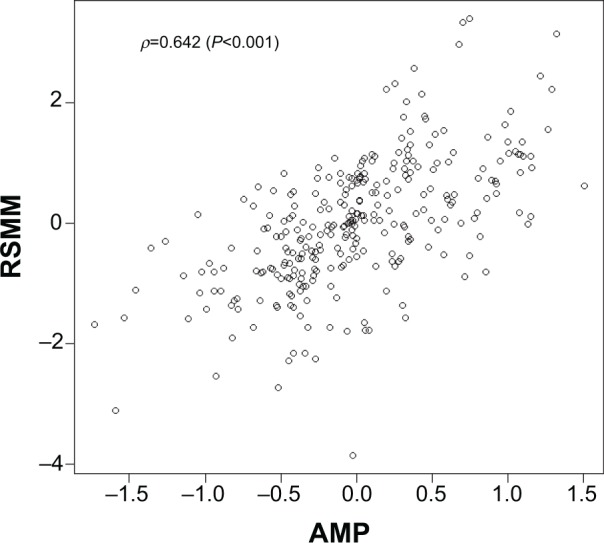
Results: The AMP-RSMM correlation was equal to +0.642 (95% confidence interval, +0.512 to +0.773; P<0.001). Hence, a negative association between sarcopenia severity and adiposity/metabolic biochemical markers was highlighted.
Conclusion: This study contained a novel way to examine the relationship between the variables of interest based on a composite index of adiposity and metabolic conditions. Results shed light on the orientation and magnitude of adiposity and metabolic markers in preventing muscle mass loss. There might be a protective effect of adiposity, compatible with the "obesity paradox."
Keywords: dual energy X-ray absorptiometry; elderly; metabolic risk markers; muscle mass loss.
Figures
References
-
- Short KR, Nair KS. The effect of age on protein metabolism. Curr Opin Clin Nutr Metab Care. 2000;3:39–44. - PubMed
-
- Cesari M, Kritchevsky SB, Baumgartner RN, et al. Sarcopenia, obesity, and inflammation results from the Trial of Angiotensin Converting Enzyme Inhibition and Novel Cardiovascular Risk Factors study. Am J Clin Nutr. 2005;82:428–434. - PubMed
-
- Chin KY, Soelaiman IN, Mohamed IN, Ibrahim S, Wan Ngah WZ. The effects of age, physical activity level, and body anthropometry on calcaneal speed of sound value in men. Arch Osteoporos. 2012;7:135–145. - PubMed
-
- Goodpaster BH, Park Sw, Harris TB, et al. The loss of skeletal muscle strength, mass, and quality in older adults: the health, aging and body composition study. J Gerontol A Biol Sci Med Sci. 2006;61:1059–1064. - PubMed
-
- Karakelides H, Nair KS. Sarcopenia of aging and its metabolic impact. Curr Top Dev Biol. 2005;68:123–148. - PubMed
MeSH terms
Substances
LinkOut - more resources
Full Text Sources
Research Materials
