. 2015 Mar 9;5(1):744-69.
doi: 10.3390/life5010744.

CaCO3 precipitation in multilayered cyanobacterial mats: clues to explain the alternation of micrite and sparite layers in calcareous stromatolites

Affiliations

CaCO3 precipitation in multilayered cyanobacterial mats: clues to explain the alternation of micrite and sparite layers in calcareous stromatolites

Józef Kaźmierczak et al. Life (Basel). .

Abstract

Marine cyanobacterial mats were cultured on coastal sediments (Nivå Bay, Øresund, Denmark) for over three years in a closed system. Carbonate particles formed in two different modes in the mat: (i) through precipitation of submicrometer-sized grains of Mg calcite within the mucilage near the base of living cyanobacterial layers, and (ii) through precipitation of a variety of mixed Mg calcite/aragonite morphs in layers of degraded cyanobacteria dominated by purple sulfur bacteria. The d13C values were about 2‰ heavier in carbonates from the living cyanobacterial zones as compared to those generated in the purple bacterial zones. Saturation indices calculated with respect to calcite, aragonite, and dolomite inside the mats showed extremely high values across the mat profile. Such high values were caused by high pH and high carbonate alkalinity generated within the mats in conjunction with increased concentrations of calcium and magnesium that were presumably stored in sheaths and extracellular polymer substances (EPS) of the living cyanobacteria and liberated during their post-mortem degradation. The generated CaCO3 morphs were highly similar to morphs reported from heterotrophic bacterial cultures, and from bacterially decomposed cyanobacterial biomass emplaced in Ca-rich media. They are also similar to CaCO3 morphs precipitated from purely inorganic solutions. No metabolically (enzymatically) controlled formation of particular CaCO3 morphs by heterotrophic bacteria was observed in the studied mats. The apparent alternation of in vivo and post-mortem generated calcareous layers in the studied cyanobacterial mats may explain the alternation of fine-grained (micritic) and coarse-grained (sparitic) laminae observed in modern and fossil calcareous cyanobacterial microbialites as the result of a probably similar multilayered mat organization.


Figures
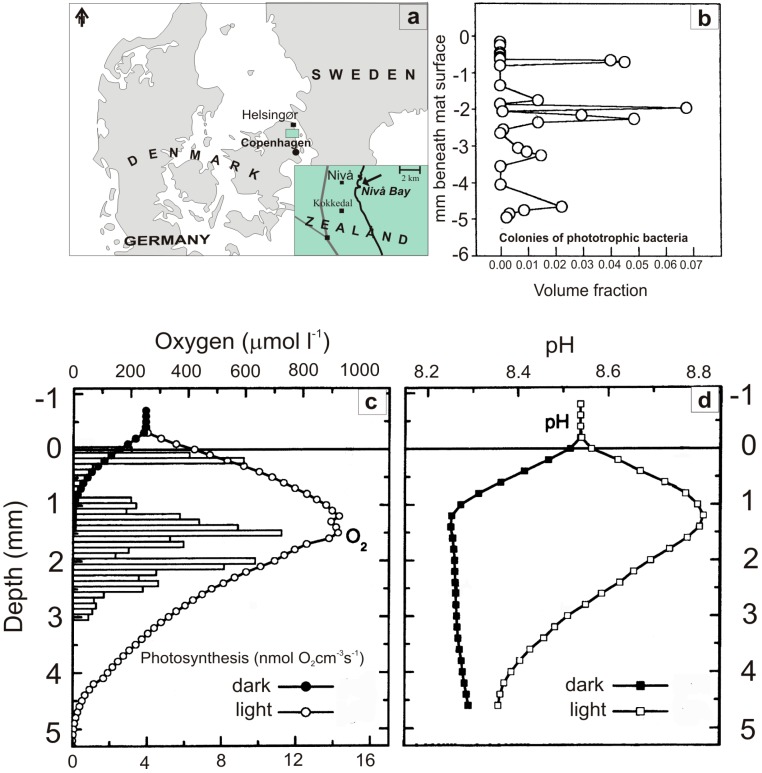
Figure 1
Figure 1
(a) Map of Denmark with inset showing Nivå Bay (Øresund), the origin of defaunated sediment samples used for cultivating cyanobacterial mats. (b) to (d) Microprofiles across a 5 mm thick artificial cyanobacterial mat showing volume fraction of colonies of phototrophic bacteria (b), O2 concentration (c), and pH (d) under light and dark conditions (from [49]).
Figure 2
Figure 2
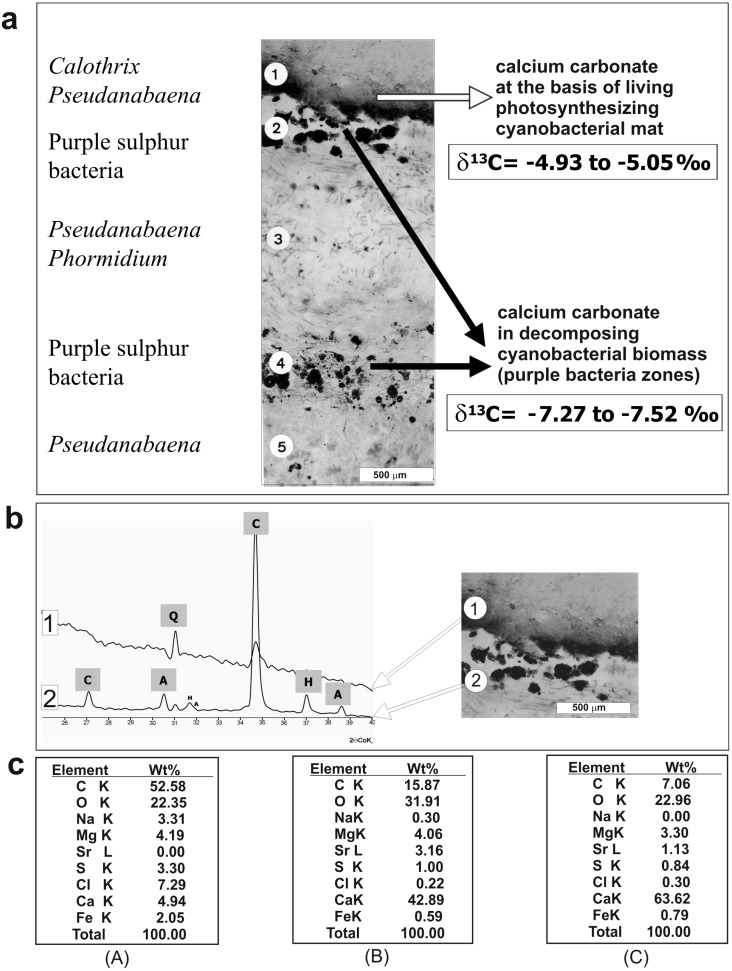
(a) Vertical cryomicrotome section of a three-year-old mat showing locations of the CaCO3-rich layers (1, 2 and 4) with indicated dominating microbiota and δ13C values. (b) X-ray diffractograms of mineral components from mat from layers l and 2: C—Mg calcite, A—aragonite, H—halite, Q—quartz (sand grains). The numbers of mat zones correspond to those shown in the diagram in Figure 4. (c) SEM-EDS spectra of elemental frequency (wt%) from dried living cyanobacterial biomass from the mat surface layer (A), micrite layer (B), and sparite layer (C).
Figure 3
Figure 3
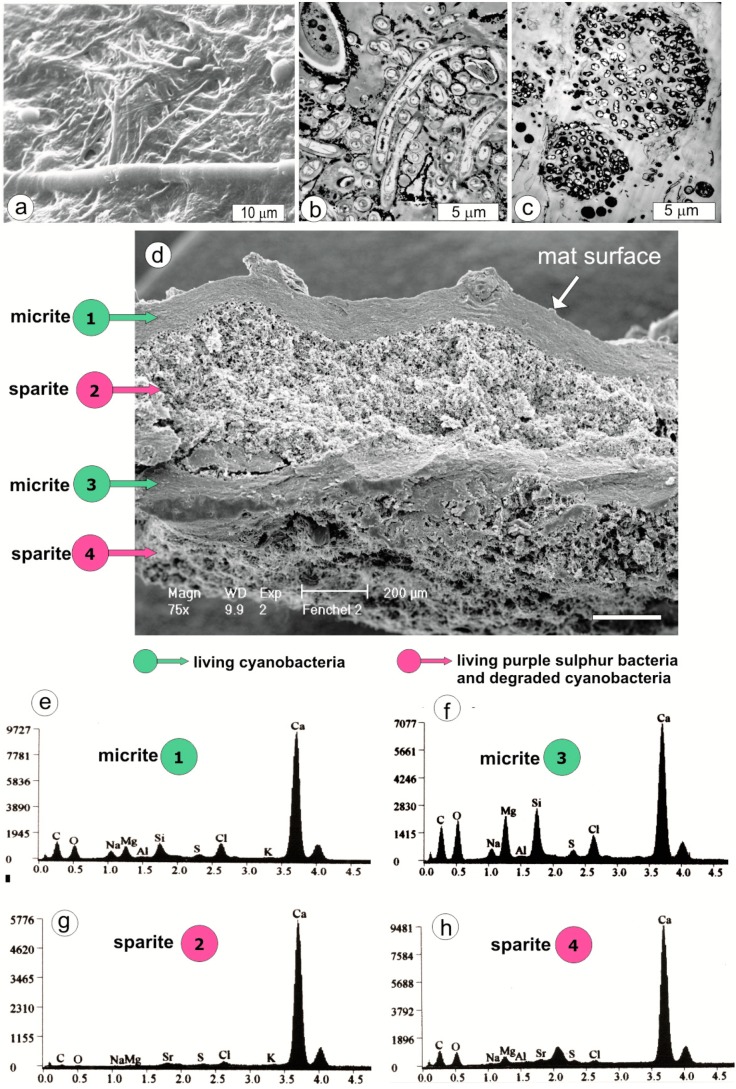
(a) SEM image of the artificial mat surface (hot air-dried shrunken specimen) showing thinner filaments of Pseudanabaena and thicker filaments of Calothrix. (b) TEM image of Pseudanabaena and Calothrix filaments from about 0.3 mm below the mat surface. Note the large volume of extracellular polymers (EPS) excreted by the cyanobacterial filaments, which are incidentally associated with much smaller heterotrophic bacteria, and more rarely Mg calcite nanograins (opaque matter) precipitated in larger accumulations particularly on Calothrix filament (upper left corner). (c) TEM image of colonies of purple sulfur bacteria (possibly Thiocapsa) characteristic of the mat layers 2, 4, 6 and 8 (see diagram in Figure 4). (d) Vertical section of hot air-dried fragment of the artificial mat showing shrunken and weakly mineralized living cyanobacterial layers (micrite) alternating with strongly mineralized layers (sparite) composed of degraded cyanobacteria (mostly empty sheaths) and purple sulfur bacteria. (e, f) SEM-EDS spectra to show the negligible presence of Mg silicate in Mg calcite from the surficial cyanobacterial layer (micrite 1) and much higher in the Mg calcite from deeper located cyanobacterial layer (micrite 3).
Figure 4
Figure 4
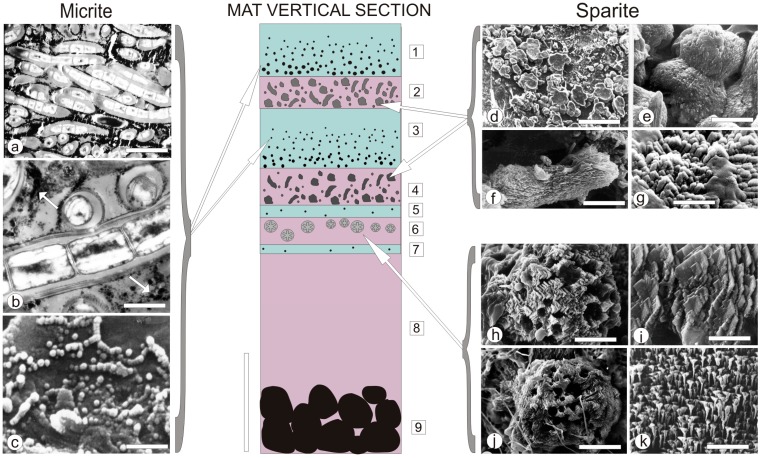
A schematic presentation of the artificial mat zonation (in vertical section), with examples of most characteristic calcium carbonate morphs precipitated in micritic (left column) and sparitic (right column) layers (modified after [50]). For detailed explanation see text. Scale bars: (a) 5 μm, (b) 1 μm, (c) 1 μm, (d) 100 μm, (e) 10 μm, (f) 10 μm, (g) 10 μm, (h) 10 μm ,(i) 3 μm, (j) 20 μm, (k) 2 μm.
Figure 5
Figure 5
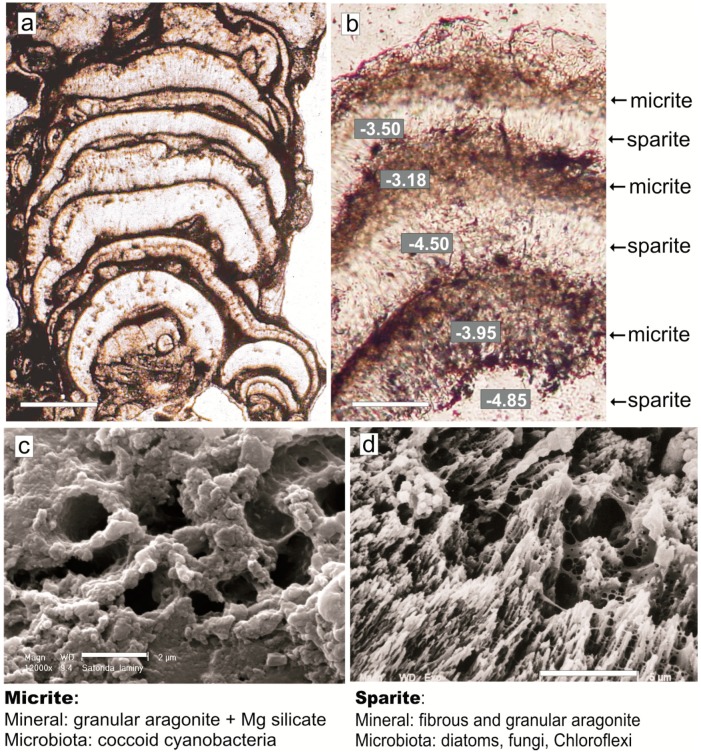
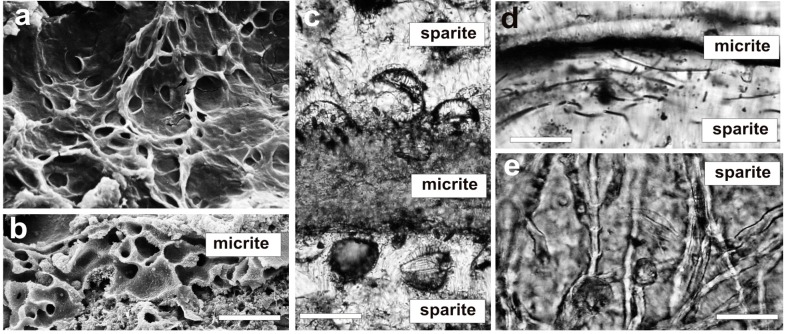
Subfossil microstromatolite from the quasi-marine Satonda Crater Lake (Central Indonesia) interpreted as the product of a multilayered coccoid cyanobacterial mat analogous to the studied artificial cyanobacterial mat. (a) Optical micrograph of vertical petrographic thin section of the Satonda stromatolite showing well-expressed alternation of micritic and sparitic layers. (b) Magnification of a series of alternating micrite and sparite layers with indicated stable carbon isotope (δ13C vs. PDB) signatures. (c) and (d) SEM images of vertical sections of polished and with 5% formic acid etched micritic (c) and sparitic (d) layers; note the well-preserved, due to in vivo mineralization, pattern of the common mucilage sheaths (glycocalyx) in the micritic layer, and the almost totally degraded remains of mucilage sheaths in the sparitic layer. Scale bars: (a) 500 μm, (b) 200 μm, (c) 2 μm, (d) 5 μm.
Figure 6
Figure 6
Microbiota associated with calcium carbonate layers in microstromatolites from the quasi-marine Satonda Crater Lake (Central Indonesia). (a) SEM image (top view) of a coccoid pleurocapsalean cyanobacterial mat growing today in the lake. (b) SEM image of vertical mat section showing mucilage sheaths (glycocalyx) of coccoid pseudocapsalean cyanobacteria permineralized in vivo with aragonite nanograins (micrite). (ce) Micrographs of thin sections showing examples of remains of microbiota associated with aragonite layers (sparite) precipitated in decomposing biomass of coccoid cyanobacteria: diatoms (c), Chloroflexus-like bacteria (d) and aquatic fungi. Scale bars: (a) 20 μm, (b) 20 μm, (c) 10 μm, (d) 10 μm, (e) 20 μm.
Figure 7
Figure 7
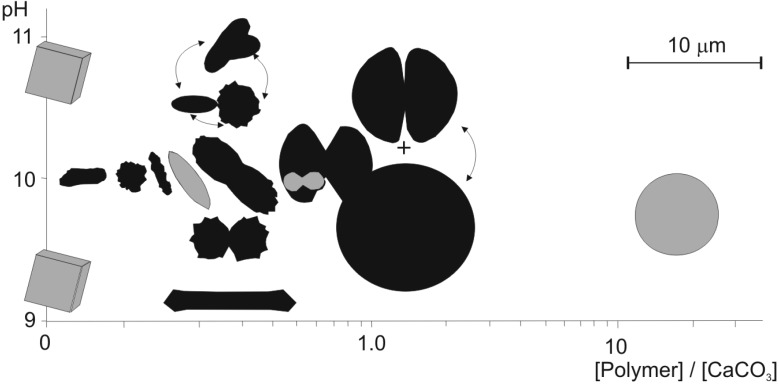
Diagram showing a variety of CaCO3 morphs precipitated under controlled conditions from a solution of different pH and [polymer]/[CaCO3] ratio for which the unit for both concentrations is g L−1. Arrows indicate morphologies observed simultaneously. Morphs obtained from the same system are drawn in gray and those from other experiments are drawn in black (from [58], slightly modified).

References

    1. Lyons W.B., Long D.T., Hines M.E., Gaudette H.E., Armstrong P.B. Calcification of cyanobacterial mats in Solar Lake, Sinai. Geology. 1984;12:623–626. doi: 10.1130/0091-7613(1984)12<623:COCMIS>2.0.CO;2. - DOI
    1. Caudwell C. Étude expérimentale de la formation de micrite et de sparite dans les stromatolites d’eau douce á Rivularia. Bulletin de la Société géologique de France. 1987;3:299–306. (In French)
    1. Pentecost A., Bauld J. Nucleation of calcite on the sheaths of cyanobacteria using a simple diffusion cell. Geomicrobiol. J. 1988;8:17–26. doi: 10.1080/01490459009377875. - DOI
    1. Kempe S., Kazmierczak J. Calcium carbonate supersaturation and the formation of in situ calcified stromatolites. In: Ittekkot V., Kempe S., Michaelis W., Spitzy A., editors. Facets of Modern Biogeochemistry. Springer; Berlin/Heidelberg, Germany: 1990. pp. 255–278.
    1. Kempe S., Kazmierczak J. Hydrochemical key to the genesis of calcareous nonlaminated and laminated cyanobacterial microbialites. In: Seckbach J., editor. Algae and Cyanobacteria in Extreme Environments. Springer; Dordrecht, The Netherlands: 2007. pp. 242–264.

LinkOut - more resources