


Newborn screening for homocystinurias and methylation disorders: systematic review and proposed guidelines
- PMID: 25762406
- PMCID: PMC4626539
- DOI: 10.1007/s10545-015-9830-z
Newborn screening for homocystinurias and methylation disorders: systematic review and proposed guidelines
Abstract
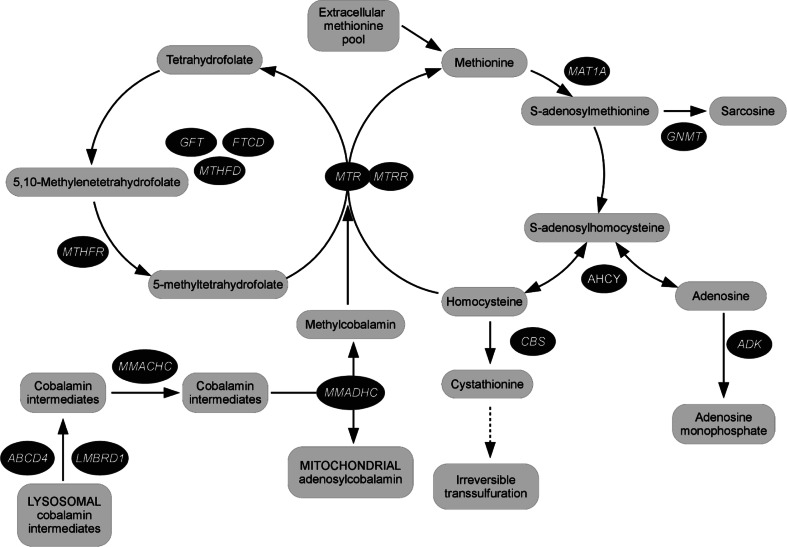
Newborn screening (NBS) is justified if early intervention is effective in a disorder generally not detected early in life on a clinical basis, and if sensitive and specific biochemical markers exist. Experience with NBS for homocystinurias and methylation disorders is limited. However, there is robust evidence for the success of early treatment with diet, betaine and/or pyridoxine for CBS deficiency and good evidence for the success of early betaine treatment in severe MTHFR deficiency. These conditions can be screened in dried blood spots by determining methionine (Met), methionine-to-phenylanine (Met/Phe) ratio, and total homocysteine (tHcy) as a second tier marker. Therefore, we recommend NBS for cystathionine beta-synthase and severe MTHFR deficiency. Weaker evidence is available for the disorders of intracellular cobalamin metabolism. Early treatment is clearly of advantage for patients with the late-onset cblC defect. In the early-onset type, survival and non-neurological symptoms improve but the effect on neurocognitive development is uncertain. The cblC defect can be screened by measuring propionylcarnitine, propionylcarnitine-to-acetylcarnitine ratio combined with the second tier markers methylmalonic acid and tHcy. For the cblE and cblG defects, evidence for the benefit of early treatment is weaker; and data on performance of Met, Met/Phe and tHcy even more limited. Individuals homozygous or compound heterozygous for MAT1A mutations may benefit from detection by NBS using Met, which on the other hand also detects asymptomatic heterozygotes. Clinical and laboratory data is insufficient to develop any recommendation on NBS for the cblD, cblF, cblJ defects, glycineN-methyltransferase-, S-adenosylhomocysteinehydrolase- and adenosine kinase deficiency.
Figures
References
-
- Abeling NG, van Gennip AH, Blom H, Wevers RA, Vreken P, van Tinteren HL, Bakker HD. Rapid diagnosis and methionine administration: basis for a favourable outcome in a patient with methylene tetrahydrofolate reductase deficiency. J Inherit Metab Dis. 1999;22:240–242. doi: 10.1023/A:1005509400481. - DOI - PubMed
-
- Accinni R, Campolo J, Parolini M, et al. Newborn screening of homocystinuria: quantitative analysis of total homocyst(e)ine on dried blood spot by liquid chromatography with fluorimetric detection. J Chromatogr B Anal Technol Biomed Life Sci. 2003;785:219–226. doi: 10.1016/S1570-0232(02)00852-8. - DOI - PubMed
Publication types
MeSH terms
Substances
LinkOut - more resources
Full Text Sources
Other Literature Sources
Medical
Research Materials
Miscellaneous
