


Systematic and meta-analytic review of research examining the impact of menstrual cycle phase and ovarian hormones on smoking and cessation
- PMID: 25762750
- PMCID: PMC4429881
- DOI: 10.1093/ntr/ntu249
Systematic and meta-analytic review of research examining the impact of menstrual cycle phase and ovarian hormones on smoking and cessation
Abstract
Introduction: To determine the effect of ovarian hormones on smoking, we conducted a systematic review of menstrual cycle effects on smoking (i.e., ad lib smoking, smoking topography, and subjective effects) and cessation-related behaviors (i.e., cessation, withdrawal, tonic craving, and cue-induced craving).
Methods: Thirty-six papers were identified on MEDLINE that included a menstrual-related search term (e.g., menstrual cycle, ovarian hormones), a smoking-related search term (e.g., smoking, nicotine), and met all inclusion criteria. Thirty-two studies examined menstrual phase, 1 study measured hormone levels, and 3 studies administered progesterone.
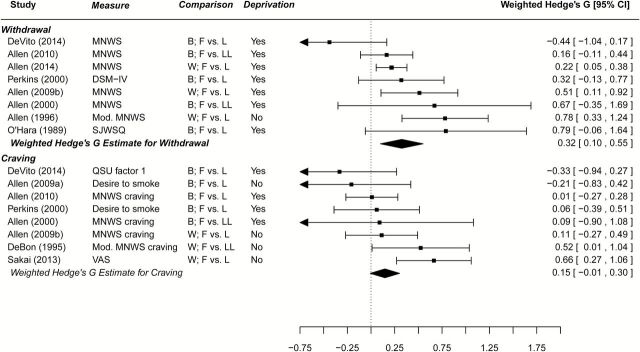
Results: Sufficient data were available to conduct meta-analyses for only 2 of the 7 variables: withdrawal and tonic craving. Women reported greater withdrawal during the luteal phase than during the follicular phase, and there was a nonsignificant trend for greater tonic craving in the luteal phase. Progesterone administration was associated with decreased positive and increased negative subjective effects of nicotine. Studies of menstrual phase effects on the other outcome variables were either small in number or yielded mixed outcomes.
Conclusions: The impact of menstrual cycle phase on smoking behavior and cessation is complicated, and insufficient research is available upon which to conduct meta-analyses on most smoking outcomes. Future progress will require collecting ovarian hormone levels to more precisely quantify the impact of dynamic changes in hormone levels through the cycle on smoking behavior. Clarifying the relationship between hormones and smoking-particularly related to quitting, relapse, and medication response-could determine the best type and timing of interventions to improve quit rates for women.
© The Author 2015. Published by Oxford University Press on behalf of the Society for Research on Nicotine and Tobacco. All rights reserved. For permissions, please e-mail: journals.permissions@oup.com.
Figures
References
-
- USDHHS. The health consequences of smoking—50 years of progress: a report of the surgeon general. Atlanta, GA: U.S. Department of Health and Human Services, Centers for Disease Control and Prevention, National Center for Chronic Disease Prevention and Health Promotion, Office on Smoking and Health; 2014. - PubMed
-
- WHO. WHO global report: mortality attributable to tobacco. Geneva, Switzerland: WHO Press; 2012.
-
- Shiffman S, Brockwell SE, Pillitteri JL, Gitchell JG. Use of smoking-cessation treatments in the United States. Am J Prev Med. 2008;34: 102–111. - PubMed
-
- CDC. Vital signs: current cigarette smoking among adults aged ≥18 years—United States, 2009. MMWR. 2010;59:1135–1140. - PubMed
Publication types
MeSH terms
Grants and funding
LinkOut - more resources
Full Text Sources
Other Literature Sources
Medical
Miscellaneous
