


Active video games and energy balance in male adolescents: a randomized crossover trial
- PMID: 25762809
- PMCID: PMC6879016
- DOI: 10.3945/ajcn.114.105528
Active video games and energy balance in male adolescents: a randomized crossover trial
Abstract
Background: Active video games (AVGs) have been shown to acutely increase energy expenditure when compared with seated video games; however, the influence of AVGs on compensatory adjustments in energy intake and expenditure is largely unknown.
Objective: The aim was to examine the acute effects of AVGs on energy intake and expenditure.
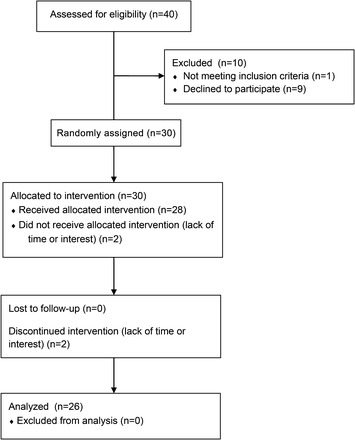
Design: With the use of a randomized crossover design, 26 male adolescents (mean ± SD age: 14.5 ± 1.4 y) completed three 1-h experimental conditions: resting control, seated video game play (Xbox 360; Microsoft), and AVG play (Kinect Adventures on Xbox 360) followed by an ad libitum lunch. A validated food menu was used to assess food intake immediately after the conditions and for the remainder of the day, and a dietary record was used for the subsequent 3-d period. Energy expenditure was measured by using portable indirect calorimetry throughout each experimental condition, and an accelerometer was used to assess the subsequent 3-d period. Appetite sensations were assessed by using visual analog scales at different time points during the testing day. The primary outcomes were acute (immediately after the conditions and 24-h) and short-term (3-d) energy intake and expenditure.
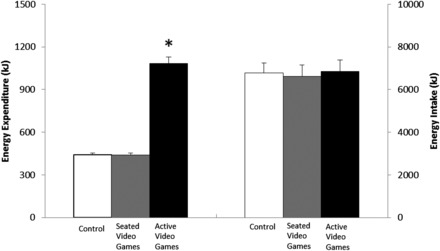
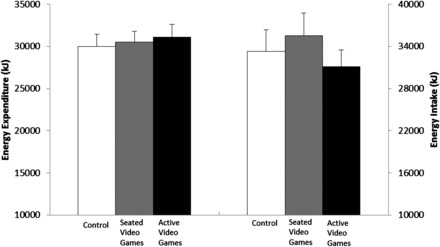
Results: Energy expenditure was significantly higher (~145%; P < 0.001) during the AVG condition than during the resting control and seated video game conditions; however, no significant differences in energy expenditure were observed 24 h (~6%; P > 0.49) and 3 d after the experimental conditions (~3%; P > 0.82). No significant differences were observed in absolute energy intake immediately after the conditions (~2%; P > 0.94) or in absolute energy intake 24 h (~5%; P > 0.63) and 3 d (~9%; P > 0.53) after the experimental conditions. Finally, appetite sensations were similar between conditions at all time points (P > 0.05).
Conclusions: The increase in energy expenditure promoted by a single session of Kinect AVG play is not associated with increased food intake but is compensated for after the intervention, resulting in no measurable change in energy balance after 24 h. These results suggest that the potential of Kinect to reduce the energy gap underlying weight gain is offset within 24 h in male adolescents. This trial was registered at clinicaltrials.gov as NCT01655901.
Keywords: appetite; energy expenditure; energy intake; exergaming; food; obesity; teenagers.
© 2015 American Society for Nutrition.
Figures


Comment in
-
Are active video games useful to combat obesity?Am J Clin Nutr. 2015 Jun;101(6):1107-8. doi: 10.3945/ajcn.115.110221. Epub 2015 Mar 25. Am J Clin Nutr. 2015. PMID: 25809852 Free PMC article. No abstract available.
-
Compensation in physical activity energy expenditure after active video games: role of sample size and analysis.Am J Clin Nutr. 2015 Dec;102(6):1616. doi: 10.3945/ajcn.115.122283. Am J Clin Nutr. 2015. PMID: 26628572 No abstract available.
-
Reply to VB Paravidino et al.Am J Clin Nutr. 2015 Dec;102(6):1616-7. doi: 10.3945/ajcn.115.122309. Am J Clin Nutr. 2015. PMID: 26628573 No abstract available.
References
-
- Rideout VG, Roberts DF, Foehr UG.. Generation M: media in the lives of 8-18 year olds. Kaiser Family Foundation: Menlo Park (CA); 2005.
-
- Rideout VG, Foehr UG, Roberts DF.. Generation M2 media in the lives of 8-18 year olds. Kaiser Family Foundation: Menlo Park (CA); 2010.
-
- Chaput JP, Visby T, Nyby S, Klingenberg L, Gregersen NT, Tremblay A, Astrup A, Sjödin A.. Video game playing increases food intake in adolescents: a randomized crossover study. Am J Clin Nutr 2011;93:1196–203. - PubMed
-
- Bellisle F, Dalix AM, Slama G.. Non food-related environmental stimuli induce increased meal intake in healthy women: comparison of television viewing versus listening to a recorded story in laboratory settings. Appetite 2004;43:175–80. - PubMed
-
- Barnes JD, Colley RC, Tremblay MS.. Results from the Active Healthy Kids Canada 2011 Report Card on Physical Activity for Children and Youth. Appl Physiol Nutr Metab 2012;37:793–7. - PubMed
Publication types
MeSH terms
Associated data
Grants and funding
LinkOut - more resources
Full Text Sources
Other Literature Sources
Medical
Miscellaneous
