. 2015 Feb 13:6:104.
doi: 10.3389/fmicb.2015.00104. eCollection 2015.

Long-term forest soil warming alters microbial communities in temperate forest soils

Affiliations

Long-term forest soil warming alters microbial communities in temperate forest soils

Kristen M DeAngelis et al. Front Microbiol. .

Abstract

Soil microbes are major drivers of soil carbon cycling, yet we lack an understanding of how climate warming will affect microbial communities. Three ongoing field studies at the Harvard Forest Long-term Ecological Research (LTER) site (Petersham, MA) have warmed soils 5°C above ambient temperatures for 5, 8, and 20 years. We used this chronosequence to test the hypothesis that soil microbial communities have changed in response to chronic warming. Bacterial community composition was studied using Illumina sequencing of the 16S ribosomal RNA gene, and bacterial and fungal abundance were assessed using quantitative PCR. Only the 20-year warmed site exhibited significant change in bacterial community structure in the organic soil horizon, with no significant changes in the mineral soil. The dominant taxa, abundant at 0.1% or greater, represented 0.3% of the richness but nearly 50% of the observations (sequences). Individual members of the Actinobacteria, Alphaproteobacteria and Acidobacteria showed strong warming responses, with one Actinomycete decreasing from 4.5 to 1% relative abundance with warming. Ribosomal RNA copy number can obfuscate community profiles, but is also correlated with maximum growth rate or trophic strategy among bacteria. Ribosomal RNA copy number correction did not affect community profiles, but rRNA copy number was significantly decreased in warming plots compared to controls. Increased bacterial evenness, shifting beta diversity, decreased fungal abundance and increased abundance of bacteria with low rRNA operon copy number, including Alphaproteobacteria and Acidobacteria, together suggest that more or alternative niche space is being created over the course of long-term warming.

Keywords: climate change; microbial ecology; ribosomal RNA; rrn operon copy number; trophic strategy.


Figures
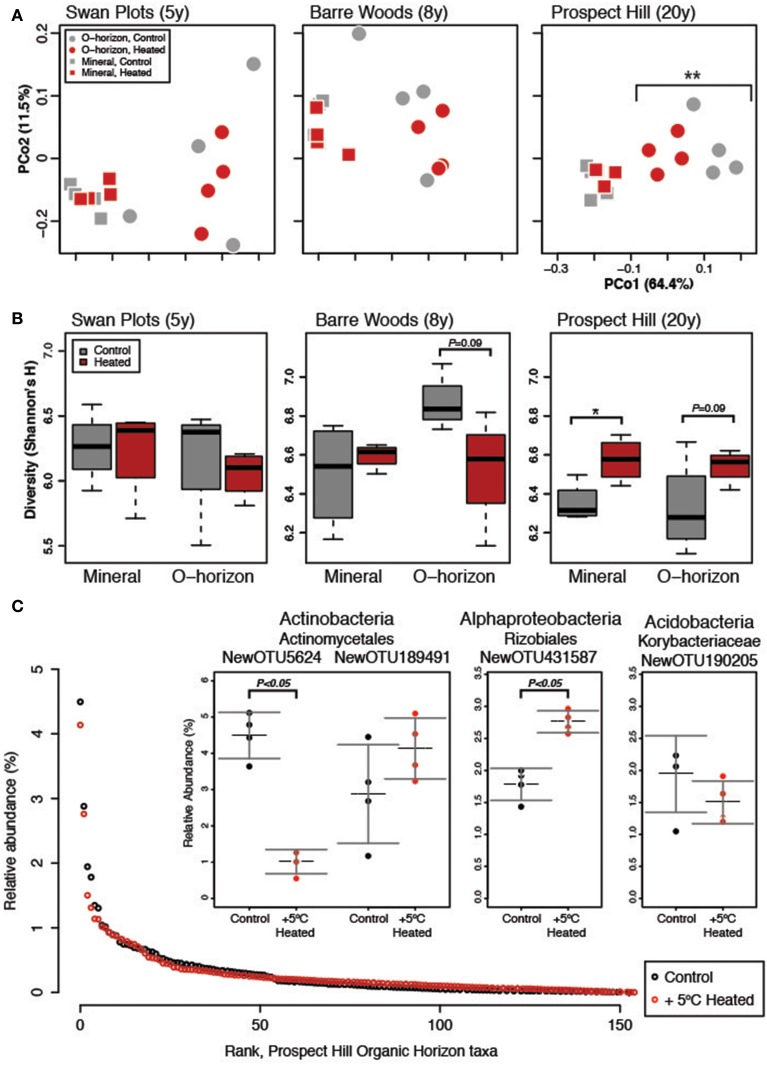
Figure 1
Figure 1
Measures of diversity for the warming chronosequence, based on the dominant subset community (N = 155). (A) One PCoA ordination was performed on all sites, both treatments and both soil types, but the three sites are shown separately for clarity: SWaN Plots, Barre Woods, and Prospect Hill. (B) Diversity as measured by Shannon's H index is shown for the three sites as box (first and third quartiles) and whisker (95% CI) plots where the solid bar is median. (C) Rank abundance curve of the 155 dominant species in the community, with inset showing the three most abundant taxa and their relative abundance in heated versus control treatments averaged for the three sites. Statistical significance is indicated as *P < 0.05, **P < 0.01.
Figure 2
Figure 2
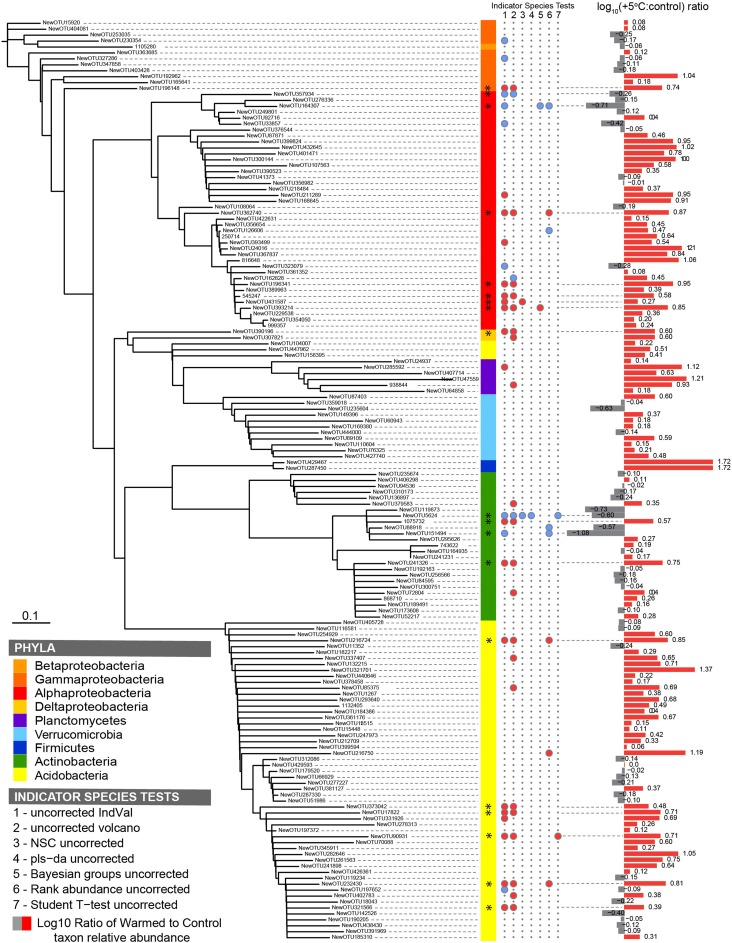
Phylogenetic tree of the dominant subset community (n = 155) in the Prospect Hill 20-year warmed sites, where (from left to right) the color strips denote phylum-level classification; the circles denote a significant indicator species test (P < 0.05) with blue circles indicative of control treatments and red circles indicative of heated treatments; bars show fold change in OTU abundance with warming treatment. The seven indicator species analyses are (1) Dufrêne and Legendre's IndVal, (2) fold change (volcano-plots), (3) nearest shrunken centroid, (4) PLS-DA loadings test, (5) Bayesian group comparison, (6) Rank abundance test, (7) Student's t-test. Taxa with two or more significant indicator species tests are marked (*).
Figure 3
Figure 3
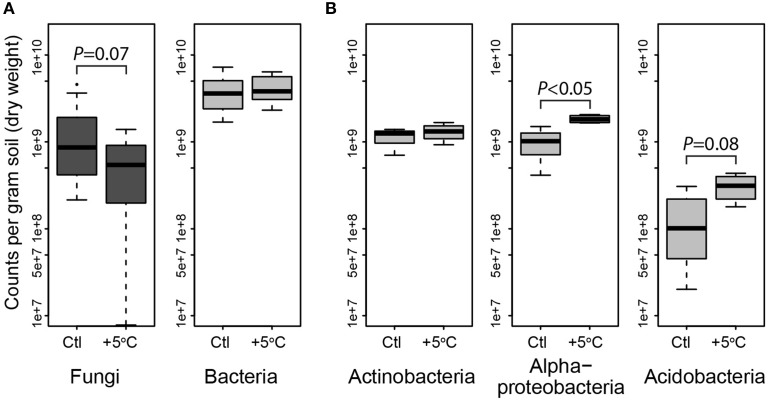
Quantitative PCR of bacteria and fungi, and the phyla Actinobacteria, Acidobacteria and Alphaproteobacteria showing abundance of dominant microbial phylogenetic groups for both treatments in organic horizon (averaged by site, which was not a significant factor). Fungi were less abundant, and bacteria unchanged in heated (+5°C) compared to control (Ctl) organic horizon soils across the three sites (A). In the organic horizons of the Prospect Hill site, Actinobacteria were unchanged, while Alpha-proteobacteria and Acidobacteria were enriched by long-term warming (B). Means are shown as as box (first and third quartiles) and whisker (95% CI) plots where the solid bar is median.
Figure 4
Figure 4
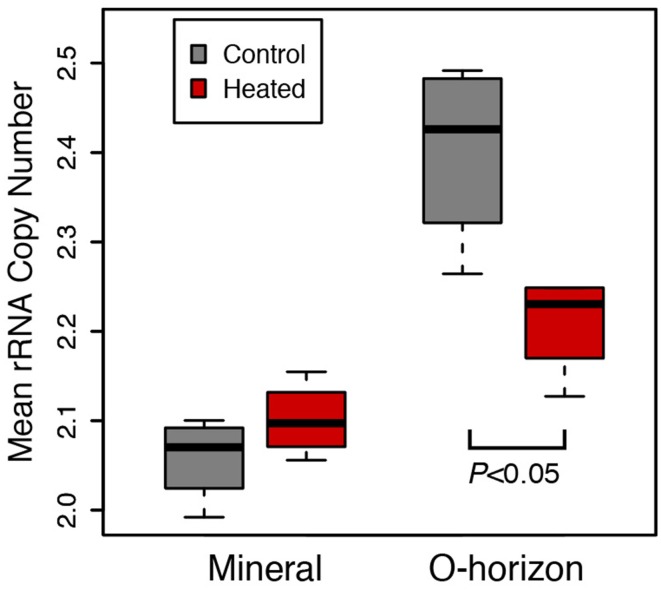
Mean ribosomal RNA copy number was calculated for Prospect Hill (20 years warmed) soil communities, and these calculations were based on phylogenetic inference (see methods for details). Means are shown as as box (first and third quartiles) and whisker (95% CI) plots where the solid bar is median; statistical significance was determined based on ANOVA (P < 0.05).

References

    1. Allison S. D., Wallenstein M. D., Bradford M. A. (2010). Soil-carbon response to warming dependent on microbial physiology. Nat. Geosci. 3, 336–340 10.1038/ngeo846 - DOI
    1. Andrews J. A., Matamala R., Westover K. M., Schlesinger W. H. (2000). Temperature effects on the diversity of soil heterotrophs and the δ 13C of soil-respired CO2. Soil Biol. Biochem. 32, 699–706 10.1016/S0038-0717(99)00206-0 - DOI
    1. Andrews S. (2010). FASTQC. A Quality Control Tool for High Throughput Sequence Data. Available online at: http://www.bioinformatics.babraham.ac.uk/projects/fastqc
    1. Arndt D., Xia J., Liu Y., Zhou Y., Guo A. C., Cruz J. A., et al. . (2012). METAGENassist: a comprehensive web server for comparative metagenomics. Nucleic Acids Res. 40, W88–W95. 10.1093/nar/gks497 - DOI - PMC - PubMed
    1. Bacchetti De Gregoris T., Aldred N., Clare A. S., Burgess J. G. (2011). Improvement of phylum- and class-specific primers for real-time PCR quantification of bacterial taxa. J. Microbiol. Methods 86, 351–356. 10.1016/j.mimet.2011.06.010 - DOI - PubMed

LinkOut - more resources