


Suspected community-acquired pneumonia in an ambulatory setting (CAPA): a French prospective observational cohort study in general practice
- PMID: 25763466
- PMCID: PMC4373492
- DOI: 10.1038/npjpcrm.2015.10
Suspected community-acquired pneumonia in an ambulatory setting (CAPA): a French prospective observational cohort study in general practice
Abstract
Background: Few studies have addressed the pragmatic management of ambulatory patients with suspected community-acquired pneumonia (CAP) using a precise description of the disease with or without chest X-ray (X-ray) evidence.
Aims: To describe the characteristics, clinical findings, additional investigations and disease progression in patients with suspected CAP managed by French General Practitioners (GPs).
Methods: The patients included were older than 18 years, with signs or symptoms suggestive of CAP associated with recent-onset unilateral crackles on auscultation or a new opacity on X-ray. They were followed for up to 6 weeks. Descriptive analyses of all patients and according to their management with X-rays were carried out.
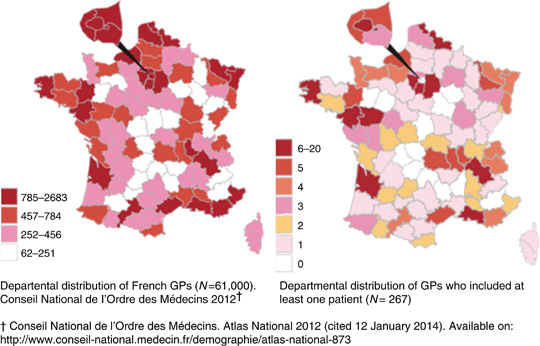
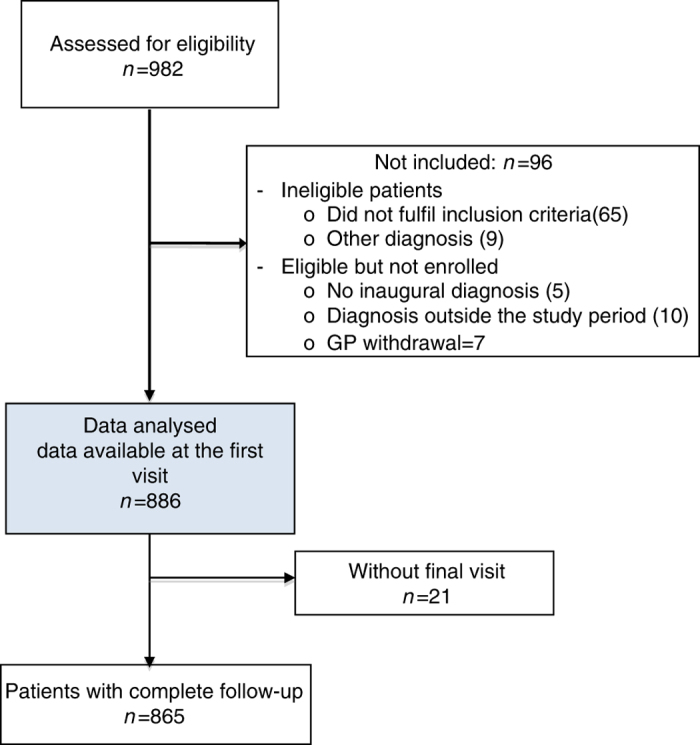
Results: From September 2011 to July 2012, 886 patients have been consulted by 267 GPs. Among them, 278 (31%) were older than 65 years and 337 (38%) were at increased risk for invasive pneumococcal disease. At presentation, the three most common symptoms, cough (94%), fever (93%), and weakness or myalgia (81%), were all observed in 70% of patients. Unilateral crackles were observed in 77% of patients. Among patients with positive radiography (64%), 36% had no unilateral crackles. A null CRB-65 score was obtained in 62% of patients. Most patients (94%) initially received antibiotics and experienced uncomplicated disease progression regardless of their management with X-rays. Finally, 7% of patients were hospitalised and 0.3% died.
Conclusions: Most patients consulting GPs for suspected CAP had the three following most common symptoms: cough, fever, and weakness or myalgia. More than a third of them were at increased risk for invasive pneumococcal disease. With or without X-rays, most patients received antibiotics and experienced uncomplicated disease progression.
Figures
References
-
- Société de Pathologie Infectieuse de Langue Française [15th consensus conference about management of lower respiratory tract infections in immunocompetent adult] Med Mal Infect. 2006;36:235–244. - PubMed
-
- Mayaud C, Fartoukh M, Prigent H, Parrot A, Cadranel J. [Critical evaluation and predictive value of clinical presentation in out-patients with acute community-acquired pneumonia] Med Mal Infect. 2006;36:625–635. - PubMed
-
- Hopstaken RM, Coenen S, Butler CC. Treating patients not diagnoses: challenging assumptions underlying the investigation and management of LRTI in general practice. J Antimicrob Chemother. 2005;56:941–943. - PubMed
Publication types
MeSH terms
Substances
LinkOut - more resources
Full Text Sources
Other Literature Sources
Medical
Miscellaneous
