


Neutrophils: Between host defence, immune modulation, and tissue injury
- PMID: 25764063
- PMCID: PMC4357453
- DOI: 10.1371/journal.ppat.1004651
Neutrophils: Between host defence, immune modulation, and tissue injury
Abstract
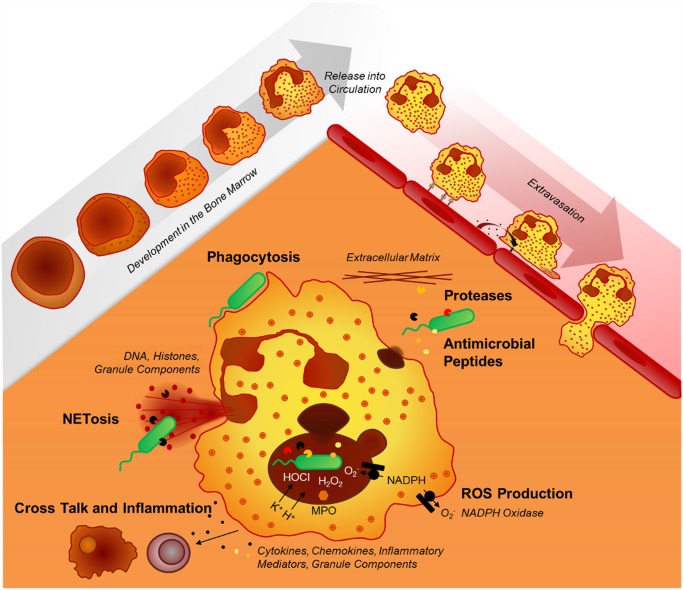
Neutrophils, the most abundant human immune cells, are rapidly recruited to sites of infection, where they fulfill their life-saving antimicrobial functions. While traditionally regarded as short-lived phagocytes, recent findings on long-term survival, neutrophil extracellular trap (NET) formation, heterogeneity and plasticity, suppressive functions, and tissue injury have expanded our understanding of their diverse role in infection and inflammation. This review summarises our current understanding of neutrophils in host-pathogen interactions and disease involvement, illustrating the versatility and plasticity of the neutrophil, moving between host defence, immune modulation, and tissue damage.
Conflict of interest statement
The authors have declared that no competing interests exist.
Figures
References
-
- Semerad CL, Liu F, Gregory AD, Stumpf K, Link DC (2002) G-CSF is an essential regulator of neutrophil trafficking from the bone marrow to the blood. Immunity 17: 413–423. - PubMed
-
- Lieschke GJ, Grail D, Hodgson G, Metcalf D, Stanley E, et al. (1994) Mice lacking granulocyte colony-stimulating factor have chronic neutropenia, granulocyte and macrophage progenitor cell deficiency, and impaired neutrophil mobilization. Blood 84: 1737–1746. - PubMed
-
- Basu S, Hodgson G, Katz M, Dunn AR (2002) Evaluation of role of G-CSF in the production, survival, and release of neutrophils from bone marrow into circulation. Blood 100: 854–861. - PubMed
Publication types
MeSH terms
LinkOut - more resources
Full Text Sources
Other Literature Sources
