


Age-stratified risk of unexpected uterine sarcoma following surgery for presumed benign leiomyoma
- PMID: 25765878
- PMCID: PMC4391766
- DOI: 10.1634/theoncologist.2014-0361
Age-stratified risk of unexpected uterine sarcoma following surgery for presumed benign leiomyoma
Abstract
Background: Estimates of unexpected uterine sarcoma following surgery for presumed benign leiomyoma that use age-stratification are lacking.
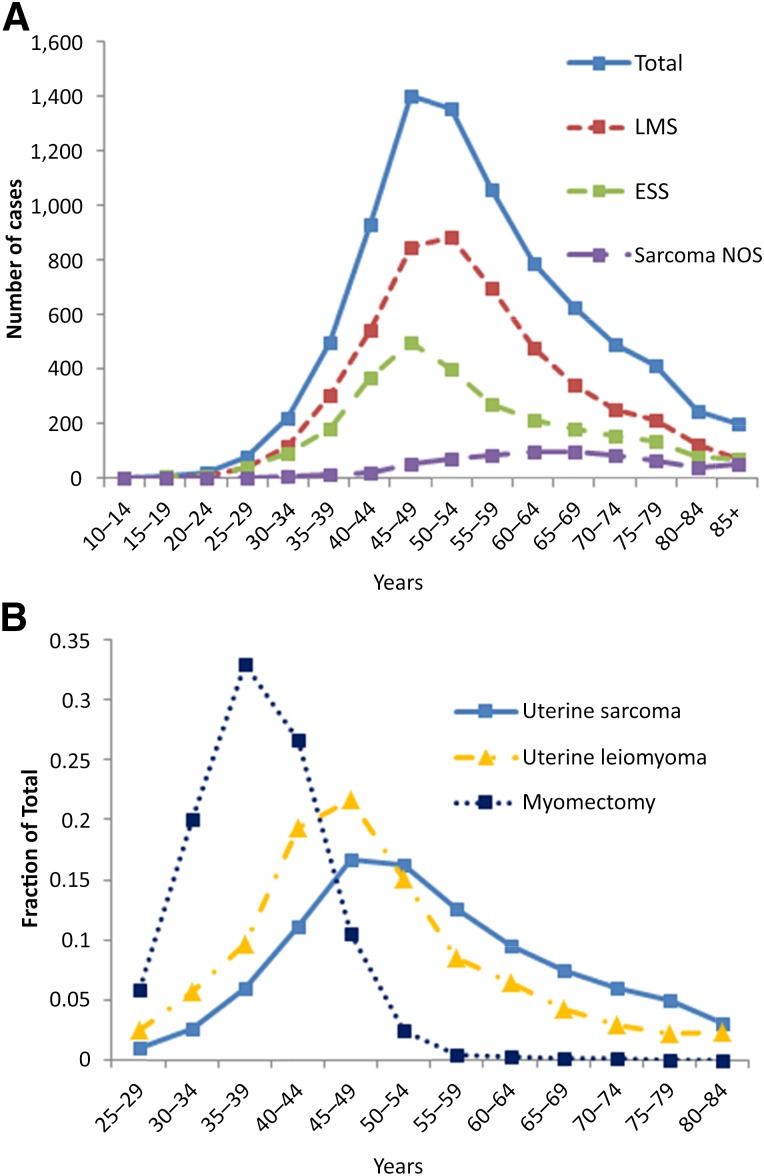
Patients and methods: A retrospective cohort of 2,075 patients that had undergone myomectomy was evaluated to determine the case incidence of unexpected uterine sarcoma. An aggregate risk estimate was generated using a meta-analysis of similar studies plus our data. Database-derived age distributions of the incidence rates of uterine sarcoma and uterine leiomyoma surgery were used to stratify risk by age.
Results: Of 2,075 patients in our retrospective cohort, 6 were diagnosed with uterine sarcoma. Our meta-analysis revealed 8 studies from 1980 to 2014. Combined with our study, 18 cases of leiomyosarcoma are reported in 10,120 patients, for an aggregate risk of 1.78 per 1,000 (95% confidence interval [CI]: 1.1-2.8) or 1 in 562. Eight cases of other uterine sarcomas were reported in 6,889 patients, for an aggregate risk of 1.16 per 1,000 (95% CI: 0.5-4.9) or 1 in 861. The summation of these risks gives an overall risk of uterine sarcoma of 2.94 per 1,000 (95% CI: 1.8-4.1) or 1 in 340. After stratification by age, we predict the risk of uterine sarcoma to range from a peak of 10.1 cases per 1,000, or 1 in 98, for patients aged 75-79 years to <1 case per 500 for patients aged <30 years.
Conclusion: The risk of unexpected uterine sarcoma varies significantly across age groups. Our age-stratified predictive model should be incorporated to more accurately counsel patients and to assist in providing guidelines for the surgical technique for leiomyoma.
Keywords: Endometrial stromal sarcoma; Hysterectomy; Leiomyoma; Leiomyosarcoma; Uterine myomectomy.
©AlphaMed Press.
Conflict of interest statement
Disclosures of potential conflicts of interest may be found at the end of this article.
Figures
References
-
- Bojahr B, Raatz D, Schonleber G, et al. Perioperative complication rate in 1706 patients after a standardized laparoscopic supracervical hysterectomy technique. J Minim Invasive Gynecol. 2006;13:183–189. - PubMed
-
- Brooks SE, Zhan M, Cote T, et al. Surveillance, epidemiology, and end results analysis of 2677 cases of uterine sarcoma 1989-1999. Gynecol Oncol. 2004;93:204–208. - PubMed
-
- George S, Barysauskas C, Serrano C, et al. Retrospective cohort study evaluating the impact of intraperitoneal morcellation on outcomes of localized uterine leiomyosarcoma. Cancer. 2014;120:3154–3158. - PubMed
-
- Park JY, Park SK, Kim DY, et al. The impact of tumor morcellation during surgery on the prognosis of patients with apparently early uterine leiomyosarcoma. Gynecol Oncol. 2011;122:255–259. - PubMed
-
- Perri T, Korach J, Sadetzki S, et al. Uterine leiomyosarcoma: Does the primary surgical procedure matter? Int J Gynecol Cancer. 2009;19:257–260. - PubMed
Publication types
MeSH terms
Grants and funding
LinkOut - more resources
Full Text Sources
Other Literature Sources
Medical
