Is There a Clinical Role For Smartphone Sleep Apps? Comparison of Sleep Cycle Detection by a Smartphone Application to Polysomnography
- PMID: 25766719
- PMCID: PMC4481053
- DOI: 10.5664/jcsm.4840
Is There a Clinical Role For Smartphone Sleep Apps? Comparison of Sleep Cycle Detection by a Smartphone Application to Polysomnography
Abstract
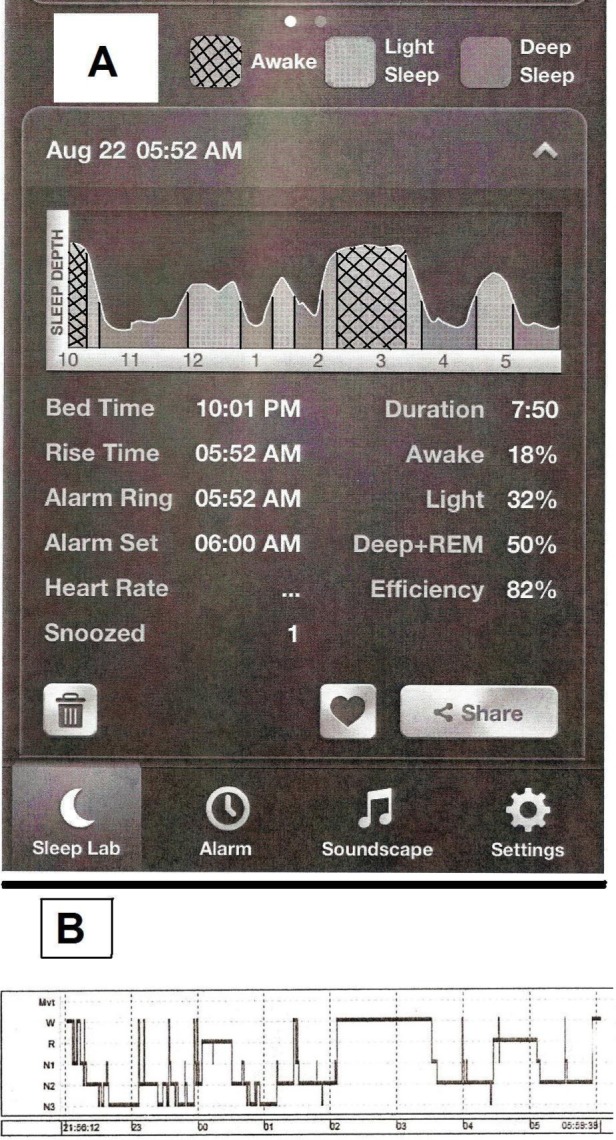
Study objectives: Several inexpensive, readily available smartphone apps that claim to monitor sleep are popular among patients. However, their accuracy is unknown, which limits their widespread clinical use. We therefore conducted this study to evaluate the validity of parameters reported by one such app, the Sleep Time app (Azumio, Inc., Palo Alto, CA, USA) for iPhones.
Methods: Twenty volunteers with no previously diagnosed sleep disorders underwent in-laboratory polysomnography (PSG) while simultaneously using the app. Parameters reported by the app were then compared to those obtained by PSG. In addition, an epoch-by-epoch analysis was performed by dividing the PSG and app graph into 15-min epochs.
Results: There was no correlation between PSG and app sleep efficiency (r = -0.127, p = 0.592), light sleep percentage (r = 0.024, p = 0.921), deep sleep percentage (r = 0.181, p = 0.444) or sleep latency (rs = 0.384, p = 0.094). The app slightly and nonsignificantly overestimated sleep efficiency by 0.12% (95% confidence interval [CI] -4.9 to 5.1%, p = 0.962), significantly underestimated light sleep by 27.9% (95% CI 19.4-36.4%, p < 0.0001), significantly overestimated deep sleep by 11.1% (CI 4.7-17.4%, p = 0.008) and significantly overestimated sleep latency by 15.6 min (CI 9.7-21.6, p < 0.0001). Epochwise comparison showed low overall accuracy (45.9%) due to poor interstage discrimination, but high accuracy in sleep-wake detection (85.9%). The app had high sensitivity but poor specificity in detecting sleep (89.9% and 50%, respectively).
Conclusions: Our study shows that the absolute parameters and sleep staging reported by the Sleep Time app (Azumio, Inc.) for iPhones correlate poorly with PSG. Further studies comparing app sleep-wake detection to actigraphy may help elucidate its potential clinical utility.
Commentary: A commentary on this article appears in this issue on page 695.
Keywords: actigraphy; apps; iPhones and sleep; mobile phones and sleep; sleep apps; sleep cycle; smartphones and sleep.
© 2015 American Academy of Sleep Medicine.
Figures
Comment in
-
Consumer Sleep Apps: When it Comes to the Big Picture, it's All About the Frame.J Clin Sleep Med. 2015 Jul 15;11(7):695-6. doi: 10.5664/jcsm.4834. J Clin Sleep Med. 2015. PMID: 26094923 Free PMC article. No abstract available.
-
Long-Term Anticoagulation for Unprovoked Pulmonary Embolism, Monitoring Sleep with an App, and Interventional Bronchoscopy for Airway Obstruction.Am J Respir Crit Care Med. 2016 Feb 1;193(3):330-2. doi: 10.1164/rccm.201509-1821RR. Am J Respir Crit Care Med. 2016. PMID: 26652659 No abstract available.
References
-
- Batista MA, Gaglani SM. The future of smartphones in health care. Virtual Mentor. 2013;15:947–50. - PubMed
-
- Behar J, Roebuck A, Domingos JS, Gederi E, Clifford GD. A review of current sleep screening applications for smartphones. Physiol Meas. 2013;34:R29–46. - PubMed
-
- Al-Mardini M, Aloul F, Sagahyroon A, Al-Husseini L. Classifying obstructive sleep apnea using smartphones. J Biomed Inform. 2014;52:251–9. - PubMed
-
- Bhopi R, Nagy D, Erichsen D. Can a novel smartphone application detect periodic limb movements? Stud Health Technol Inform. 2012;182:36–42. - PubMed
Publication types
MeSH terms
LinkOut - more resources
Full Text Sources
Other Literature Sources