


Bilingualism modulates infants' selective attention to the mouth of a talking face
- PMID: 25767208
- PMCID: PMC4398611
- DOI: 10.1177/0956797614568320
Bilingualism modulates infants' selective attention to the mouth of a talking face
Abstract
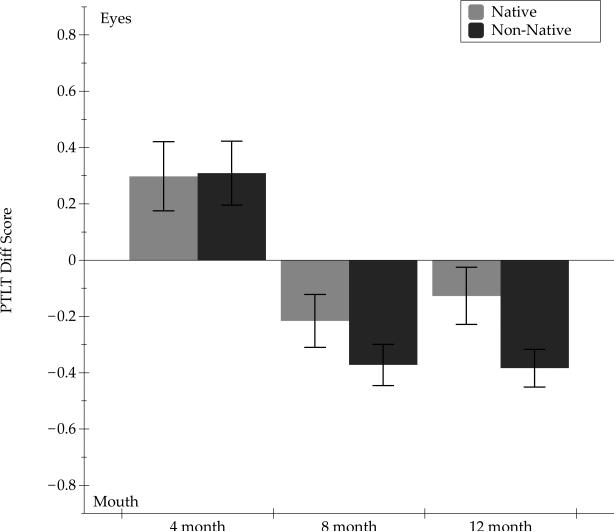
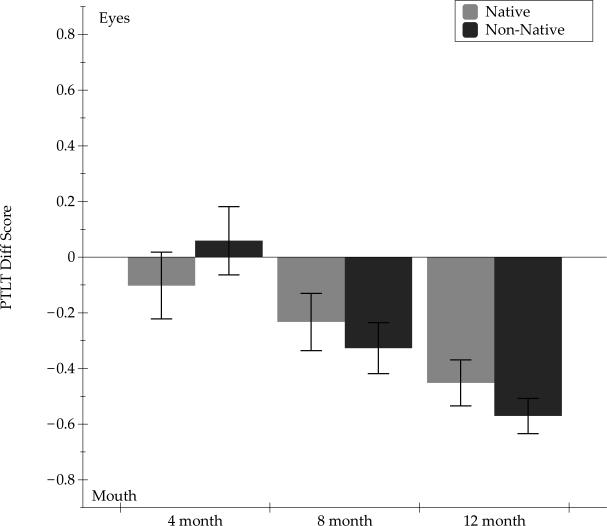
Infants growing up in bilingual environments succeed at learning two languages. What adaptive processes enable them to master the more complex nature of bilingual input? One possibility is that bilingual infants take greater advantage of the redundancy of the audiovisual speech that they usually experience during social interactions. Thus, we investigated whether bilingual infants' need to keep languages apart increases their attention to the mouth as a source of redundant and reliable speech cues. We measured selective attention to talking faces in 4-, 8-, and 12-month-old Catalan and Spanish monolingual and bilingual infants. Monolinguals looked more at the eyes than the mouth at 4 months and more at the mouth than the eyes at 8 months in response to both native and nonnative speech, but they looked more at the mouth than the eyes at 12 months only in response to nonnative speech. In contrast, bilinguals looked equally at the eyes and mouth at 4 months, more at the mouth than the eyes at 8 months, and more at the mouth than the eyes at 12 months, and these patterns of responses were found for both native and nonnative speech at all ages. Thus, to support their dual-language acquisition processes, bilingual infants exploit the greater perceptual salience of redundant audiovisual speech cues at an earlier age and for a longer time than monolingual infants.
Keywords: audiovisual speech; bilingualism; human infants; language development; multisensory perception; selective attention.
© The Author(s) 2015.
Figures
References
-
- Bosch L, Ramon-Casas M. First translation equivalents in bilingual toddlers’ expressive vocabulary: Does form similarity matter? International Journal of Behavioral Development. 2014;38:317–322.
-
- Bosch L, Sebastián-Gallés N. Native language recognition abilities in 4-month-old infants from monolingual and bilingual environments. Cognition. 1997;65:33–69. - PubMed
-
- Bosch L, Sebastián-Gallés N. Early language differentiation in bilingual infants. In: Cenoz J, Genesee F, editors. Trends in bilingual acquisition. John Benjamins Publishing Company; Amsterdam: 2001a. pp. 71–93.
Publication types
MeSH terms
Grants and funding
LinkOut - more resources
Full Text Sources
Other Literature Sources
