


Factors associated with malaria parasitemia, anemia and serological responses in a spectrum of epidemiological settings in Uganda
- PMID: 25768015
- PMCID: PMC4358889
- DOI: 10.1371/journal.pone.0118901
Factors associated with malaria parasitemia, anemia and serological responses in a spectrum of epidemiological settings in Uganda
Abstract
Background: Understanding the current epidemiology of malaria and the relationship between intervention coverage, transmission intensity, and burden of disease is important to guide control activities. We aimed to determine the prevalence of anemia, parasitemia, and serological responses to P. falciparum antigens, and factors associated with these indicators, in three different epidemiological settings in Uganda.
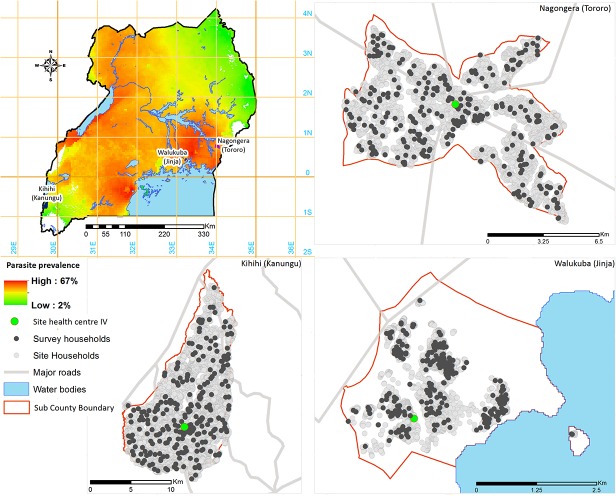
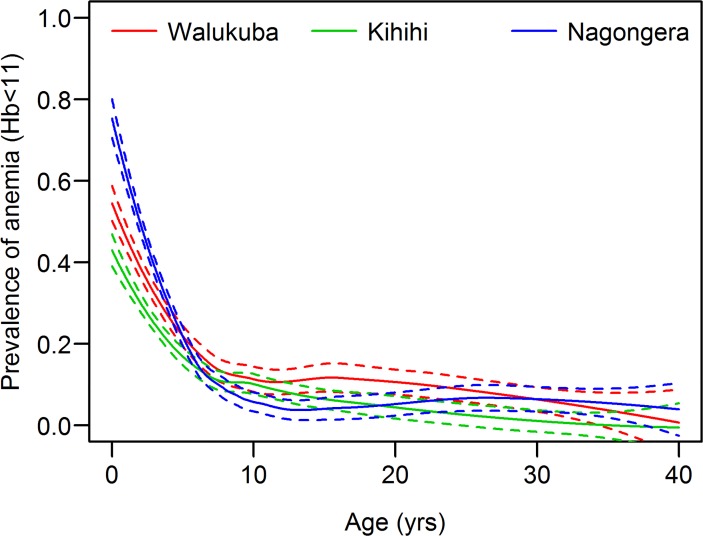
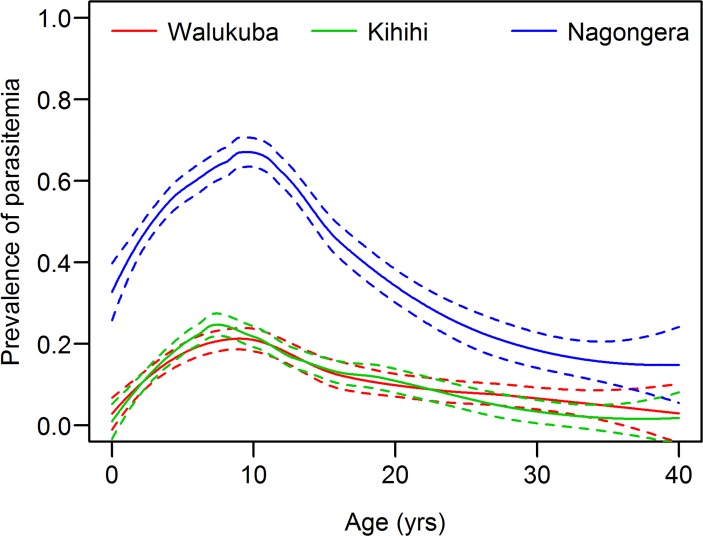
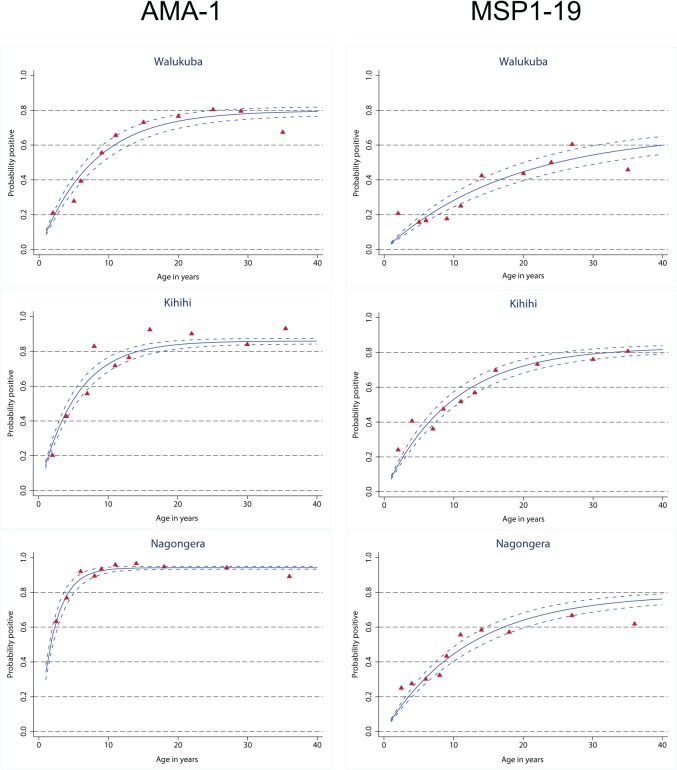
Methods and findings: In 2012, cross-sectional surveys were conducted in 200 randomly selected households from each of three sites: Walukuba, Jinja district (peri-urban); Kihihi, Kanungu district (rural); and Nagongera, Tororo district (rural) with corresponding estimates of annual entomologic inoculation rates (aEIR) of 3.8, 26.6, and 125.0, respectively. Of 2737 participants, laboratory testing was done in 2227 (81.4%), including measurement of hemoglobin, parasitemia using microscopy, and serological responses to P. falciparum apical membrane antigen 1 (AMA-1) and merozoite surface protein 1, 19 kilodalton fragment (MSP-119). Analysis of laboratory results was restricted to 1949 (87.5%) participants aged ≤ 40 years. Prevalence of anemia (hemoglobin < 11.0 g/dL) was significantly higher in Walukuba (18.9%) and Nagongera (17.4%) than in Kihihi (13.1%), and was strongly associated with decreasing age for those ≤ 5 years at all sites. Parasite prevalence was significantly higher in Nagongera (48.3%) than in Walukuba (12.2%) and Kihihi (12.8%), and significantly increased with age to 11 years, and then significantly decreased at all sites. Seropositivity to AMA-1 was 53.3% in Walukuba, 63.0% in Kihihi, and 83.7% in Nagongera and was associated with increasing age at all sites. AMA-1 seroconversion rates strongly correlated with transmission intensity, while serological responses to MSP-119 did not.
Conclusion: Anemia was predominant in young children and parasitemia peaked by 11 years across 3 sites with varied transmission intensity. Serological responses to AMA-1 appeared to best reflect transmission intensity, and may be a more accurate indicator for malaria surveillance than anemia or parasitemia.
Conflict of interest statement
Figures
References
-
- World malaria report 2010, World Health Organization, (2010) Available: http://www.who.int/malaria/world_malaria_report_2010/.
Publication types
MeSH terms
Substances
Grants and funding
LinkOut - more resources
Full Text Sources
Other Literature Sources
Medical
Molecular Biology Databases
Research Materials
