


Impact of support groups for people living with HIV on clinical outcomes: a systematic review of the literature
- PMID: 25768876
- PMCID: PMC4709521
- DOI: 10.1097/QAI.0000000000000519
Impact of support groups for people living with HIV on clinical outcomes: a systematic review of the literature
Abstract
Background: Support groups for people living with HIV are integrated into HIV care and treatment programs as a modality for increasing patient literacy and as an intervention to address the psychosocial needs of patients. However, the impact of support groups on key health outcomes has not been fully determined.
Methods: We searched electronic databases from January 1995 through May 2014 and reviewed relevant literature on the impact of support groups on mortality, morbidity, retention in HIV care, quality of life (QOL), and ongoing HIV transmission, as well as their cost-effectiveness.
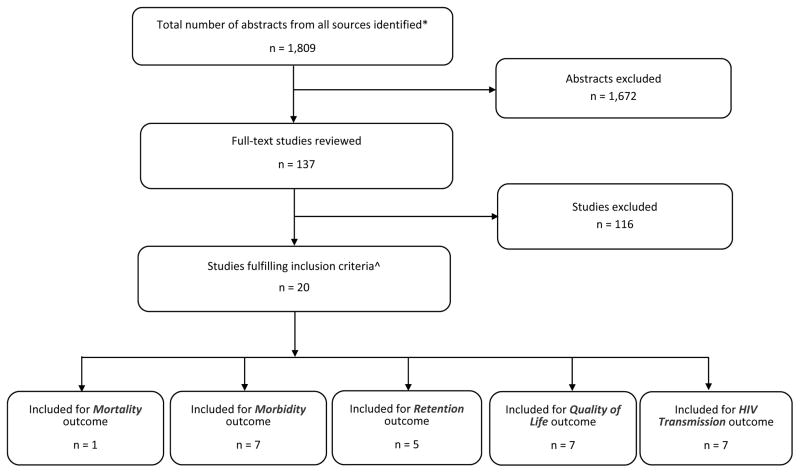
Results: Of 1809 citations identified, 20 met the inclusion criteria. One reported on mortality, 7 on morbidity, 5 on retention in care, 7 on QOL, and 7 on ongoing HIV transmission. Eighteen (90%) of the articles reported largely positive results on the impact of support group interventions on key outcomes. Support groups were associated with reduced mortality and morbidity, increased retention in care, and improved QOL. Because of study limitations, the overall quality of evidence was rated as fair for mortality, morbidity, retention in care, and QOL, and poor for HIV transmission.
Conclusions: Implementing support groups as an intervention is expected to have a high impact on morbidity and retention in care and a moderate impact on mortality and QOL of people living with HIV. Support groups improve disclosure with potential prevention benefits but the impact on ongoing transmission is uncertain. It is unclear whether this intervention is cost-effective given the paucity of studies in this area.
Conflict of interest statement
The authors have no conflicts of interest to disclose
Figures
References
-
- AIDS Information Centre (AIC) AIDS Information Centre 2004 annual report. Kampala, Uganda: 2004.
-
- WHO. Consolidated guidelines on the use of antiretroviral drugs for treating and preventing HIV infection: recommendations for a public health approach 2013 - PubMed
-
- WHO. Operations Manual for Delivery of HIV Prevention, Care and Treatment in High-Prevalence, Resource-Constrained Settings (Edition 1 for field testing and country adaptation) Chapter 4: Community. 2008 The full operations manual is available at: http://www.who.int/hiv/pub/imai/operations_manual/en/ - PubMed
-
- OGAC. Technical Considerations Provided by PEPFAR Technical Working Groups for FY 2014 COPS and ROPS. Washington, DC: OGAC; 2013. http://www.pepfar.gov/documents/organization/217761.pdf.
Publication types
MeSH terms
Grants and funding
LinkOut - more resources
Full Text Sources
Medical
Miscellaneous
