


When does cognitive functioning peak? The asynchronous rise and fall of different cognitive abilities across the life span
- PMID: 25770099
- PMCID: PMC4441622
- DOI: 10.1177/0956797614567339
When does cognitive functioning peak? The asynchronous rise and fall of different cognitive abilities across the life span
Abstract
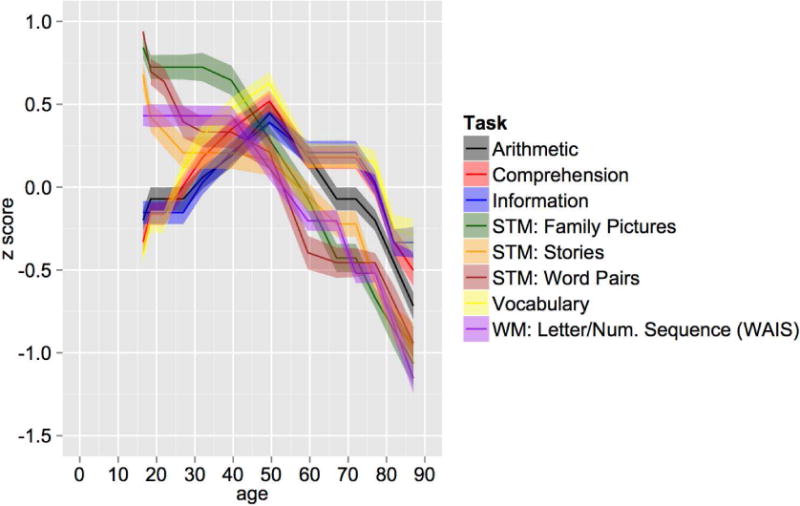
Understanding how and when cognitive change occurs over the life span is a prerequisite for understanding normal and abnormal development and aging. Most studies of cognitive change are constrained, however, in their ability to detect subtle, but theoretically informative life-span changes, as they rely on either comparing broad age groups or sparse sampling across the age range. Here, we present convergent evidence from 48,537 online participants and a comprehensive analysis of normative data from standardized IQ and memory tests. Our results reveal considerable heterogeneity in when cognitive abilities peak: Some abilities peak and begin to decline around high school graduation; some abilities plateau in early adulthood, beginning to decline in subjects' 30s; and still others do not peak until subjects reach their 40s or later. These findings motivate a nuanced theory of maturation and age-related decline, in which multiple, dissociable factors differentially affect different domains of cognition.
Keywords: cognitive ability; cognitive development; individual differences; intelligence; language development.
© The Author(s) 2015.
Conflict of interest statement
Figures



References
-
- Ardila A. Normal aging increases cognitive heterogeneity: Analysis of dispersion in WAIS-III scores across age. Archives of Clinical Neuropsychology. 2007;22:1003–1011. - PubMed
-
- Baltes PB. Theoretical propositions of life-span developmental psychology: On the dynamics between growth and decline. Developmental Psychology. 1987;23:611–626.
-
- Baron-Cohen S, Wheelwright S, Hill J. The ‘Reading the Mind in the Eyes’ test revised version: A study with normal adults and adults with Asperger Syndrome or High-Functioning autism. Journal of Child Psychology and Psychiatry. 2001;42:241–252. - PubMed
-
- Bayley N. Development of mental abilities. In: Mussen PH, editor. Carmichael’s Manual of Child Psychology. 3. Vol. 1. New York: Wiley; 1970. pp. 1163–1209.
-
- Cattell RB. Abilities: Their Structure, Growth & Action. Boston: Houghton Mifflin; 1971.
Publication types
MeSH terms
Grants and funding
LinkOut - more resources
Full Text Sources
Other Literature Sources
Medical
