


Comment
doi: 10.1073/pnas.1500911112.
Epub 2015 Mar 13.
Loss of HtrA1-induced attenuation of TGF-β signaling in fibroblasts might not be the main mechanism of CARASIL pathogenesis
Affiliations
- PMID: 25770224
- PMCID: PMC4394265
- DOI: 10.1073/pnas.1500911112
Item in Clipboard
Comment
Loss of HtrA1-induced attenuation of TGF-β signaling in fibroblasts might not be the main mechanism of CARASIL pathogenesis
Proc Natl Acad Sci U S A.
.
No abstract available
Conflict of interest statement
The authors declare no conflict of interest.
Figures
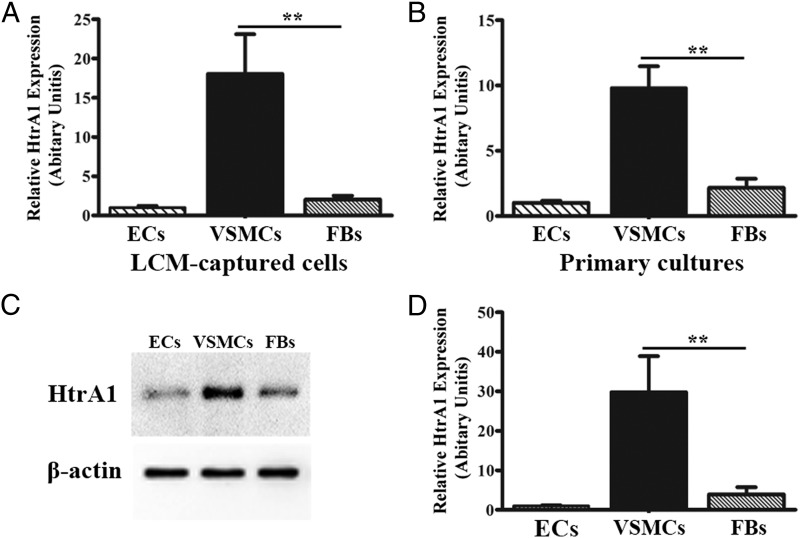
Expression pattern of HtrA1 in small arteries. RT-PCR analysis of HtrA1 expression in LCM-captured (A) and primary-cultured (B) ECs, VSMCs, and FBs from human coronary small arteries. n = 3, **P < 0.01. (C) Immunoblots of HtrA1 and β-actin protein in primary-cultured cells. (D) Quantification of HtrA1 secretion from primary-cultured cells by ELISA. n = 3, **P < 0.01.
Comment in
-
Reply to Liu et al.: Loss of TGF-β signaling in CARASIL pathogenesis.Proc Natl Acad Sci U S A. 2015 Apr 7;112(14):E1694. doi: 10.1073/pnas.1501817112. Epub 2015 Mar 13. Proc Natl Acad Sci U S A. 2015. PMID: 25770223 Free PMC article. No abstract available.
Comment on
-
Cerebral small vessel disease-related protease HtrA1 processes latent TGF-β binding protein 1 and facilitates TGF-β signaling.Proc Natl Acad Sci U S A. 2014 Nov 18;111(46):16496-501. doi: 10.1073/pnas.1418087111. Epub 2014 Nov 4. Proc Natl Acad Sci U S A. 2014. PMID: 25369932 Free PMC article.
References
-
- Arima K, Yanagawa S, Ito N, Ikeda S. Cerebral arterial pathology of CADASIL and CARASIL (Maeda syndrome) Neuropathology. 2003;23(4):327–334. - PubMed
-
- Leask A, Abraham DJ. TGF-beta signaling and the fibrotic response. FASEB J. 2004;18(7):816–827. - PubMed
-
- Hara K, et al. Association of HTRA1 mutations and familial ischemic cerebral small-vessel disease. N Engl J Med. 2009;360(17):1729–1739. - PubMed
Publication types
MeSH terms
Substances
LinkOut - more resources
Full Text Sources
Other Literature Sources
Medical
