


Predictors of intentions to quit smoking in Aboriginal tobacco smokers of reproductive age in regional New South Wales (NSW), Australia: quantitative and qualitative findings of a cross-sectional survey
- PMID: 25770232
- PMCID: PMC4360823
- DOI: 10.1136/bmjopen-2014-007020
Predictors of intentions to quit smoking in Aboriginal tobacco smokers of reproductive age in regional New South Wales (NSW), Australia: quantitative and qualitative findings of a cross-sectional survey
Abstract
Objectives: To assess the predictors of intentions to quit smoking in a community sample of Aboriginal smokers of reproductive age, in whom smoking prevalence is slow to decline.
Design, setting and participants: A cross-sectional survey involved 121 Aboriginal smokers, aged 18-45 years from January to May 2014, interviewed at community events on the Mid-North Coast NSW. Qualitative and quantitative data were collected on smoking and quitting attitudes, behaviours and home smoking rules. Perceived efficacy for quitting, and perceived threat from smoking, were uniquely assessed with a validated Risk Behaviour Diagnosis (RBD) Scale.
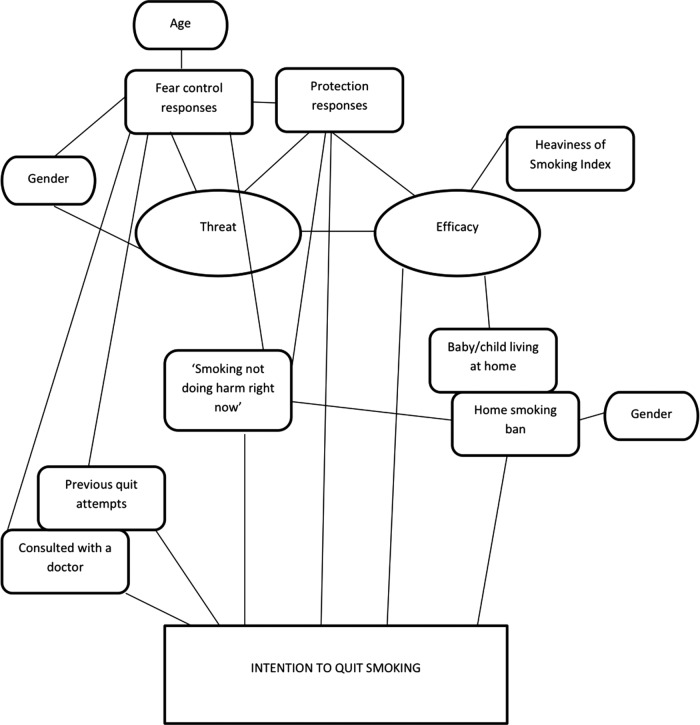
Main outcome measures: Logistic regression explored the impact of perceived efficacy, perceived threat and consulting previously with a doctor or health professional (HP) on self-reported intentions to quit smoking, controlling for potential confounders, that is, protection responses and fear control responses, home smoking rules, gender and age. Participants' comments regarding smoking and quitting were investigated via inductive analysis, with the assistance of Aboriginal researchers.
Results: Two-thirds of smokers intended to quit within 3 months. Perceived efficacy (OR=4.8; 95% CI 1.78 to 12.93) and consulting previously with a doctor/HP about quitting (OR=3.82; 95% CI 1.43 to 10.2) were significant predictors of intentions to quit. 'Smoking is not doing harm right now' was inversely associated with quit intentions (OR=0.25; 95% CI 0.08 to 0.8). Among those who reported making a quit attempt, after consulting with a doctor/HP, 40% (22/60) rated the professional support received as low (0-2/10). Qualitative themes were: the negatives of smoking (ie, disgust, regret, dependence and stigma), health effects and awareness, quitting, denial, 'smoking helps me cope' and social aspects of smoking.
Conclusions: Perceived efficacy and consulting with a doctor/HP about quitting may be important predictors of intentions to quit smoking in Aboriginal smokers of reproductive age. Professional support was generally perceived to be low; thus, it could be improved for these Aboriginal smokers. Aboriginal participants expressed strong sentiments about smoking and quitting.
Keywords: PREVENTIVE MEDICINE; PUBLIC HEALTH; QUALITATIVE RESEARCH.
Published by the BMJ Publishing Group Limited. For permission to use (where not already granted under a licence) please go to http://group.bmj.com/group/rights-licensing/permissions.
Figures
References
-
- Commonwealth of Australia. National Tobacco Strategy 2012–2018—a strategy to improve the health of all Australians by reducing the prevalence of smoking and its associated health, social and economic costs, and the inequalities it causes. Canberra: Commonwealth of Australia, 2012.
-
- Australian Bureau of Statistics. 4727.0.55.006—Australian Aboriginal and Torres Strait Islander Health Survey: Updated Results, 2012–13. Canberra: Australian Bureau of Statistics, 2014. [updated 16 Jul 2014, 11 Oct 2014]. Australian Bureau of Statistics. 4727.0.55.006—Australian Aboriginal and Torres Strait Islander Health Survey: Updated Results.
-
- Australian Institute of Health and Welfare. National Drugs Strategy Household Surveys Canberra: Australian Government; 2013 [cited 19 July 2014]. Available from: http://aihw.gov.au/alcohol-and-other-drugs/ndshs/2013/tobacco/.
Publication types
MeSH terms
LinkOut - more resources
Full Text Sources
Other Literature Sources
Medical
Research Materials
Miscellaneous
