


Thinking Well: A randomised controlled feasibility study of a new CBT therapy targeting reasoning biases in people with distressing persecutory delusional beliefs
- PMID: 25770671
- PMCID: PMC4429971
- DOI: 10.1016/j.jbtep.2015.02.007
Thinking Well: A randomised controlled feasibility study of a new CBT therapy targeting reasoning biases in people with distressing persecutory delusional beliefs
Abstract
Background and objectives: Delusional beliefs with persecutory content are common in psychosis, but difficult to treat. Interventions targeting hypothesised causal and maintaining factors have been proposed as a way of improving therapy. The current study is a feasibility randomised controlled trial of the 'Thinking Well (TW)' intervention: This novel approach combines the recently developed Maudsley Review Training Programme (MRTP), with additional, focussed cognitive-behavioural therapy sessions.
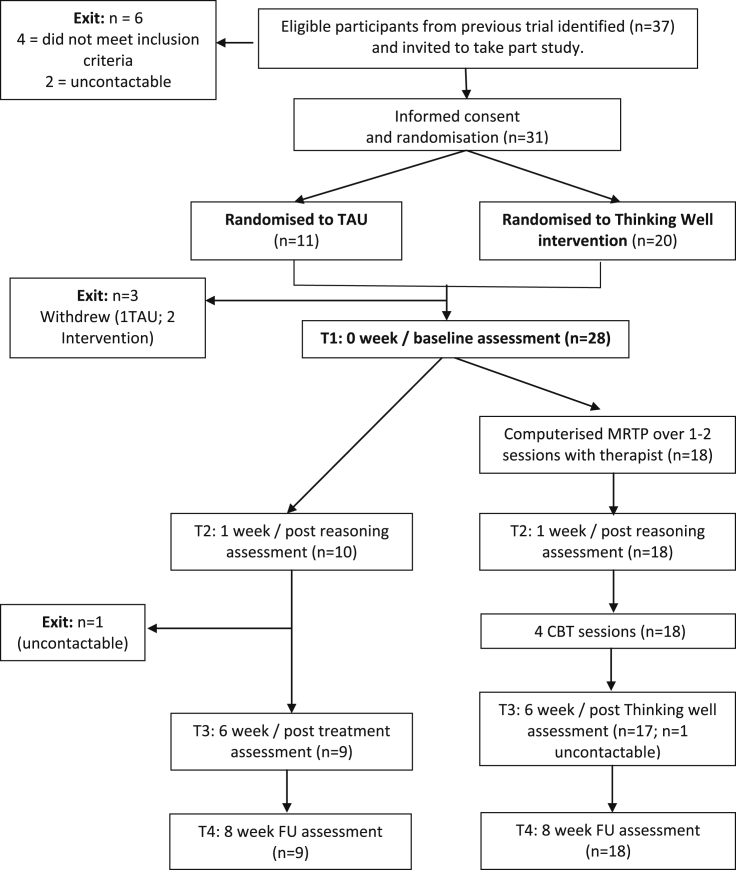
Methods: 31 participants with distressing persecutory delusions and schizophrenia spectrum disorders were randomised to TW or to treatment as usual in a 2:1 ratio. Participants completed outcome assessments at 0 (baseline), 1 (post-MRTP), 6 (post-TW) and 8 (follow-up) weeks. Key outcomes included belief flexibility, paranoia, and delusional conviction and distress. Participants allocated to TW completed the MRTP package and four CBT sessions with a clinical psychologist.
Results: Recruitment proved feasible. Participants reported the intervention was relevant and had resulted in positive changes in thinking and mood, which they could use in everyday life. Treatment effects were moderate-large for key outcomes including belief flexibility, paranoia conviction and distress. The additional TW sessions appeared to confer benefits over MRTP alone.
Limitations: Assessments were not carried out blind to treatment condition. Recruitment was opportunistic, from an identified pool of research participants. Finally, a few participants had already completed the MRTP as part of a previous study.
Conclusions: The TW intervention appears to be feasible and acceptable to participants, and the effects of treatment are promising. A fully powered randomised controlled trial of the intervention is warranted.
Keywords: Belief flexibility; CBT; Psychosis; Reasoning.
Copyright © 2015 The Authors. Published by Elsevier Ltd.. All rights reserved.
References
-
- Andreasen N.C. University of Iowa; Iowa City; IA: 1984. Scale for the Assessment of Positive Symptoms (SAPS)
-
- Coid J., Ullrich S., Kallis C., Keers R., Barker D., Cowden F. The relationship between delusions and violence. JAMA Psychiatry. 2013;70:465–471. - PubMed
-
- Evans J.S. Dual processing accounts of reasoning, judgment and social cognition. Annual Review of Clinical Psychology. 2008;59:255–278. - PubMed
-
- Freeman D. Improving cognitive treatments for delusions. Schizophrenia Research. 2011;132(2–3):135–139. - PubMed
Publication types
MeSH terms
Grants and funding
LinkOut - more resources
Full Text Sources
Other Literature Sources
Medical
