


The Internalization of Neurotensin by the Low-Affinity Neurotensin Receptors (NTSR2 and vNTSR2) Activates ERK 1/2 in Glioma Cells and Allows Neurotensin-Polyplex Transfection of tGAS1
- PMID: 25772140
- PMCID: PMC11486267
- DOI: 10.1007/s10571-015-0172-z
The Internalization of Neurotensin by the Low-Affinity Neurotensin Receptors (NTSR2 and vNTSR2) Activates ERK 1/2 in Glioma Cells and Allows Neurotensin-Polyplex Transfection of tGAS1
Abstract
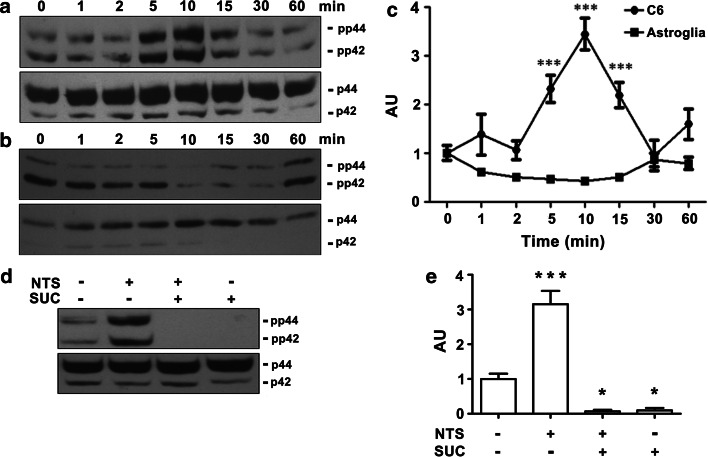
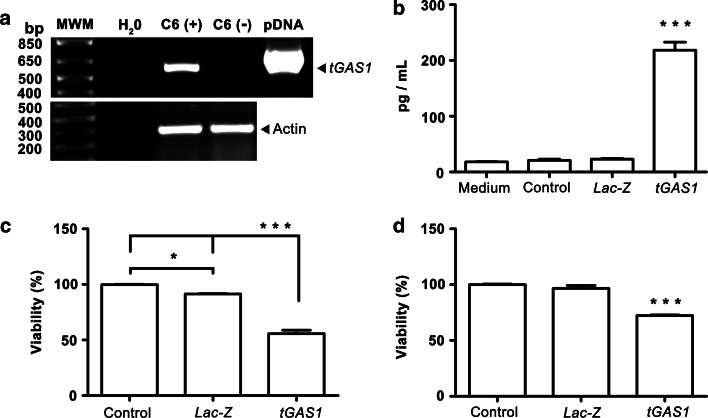
Glioblastoma is the most malignant primary brain tumor and is very resistant to treatment; hence, it has a poor prognosis. Neurotensin receptor type 1 (NTSR1) plays a key role in cancer malignancy and has potential therapeutic applications. However, the presence and function of neurotensin (NTS) receptors in glioblastoma is not clearly established. RT-PCR assays showed that healthy (non-tumor) astroglial cells and C6 glioma cells express NTSR2 and its isoform (vNTSR2) rather than NTSR1. In glioma cells, NTS promotes the phosphorylation of extracellular signal-regulated kinases 1/2 (ERK 1/2), an effect that was completely abolished by blocking the internalization of the NTS/NTSR complex. We demonstrated pharmacologically that the internalization is dependent on the activation of NTSR2 receptors and it was prevented by levocabastine, a NTSR2 receptor antagonist. The internalization of NTSR2 and vNTSR2 was further demonstrated by its ability to mediate gene transfer (transfection) via the NTS-polyplex system. Expression of reporter transgenes and of the pro-apoptotic soluble form of growth arrest specific 1 (tGAS1) was observed in glioma cells. A significant reduction on the viability of C6 cells was determined when tGAS1 was transfected into glioma cells. Conversely, astroglial cells could neither internalize NTS nor activate ERK 1/2 and could not be transfected by the NTS-polyplex. These results demonstrate that the internalization process of NTSR2 receptors is a key regulator necessary to trigger the activation of the ERK 1/2. Our data support a new internalization pathway in glioma C6 cells that involve NTSR2/vNTSR2, which can be used to selectively transfer therapeutic genes using the NTS-polyplex system.
Conflict of interest statement
The authors declare that they have no conflict of interest.
Figures



References
-
- Ahn S, Shenoy SK, Wei H, Lefkowitz RJ (2004) Differential kinetic and spatial patterns of beta-arrestin and G protein-mediated ERK activation by the angiotensin II receptor. J Biol Chem 279:35518–35525 - PubMed
-
- Alifano M et al (2010) Neurotensin receptor 1 determines the outcome of non-small cell lung cancer. Clin Cancer Res 16:4401–4410 - PubMed
-
- Arango-Rodriguez ML et al (2006) Biophysical characteristics of neurotensin polyplex for in vitro and in vivo gene transfection. Biochim Biophys Acta 1760:1009–1020 - PubMed
-
- Benitez JA, Arregui L, Vergara P, Segovia J (2007) Targeted-simultaneous expression of Gas1 and p53 using a bicistronic adenoviral vector in gliomas. Cancer Gene Ther 14:836–846 - PubMed
Publication types
MeSH terms
Substances
LinkOut - more resources
Full Text Sources
Miscellaneous
