. 2015 Oct;136(4):983-92.e7.
doi: 10.1016/j.jaci.2015.01.029. Epub 2015 Mar 13.

Jug r 2-reactive CD4(+) T cells have a dominant immune role in walnut allergy

Affiliations

Jug r 2-reactive CD4(+) T cells have a dominant immune role in walnut allergy

Luis Diego Archila et al. J Allergy Clin Immunol. 2015 Oct.

Abstract

Background: Allergic reactions to walnut can be life-threatening. Although IgE epitopes of walnut have been studied, CD4(+) T cell-specific epitopes for walnut remain uncharacterized. In particular, the relationship of both phenotype and frequency of walnut-specific T cells to the disease have not been examined.

Objectives: We sought to provide a thorough phenotypic analysis for walnut-reactive T cells in allergic and nonallergic subjects, particularly the relationship of phenotypes and frequencies of walnut-specific T cells with the disease.

Methods: The CD154 upregulation assay was used to examine CD4(+) T-cell reactivity toward the walnut allergens Jug r 1, Jug r 2, and Jug r 3. A tetramer-guided epitope mapping approach was used to identify HLA-restricted CD4(+) T-cell epitopes in Jug r 2. Direct ex vivo staining with peptide-major histocompatibility complex class II tetramers enabled comparison of the frequency and phenotype of Jug r 2-specific CD4(+) T cells between allergic and nonallergic subjects. Jug r 2-specific T-cell clones were also generated, and mRNA transcription factor levels were assessed by using quantitative RT-PCR. Intracellular cytokine staining assays were performed for further phenotypic analyses.

Results: Jug r 2 was identified as the major allergen that elicited CD4(+) T-cell responses. Multiple Jug r 2 T-cell epitopes were identified. The majority of these T cells in allergic subjects have a CCR4(+) phenotype. A subset of these T cells express CCR4(+)CCR6(+) irrespective of the asthmatic status of the allergic subjects. Intracellular cytokine staining confirmed these TH2-, TH2/TH17-, and TH17-like heterogenic profiles. Jug r 2-specific T-cell clones from allergic subjects mainly expressed GATA3, nonetheless, a portion of T-cell clones both GATA3 and RAR-related orphan receptor C (RORC) or RORC alone, confirming the presence of TH2, TH2/TH17, and TH17 cells.

Conclusions: Jug r 2-specific responses dominate walnut T-cell responses in patients with walnut allergy. Jug r 2 central memory CD4(+) cells and terminal effector T cells were detected in peripheral blood, with the central memory phenotype as the most prevalent phenotype. In addition to conventional TH2 cells, TH2/TH17 and TH17 cells were also detected in nonasthmatic and asthmatic patients with walnut allergy. Understanding this T-cell heterogeneity might render better understanding of the disease manifestation.

Keywords: Food allergy; Jug r 2; MHC class II tetramers; T cells; epitopes; walnut.


Figures

Figure 1
Figure 1
Frequencies of walnut allergen reactive CD4+ T-cells. A, Frequencies of Jug r 1-, Jug r 2- and Jug r 3-reactive T-cells in subjects with walnut allergy (n=11; filled squares) and non-allergic subjects (n=8; opened circles) with CD154 assays. Each data point represents the frequency of T-cells reactive to each allergen. An ANOVA test (with Bonferroni correction) was used to compare all columns in the statistical analysis. B, Frequencies of Jug r 2 epitope-reactive T-cells in subjects with walnut allergy (n=17; filled squares) and subjects without walnut allergy (n=19; opened circles) with tetramer assays. Each data point represents the frequency of T-cells specific to a combination of epitopes in Jug r 2. A Student t test was used in the statistical analysis. *P<0.05, **P<0.001, ***P<0.0001. NS. Not significant.
Figure 2
Figure 2
Phenotypes of Jug r 2 reactive T-cells. A, First row, profile in a DRB1*15:01 non-allergic subject. Second row, profile in a DRB1*15:01 allergic subject. The percentages of surface markers expressed by Jug r 2-specific T-cells are as indicated. B, Ex vivo expression of CCR4, CRTH2, CCR6, CXCR3 and CD27 of Jug r 2-specific T-cells in subjects with walnut allergy (n=17; filled square) and subjects without walnut allergy (n=19; opened circle). Each data point represents the percentage of tetramer positive T-cells with marker expression. C, Ex vivo frequencies of CCR4, CRTH2, CCR6, CXCR3 and CD27 expressing Jug r 2-specific T-cells per million CD4+ T-cells in subjects with walnut allergy (n=17; filled square) and subjects without walnut allergy (n=19; opened circle). Each data point represents the frequency of T-cells specific to a combination of epitopes in Jug r 2. D, Tetramer positive CD45RA T-cells were gated against CCR7 and CD27. Data are representative of 8 allergic subjects. E, Tetramer positive CD45RA T-cells were gated against CCR4 and CCR6; CXCR3 and CCR6. Each data point represents results for surface expression in tetramer positive T-cells from 17 subjects with walnut allergy (filled square) and 19 subjects without walnut allergy (opened circle). F, Surface expression of CCR4 and CCR6 was analyzed on tetramer positive T-cells from non-asthmatic and asthmatic walnut allergic subjects. A Student t test was used in the statistical analysis for Figure 1B, C, E and F. An ANOVA test (with Bonferroni correction) was used to compare all columns in the statistical analysis for Figure 1D. *P<0.05, **P<0.001, ***P<0.0001. NS. Not significant.
Figure 3
Figure 3
Jug r 2 T-cell subsets. A and B, Phenotype of T-cell clones derived from 6 non-allergic (Figure 3, A) and 8 allergic (Figure 3, B) subjects. Phenotype profiles based on surface marker expression and cytokine production in TH2= 45 TH2/TH17=6, TH17=8 TH1*=12 T-cell clones. *Derived from non-allergic subjects. The numbers of T-cell clones for each profile and specificity are as indicated. Percentages of clones for each specificity are presented as mean values from each group in pie charts. C, mRNA levels corresponding to GATA-3, TBX21, and RORC were assessed by quantitative PCR. Data were expressed as relative amounts of cytokine mRNA in Jug r 2 epitope-specific T-cell clones derived from 6 non-allergic and 8 allergic subjects. Data were normalized based on relative amounts of GTF2B mRNA.
Figure 4
Figure 4
Cytokine profiles of Jug r 2-reactiveT-cells. A, First row, Cytokine profile in a DRB1*15:01 non-allergic subject. Second row, Cytokine profile in a DR15:01 allergic subject. The frequencies of Jug r 2-specific cytokine producing T-cells per million CD4+ T-cells are as indicated. B. Gating strategy for identifying IL-4, IL-4+IL-13 and IL-4+IL-13+1L-5 Jug r-2 reactive T-cells, in this subject IL-4= 40.4%, IL-4+IL-13=36.5%, IL4+IL13+IL-5=21.2%. C and D, Cytokine profiles of Jug r 2-reactive T-cells in non-allergic and allergic subjects. Data are representative of 11 subjects with walnut allergy and 8 non-allergic subjects and are presented as the mean frequency of cytokine producing T-cells from each group in pie charts.
Figure 5
Figure 5
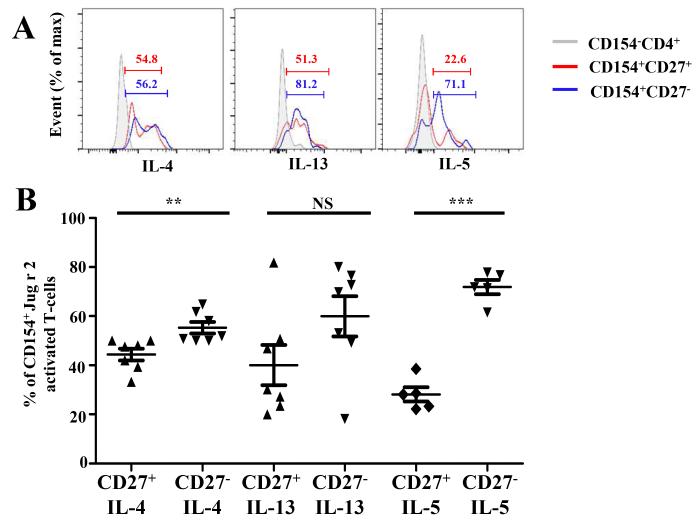
Ex vivo cytokine producing capacities of CD27+ and CD27 Jug r 2-reactive T-cells. A,IL-4, IL-13 and IL-5 expression by CD27+ (red histogram), CD27 (blue histogram) and CD154CD4+ as control (grey histogram). B, Cytokine production by CD27+ and CD27 CD154+Jug r 2-reactive T-cells in allergic subjects. Data are representative of 7 allergic subjects. A Student t test was used in the statistical analysis. *P<0.05, **P<0.001, ***P<0.0001. NS. Not significant.

References

    1. Sicherer SH, Munoz-Furlong A, Godbold JH, Sampson HA. US prevalence of self-reported peanut, tree nut, and sesame allergy: 11-year follow-up. J Allergy Clin Immunol. 2010 Jun;125(6):1322–6. - PubMed
    1. Fleischer DM, Conover-Walker MK, Matsui EC, Wood RA. The natural history of tree nut allergy. J Allergy Clin Immunol. 2005 Nov;116(5):1087–93. - PubMed
    1. Fleischer DM. The natural history of peanut and tree nut allergy. Curr Allergy Asthma Rep. 2007 Jun;7(3):175–81. - PubMed
    1. Sicherer SH, Furlong TJ, Munoz-Furlong A, Burks AW, Sampson HA. A voluntary registry for peanut and tree nut allergy: characteristics of the first 5149 registrants. J Allergy Clin Immunol. 2001 Jul;108(1):128–32. - PubMed
    1. Sicherer SH, Sampson HA. Food allergy: Epidemiology, pathogenesis, diagnosis, and treatment. J Allergy Clin Immunol. 2014 Feb;133(2):291–307. - PubMed

Publication types

MeSH terms