


Functional MRI of music emotion processing in frontotemporal dementia
- PMID: 25773639
- PMCID: PMC4402026
- DOI: 10.1111/nyas.12620
Functional MRI of music emotion processing in frontotemporal dementia
Abstract
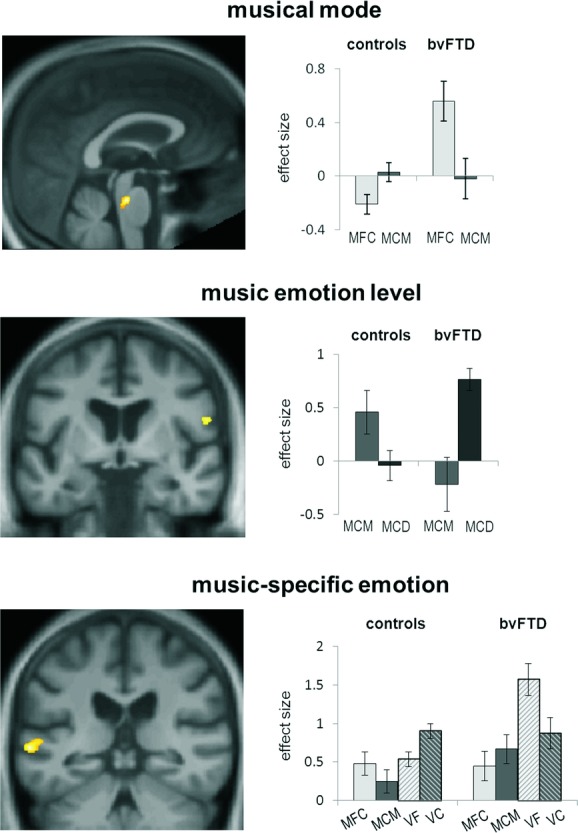
Frontotemporal dementia is an important neurodegenerative disorder of younger life led by profound emotional and social dysfunction. Here we used fMRI to assess brain mechanisms of music emotion processing in a cohort of patients with frontotemporal dementia (n = 15) in relation to healthy age-matched individuals (n = 11). In a passive-listening paradigm, we manipulated levels of emotion processing in simple arpeggio chords (mode versus dissonance) and emotion modality (music versus human emotional vocalizations). A complex profile of disease-associated functional alterations was identified with separable signatures of musical mode, emotion level, and emotion modality within a common, distributed brain network, including posterior and anterior superior temporal and inferior frontal cortices and dorsal brainstem effector nuclei. Separable functional signatures were identified post-hoc in patients with and without abnormal craving for music (musicophilia): a model for specific abnormal emotional behaviors in frontotemporal dementia. Our findings indicate the potential of music to delineate neural mechanisms of altered emotion processing in dementias, with implications for future disease tracking and therapeutic strategies.
Keywords: bvFTD; emotion; fMRI; music; musicophilia; voice.
© 2014 The Authors. Annals of the New York Academy of Sciences published by Wiley Periodicals Inc. on behalf of The New York Academy of Sciences.
Figures
References
Publication types
MeSH terms
Grants and funding
LinkOut - more resources
Full Text Sources
Other Literature Sources
Medical
