


High prevalence of "Candidatus Rickettsia andeanae" and apparent exclusion of Rickettsia parkeri in adult Amblyomma maculatum (Acari: Ixodidae) from Kansas and Oklahoma
- PMID: 25773931
- PMCID: PMC4487539
- DOI: 10.1016/j.ttbdis.2015.02.001
High prevalence of "Candidatus Rickettsia andeanae" and apparent exclusion of Rickettsia parkeri in adult Amblyomma maculatum (Acari: Ixodidae) from Kansas and Oklahoma
Abstract
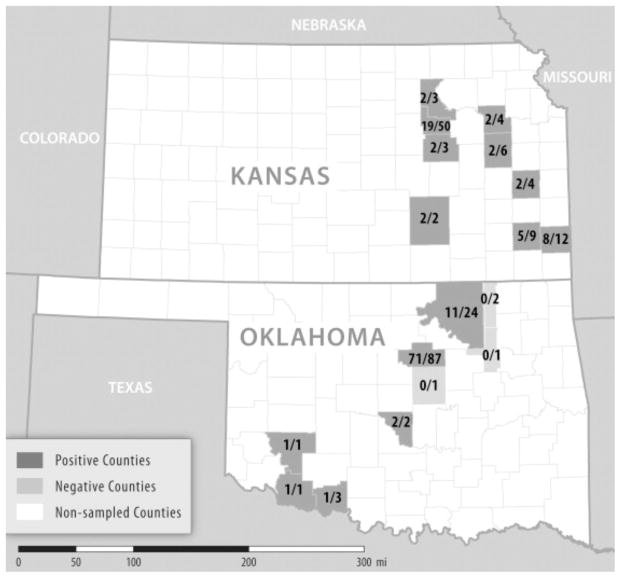
Amblyomma maculatum (the Gulf Coast tick), an aggressive, human-biting, Nearctic and Neotropical tick, is the principal vector of Rickettsia parkeri in the United States. This pathogenic spotted fever group Rickettsia species has been identified in 8-52% of questing adult Gulf Coast ticks in the southeastern United States. To our knowledge, R. parkeri has not been reported previously from adult specimens of A. maculatum collected in Kansas or Oklahoma. A total of 216 adult A. maculatum ticks were collected from 18 counties in Kansas and Oklahoma during 2011-2014 and evaluated by molecular methods for evidence of infection with R. parkeri. No infections with this agent were identified; however, 47% of 94 ticks collected from Kansas and 73% of 122 ticks from Oklahoma were infected with "Candidatus Rickettsia andeanae" a spotted fever group Rickettsia species of undetermined pathogenicity. These preliminary data suggest that "Ca. R. andeanae" is well-adapted to survival in populations of A. maculatum in Kansas and Oklahoma, and that its ubiquity in Gulf Coast ticks in these states may effectively exclude R. parkeri from their shared arthropod host, which could diminish markedly or preclude entirely the occurrence of R. parkeri rickettsiosis in this region of the United States.
Keywords: Amblyomma maculatum; Rickettsia parkeri; Rickettsial interference; “Candidatus Rickettsia andeanae”.
Published by Elsevier GmbH.
Figures
References
-
- Abaraca K, Lopez J, Acosta-Jamett G, Lepe P, Soares JF, Labruna MB. A third Amblyomma species and the first tick-borne rickettsiosis in Chile. J Med Entomol. 2012;49:219–222. - PubMed
-
- Apperson CS, Engber B, Nicholson WL, Mead DG, Engel J, Yabsley MJ, Dail K, Johnson J, Watson DW. Tick-borne diseases in North Carolina: is “Rickettsia amblyommii” a possible cause of rickettsiosis reported as Rocky Mountain spotted fever? Vector Borne Zoonotic Dis. 2008;8:597–606. - PubMed
-
- Barrett A, Little SE, Shaw E. “Rickettsia amblyommii” and R. montanensis infection in dogs following natural exposure to ticks. Vector Borne Zoonotic Dis. 2014;14:20–25. - PubMed
-
- Blair PJ, Jiang J, Schoeler GB, Moron C, Anaya E, Cespedes M, Cruz C, Felices V, Guevara C, Mendoza L, Villaseca P, Sumner JW, Richards AL, Olson JG. Characterization of spotted fever group rickettsiae in flea and tick specimens from northern Peru. J Clin Microbiol. 2004;42:4961–4967. - PMC - PubMed
-
- Blanton LS, Mendell NL, Walker DH, Bouyer DH. “Rickettsia amblyommii” induces cross protection against lethal Rocky Mountain spotted fever in a guinea pig model. Vector Borne Zoonotic Dis. 2014;14:557–562. - PubMed
Publication types
MeSH terms
Grants and funding
LinkOut - more resources
Full Text Sources
Other Literature Sources
