. 2015 Mar 13:6:5.
doi: 10.1186/s13293-015-0023-0. eCollection 2015.

The evolution of sex differences in disease

Affiliations

The evolution of sex differences in disease

Edward H Morrow. Biol Sex Differ. .

Abstract

It is now becoming widely recognized that there are important sex differences in disease. These include rates of disease incidence, symptoms and age of onset. These differences between the sexes can be seen as a subset of the more general phenomenon of sexual dimorphism of quantitative phenotypes. From a genetic point of view, this is paradoxical, since the vast majority of genetic material is shared between the sexes. How can males and females differ in so many ways and yet have a common genetic code? Traditionally, the modifying action of hormones has been offered as a solution to this paradox, but experiments disentangling the effects of hormones and sex-chromosomes have shown that this cannot be the sole explanation. In this review, I outline current ideas about the evolutionary origins of sex differences in phenotypes, with a particular focus on how sex differences in disease can arise. I also discuss how sex differences in themselves can generate new risk factors for disease, in effect becoming a new environmental factor, as well as briefly reviewing more general evidence for sexually antagonistic selection and genetic variation within humans. Taking an evolutionary view on sex differences in disease provides an opportunity for greater understanding of mechanisms of disease and as such provides a clear motivation for clinicians to explore how therapies may be tailored to the individual in a sex-dependent way.

Keywords: Darwinian medicine; Evolutionary medicine; Gender medicine; Natural selection; Personalized medicine; Sex-chromosomes; Sex-specific genetic architecture; Sexual dimorphism; Sexual selection.


Figures
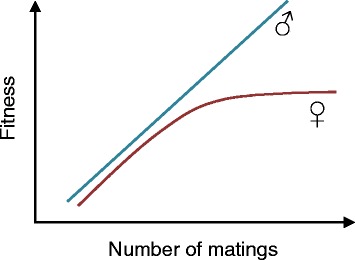
Figure 1
Figure 1
Bateman gradients. For males, fitness (in terms of reproductive output) is a simple linear function of the number of matings (or investment made in reproduction). For females however, the function is one of diminishing returns as fitness reaches a limit, at least over the short term, at an intermediate number of matings.
Figure 2
Figure 2
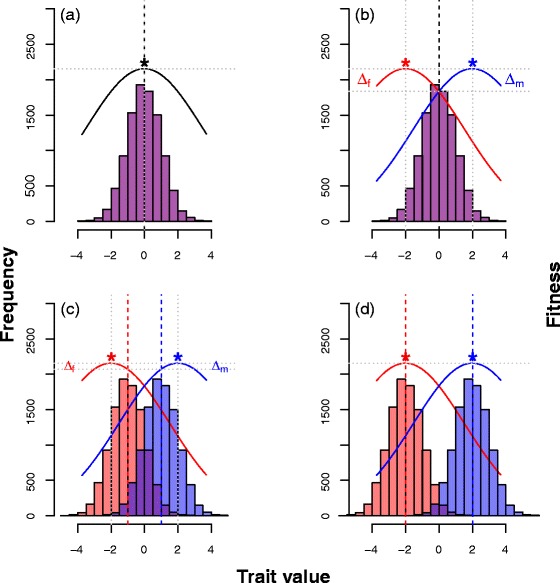
Evolution of sexual dimorphism over four stages. Each panel shows the frequency distribution of trait values for a hypothetical population (females (red), males (blue), overlap (purple)) and fitness surfaces (solid lines). Mean phenotypic trait values given by dashed vertical lines, optimum trait values given by asterisks, where fitness is maximized. (a) The trait experiences stabilizing selection to a single optimum trait value and the trait is sexual monomorphic; (b) the trait experiences sex-specific selection (red and blue fitness surfaces and optima) but is sexually monomorphic. As a consequence the population experiences a gender load (sum of Δf and Δm), which is the difference between the maximum possible fitness (upper horizontal gray dotted line) and the fitness achieved by the population mean (lower horizontal gray dotted line); (c) the trait experiences sex-specific selection but has evolved sexual dimorphism, the population therefore experiences a reduced gender-load; (d) the trait experiences sex-specific selection but since the extent of sexual dimorphism matches the fitness optima, the gender-load has been eliminated.

References

    1. Arnold AP. Promoting the understanding of sex differences to enhance equity and excellence in biomedical science. Biol Sex Differ. 2010;1:1. doi: 10.1186/2042-6410-1-1. - DOI - PMC - PubMed
    1. Shah K, McCormack CE, Bradbury NA. Do you know the sex of your cells? Am J Physiol Cell Physiol. 2014;306:C3–18. doi: 10.1152/ajpcell.00281.2013. - DOI - PMC - PubMed
    1. Clayton JA, Collins FS. Policy: NIH to balance sex in cell and animal studies. Nature. 2014;509:282–3. doi: 10.1038/509282a. - DOI - PMC - PubMed
    1. Check HE. Sex bias blights drug studies. Nat News. 2010;464:332–3. doi: 10.1038/464332b. - DOI - PubMed
    1. Ober C, Loisel DA, Gilad Y. Sex-specific genetic architecture of human disease. Nat Rev Genet. 2008;9:911–22. doi: 10.1038/nrg2415. - DOI - PMC - PubMed

LinkOut - more resources