


Are movements necessary for the sense of body ownership? Evidence from the rubber hand illusion in pure hemiplegic patients
- PMID: 25775041
- PMCID: PMC4361688
- DOI: 10.1371/journal.pone.0117155
Are movements necessary for the sense of body ownership? Evidence from the rubber hand illusion in pure hemiplegic patients
Abstract
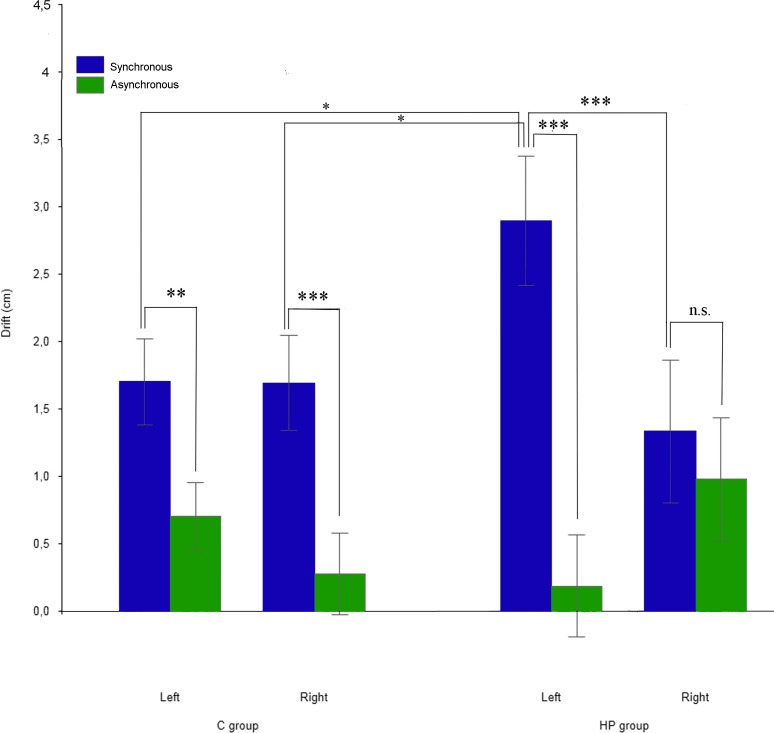
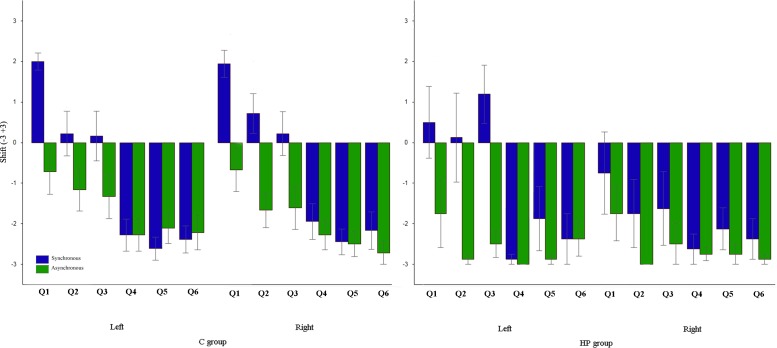
A question still debated within cognitive neuroscience is whether signals present during actions significantly contribute to the emergence of human's body ownership. In the present study, we aimed at answer this question by means of a neuropsychological approach. We administered the classical rubber hand illusion paradigm to a group of healthy participants and to a group of neurological patients affected by a complete left upper limb hemiplegia, but without any propriceptive/tactile deficits. The illusion strength was measured both subjectively (i.e., by a self-report questionnaire) and behaviorally (i.e., the location of one's own hand is shifted towards the rubber hand). We aimed at examining whether, and to which extent, an enduring absence of movements related signals affects body ownership. Our results showed that patients displayed, respect to healthy participants, stronger illusory effects when the left (affected) hand was stimulated and no effects when the right (unaffected) hand was stimulated. In other words, hemiplegics had a weaker/more flexible sense of body ownership for the affected hand, but an enhanced/more rigid one for the healthy hand. Possible interpretations of such asymmetrical distribution of body ownership, as well as limits of our results, are discussed. Broadly speaking, our findings suggest that the alteration of the normal flow of signals present during movements impacts on human's body ownership. This in turn, means that movements have a role per se in developing and maintaining a coherent body ownership.
Conflict of interest statement
Figures
References
-
- Gallagher II (2000) Philosophical conceptions of the self: implications for cognitive science. Trends in Cognitive Sciences 4: 14–21. - PubMed
-
- James W (1890) The principles of psychology New York: Dover.
-
- Botvinick M, Cohen J (1998) Rubber hands 'feel' touch that eyes see. Nature 391: 756 - PubMed
-
- Costantini M, Haggard P (2007) The rubber hand illusion: sensitivity and reference frame for body ownership. Consciousness and Cognition 16: 229–240. - PubMed
-
- Ehrsson HH, Spence C, Passingham RE (2004) That's my hand! Activity in premotor cortex reflects feeling of ownership of a limb. Science 305: 875–877. - PubMed
Publication types
MeSH terms
Substances
LinkOut - more resources
Full Text Sources
Other Literature Sources
