Randomized Controlled Trial
. 2015 Mar-Apr;29(2):533-43.
doi: 10.1111/jvim.12563. Epub 2015 Mar 16.

A prospective, randomized, blinded, placebo-controlled pilot study on the effect of Enterococcus faecium on clinical activity and intestinal gene expression in canine food-responsive chronic enteropathy

Affiliations
Randomized Controlled Trial

A prospective, randomized, blinded, placebo-controlled pilot study on the effect of Enterococcus faecium on clinical activity and intestinal gene expression in canine food-responsive chronic enteropathy

S Schmitz et al. J Vet Intern Med. 2015 Mar-Apr.

Abstract

Background: Canine chronic enteropathies (CE) are believed to be caused by an aberrant immune response towards the intestinal microbiome. Administration of probiotics can alleviate colitis in people. In vitro effects of the probiotic Enterococcus faecium NCIMB 10415 E1707 (EF) previously have been evaluated using canine cells (e.g., whole blood, intestinal biopsies), but data on in vivo efficacy are lacking.

Hypothesis/objectives: Administration of EF to dogs with food-responsive CE will improve clinical outcome and decrease the intestinal inflammatory profile.

Animals: Dogs diagnosed with CE were prospectively recruited to receive a hydrolyzed elimination diet plus either a synbiotic product containing EF or placebo for 6 weeks. Both veterinary staff and owners were blinded to the treatment.

Methods: Clinical severity index (CCECAI), clinicopathological data and gene expression using intestinal biopsies (TLR2/4/5/9, IL-17A, IL-22, IL-23p19, RORC, IL-2, IL-12p35, TNFα, IL-4, IFNy, IL-10, TGFβ, IL-1β, IL-18, NLRP3, casp-1, TFF1, TFF3 and PPARy) before and after 6 weeks of treatment were analyzed using linear mixed modeling.

Results: Of the 45 cases recruited, 12 finished the clinical trial. Seven received the synbiotic and 5 the placebo product. There was no difference between groups or treatments regarding clinical efficacy, histology scores or expression of any of the investigated genes.

Conclusions and clinical importance: Standard dietary treatment induced rapid clinical response in all cases. Because the study was underpowered, it was not possible to determine whether or not EF had an additional effect within the time period of 6 weeks.

Keywords: diarrhea; dog; inflammatory bowel disease; probiotics.


Figures

Figure 1
Figure 1
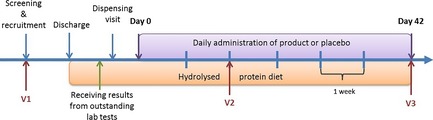
Outline of the clinical trial. Dogs were seen at three separate visits: Visit (V) 1 = recruitment and diagnosis, V2 = after 2 weeks of treatment with either Enterococcus faecium or placebo, V3 = after 6 weeks of treatment. During the duration of the trial dogs were all fed the same hydrolysed protein diet.
Figure 2
Figure 2
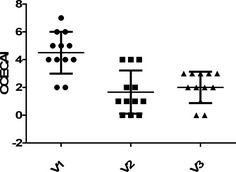
Canine chronic enteropathy clinical acvtivity index (CCECAI) in 12 dogs participating in the clinical trial at visit 1 (V1 = before treatment), visit 2 (V2 = 2 weeks after start of treatment) and visit 3 (V3 = 6 weeks after start of treatment).
Figure 3
Figure 3
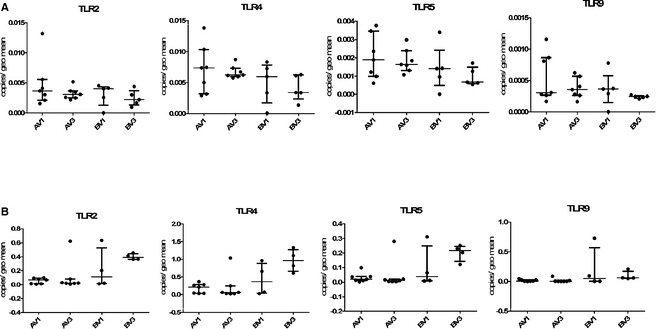
TLR expression in the duodenum (panels A) and colon (panels B) of 12 dogs participating in the clinical trial. V1 = pre‐treatment visit, V3 = after 6 weeks of dietary treatment and either synbiotic (labelled A on the x‐axis) or placebo (labelled B on the x‐axis) administration.
Figure 4
Figure 4
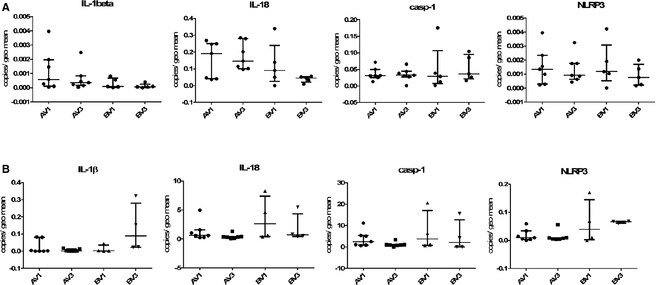
Expression of genes related to the inflammasome in the duodenum (panels A) and colon (panels B) of 12 dogs participating in the clinical trial. V1 = pre‐treatment visit, V3 = after 6 weeks of dietary treatment and either synbiotic (labelled A on the x‐axis) or placebo (labelled B on the x‐axis) administration.
Figure 5
Figure 5
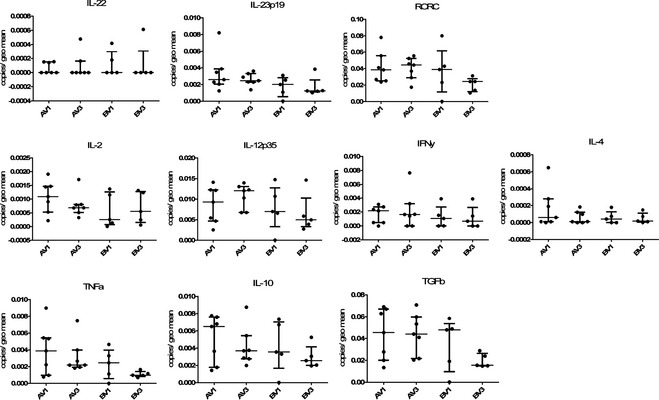
Relative gene expression of cytokines related to differen T helper cell lines in the duodenum of dogs with chronic enteropathy participating in the clinical trial. The upper panel shows factors related to Th17 cells (IL‐[Interleukin] 22, IL‐23p35 and the transcription factor RORC), the middle panel Th1 (IL‐2, IL‐12p35) and Th2 (IFNγ, IL‐4) cytokines, and the lower panel TNFα, which can be classed as innate cytokine or Th1 related, as well as IL‐10 and Transforming growth factor β (TGFβ) as representatives of cytokines produced by regulatory T cells. On the x‐axis groups represent different visits (V1 = before treatement, V3 = after 6 weeks of treatment) and different treatment groups: A = hydrolyzed protein diet plus synbiotic product containing Enterococcus faecium; B = hydrolyzed protein diet plus placebo.
Figure 6
Figure 6
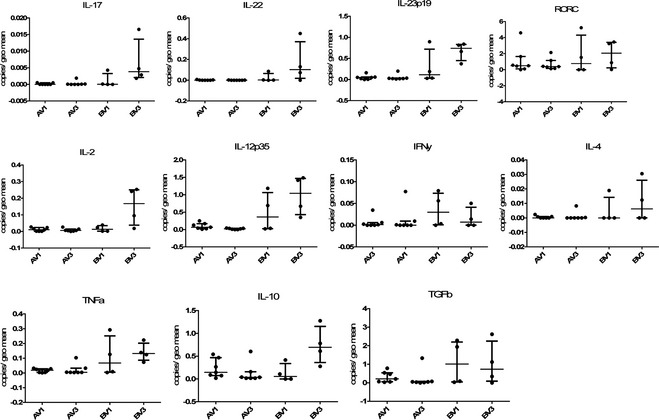
Relative gene expression of cytokines related to differen T helper cell lines in the colon of dogs with chronic enteropathy participating in the clinical trial. The upper panel shows factors related to Th17 cells (IL‐[Interleukin] 17, IL‐22, IL‐23p35 and the transcription factor RORC), the middle panel Th1 (IL‐2, IL‐12p35) and Th2 (IFNγ, IL‐4) cytokines, and the lower panel TNFα, which can be classed as innate cytokine or Th1 related, as well as IL‐10 and Transforming growth factor β (TGFβ) as representatives of cytokines produced by regulatory T cells. On the x‐axis groups represent different visits (V1 = before treatement, V3 = after 6 weeks of treatment) and different treatment groups: A = hydrolyzed protein diet plus synbiotic product containing Enterococcus faecium; B = hydrolyzed protein diet plus placebo.
Figure 7
Figure 7
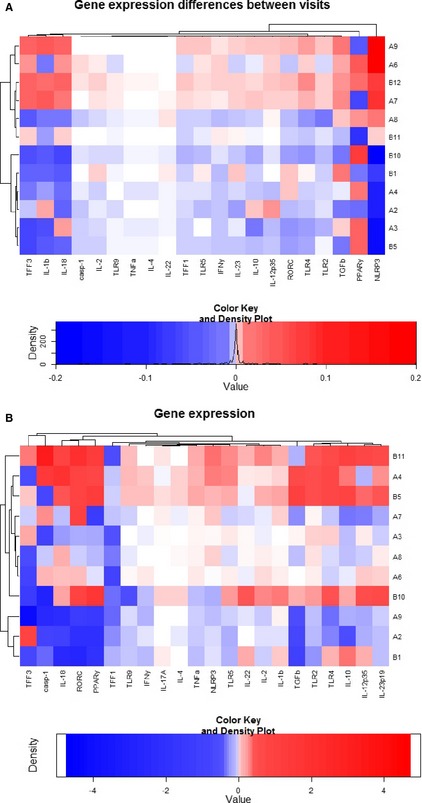
Heatmap and dendrograms depicting the difference in duodenal (A) and colonic (B) gene expression before and after treatment of 12 dogs with food‐responsive chronic enteropathy. Examined genes are listed on the x‐axis, dog IDs in numbers and with a reference to treatment (A = synbiotic; B = placebo) are shown on the y‐axis. Both clustering of genes and dogs was allowed in these heatmaps based on gene expression similarities. Red colour indicates an increase in gene expression from visit 1 (before treatment) to visit 3 (6 weeks after treatment), blue indicates a decrease as depicted by the colour key.

References

    1. Allenspach K, Wieland B, Gröne A, Gaschen F. Chronic enteropathies in dogs: evaluation of risk factors for negative outcome. J Vet Intern Med 2007;21:700–708. - PubMed
    1. Jergens AE, Moore FM, Haynes JS, Miles KG. Idiopathic inflammatory bowel disease in dogs and cats: 84 cases (1987–1990). J Am Vet Med Assoc 1992;201:1603–1608. - PubMed
    1. German AJ, Hall EJ, Day MJ. Chronic intestinal inflammation and intestinal disease in dogs. J Vet Intern Med 2003;17:8–20. - PubMed
    1. Suchodolski JS, Xenoulis PG, Paddock CG, et al. Molecular analysis of the bacterial microbiota in duodenal biopsies from dogs with idiopathic inflammatory bowel disease. Vet Microbiol 2010;142:394–400. - PubMed
    1. Suchodolski JS, Markel ME, Garcia‐Mazcorro JF, et al. The fecal microbiome in dogs with acute diarrhea and idiopathic inflammatory bowel disease. PLoS ONE 2012;7:e51907. - PMC - PubMed

Publication types